


4DMedical Lands Mayo Clinic as U.S. Expansion Accelerates Across Elite Hospitals

Team Skrill Network
Team Skrill Network comprises seasoned professionals from diverse fields including Finance, Mining, Technology, Investing, and Digital Strategy. They bring a deep knowledge and understanding of financial markets and behavioural patterns to every story, ensuring credibility and precision in every piece. Whether analysing emerging market trends or spotlighting small- and mid-cap growth companies across ASX, TSX, or NASDAQ, the team’s editorial approach blends data-driven insights with compelling storytelling. Their expertise enables them to process complex developments into content that resonates with both institutional investors and retail audiences. Backed by experience in content curation, SEO strategy, and investor-focused messaging, the team of writers at Skrill Network are committed to delivering stories that matter—authentic, relevant, and strategically aligned with the evolving landscape of global investing.
Read more
Key Highlights:
- 4DMedical secures deployment at Mayo Clinic, ranked #1 in the U.S.
- Six top-tier U.S. hospitals adopt CT:VQ™ within seven months of FDA clearance
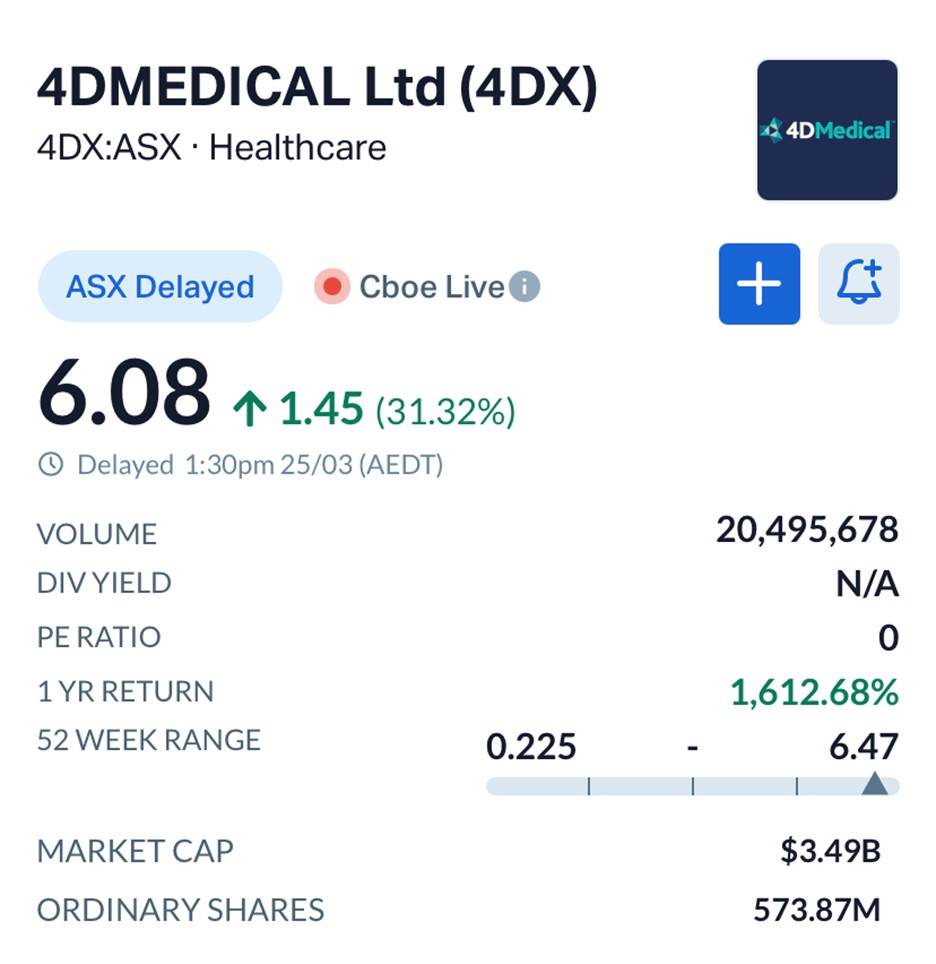
- Shares surge 30.02% to $6.02 on heavy volume
- Technology eliminates need for radioactive tracers, improving safety and workflow
- Strategy focused on “land and expand” across U.S. healthcare network
4DX Rockets: 6 Elite U.S. Hospitals in 7 Months as Mayo Clinic Joins the 4DMedical Revolution
In the world of medical technology, credibility is everything.
And sometimes, it comes in a single name.
For 4DMedical, that name is Mayo Clinic.
Market Snapshot
The Australian healthcare technology company has secured deployment of its CT:VQ™ lung imaging technology at the world’s top-ranked hospital, marking a defining moment in its U.S. expansion strategy. The announcement sent shares soaring, with 4DMedical (ASX: 4DX) jumping 30.02% to $6.02, extending a remarkable one-year return of over 1,500%.
Source: MarketIndex
But beneath the share price reaction lies a deeper story. This is not just another hospital contract. It is validation at the highest level.
A rapid rise: six elite hospitals in seven months
What stands out is not just who has signed up, but how quickly it has happened.
Since receiving FDA clearance in September 2025, 4DMedical has secured deployments across six leading U.S. Academic Medical Centers, including Stanford, Cleveland Clinic, UC San Diego Health, University of Chicago Medicine, University of Miami, and now Mayo Clinic.
In healthcare, where adoption cycles can stretch for years, this pace is unusual.
It suggests that the company’s technology is not only clinically relevant, but also commercially viable within existing hospital systems.
The technology edge: a quieter revolution in diagnostics
At the centre of this momentum is CT:VQ™, a platform designed to assess lung ventilation and blood flow using standard CT scans.
Traditionally, this type of analysis requires nuclear medicine techniques involving radioactive tracers or contrast agents. These methods are effective but come with limitations, including cost, complexity, and patient risk.
4DMedical’s approach removes those barriers.
By using advanced imaging and software, CT:VQ™ delivers similar insights without the need for radioactive materials. It also integrates directly into existing CT workflows, making adoption easier for hospitals.
This combination of safety, efficiency, and compatibility is proving to be a powerful selling point.
Why Mayo Clinic matters: the “signal effect”
Mayo Clinic’s involvement changes the conversation.
Globally recognised as a leader in clinical practice and research, Mayo often sets the benchmark for treatment standards and technology adoption.
When it adopts a new system, others tend to follow.
4DMedical Managing Director and CEO Andreas Fouras acknowledged the significance in clear terms:
“Mayo Clinic is, unquestionably, one of the most respected healthcare institutions in the world. Their decision to deploy CT:VQ™ is a landmark moment for 4DMedical and a powerful testament to the clinical significance of our technology.”
He added:
“When the world’s number one hospital chooses to use your technology, it sends the strongest possible signal to the entire U.S. healthcare market about the clinical value and readiness of CT:VQ™.”
This is what industry observers often refer to as the “reference site effect.” Once leading institutions adopt a technology, smaller and mid-tier hospitals begin to view it as the emerging standard of care.
The strategy: land first, scale later
Importantly, the Mayo agreement is not yet financially material.
The initial deployment runs for approximately 90 days and is designed to allow clinicians to integrate the technology into their workflows and evaluate its performance across different use cases.
This is a deliberate strategy.
Rather than pushing immediate large-scale contracts, 4DMedical is focusing on building clinical familiarity and trust. If successful, these early deployments can evolve into broader commercial agreements.
It is a slower approach, but one that aligns with how healthcare systems typically adopt new technologies.
Industry context: a shift in respiratory diagnostics
The broader healthcare landscape supports this trend.
Respiratory diseases remain a major global health burden, with increasing demand for earlier and more precise diagnostic tools. According to global health research bodies, improving imaging capabilities is a key priority in reducing long-term treatment costs and improving patient outcomes.
Stay ahead of the market
The most important stories, delivered to your inbox. No noise, just what matters.
By subscribing, you agree to our Privacy Policy.
At the same time, hospitals are under pressure to streamline operations and reduce reliance on complex procedures.
Technologies that can deliver better insights while simplifying workflows are gaining traction.
4DMedical appears to be positioned at the intersection of these trends.
The commercial runway: beyond prestige
While the Mayo deployment is symbolic, it also strengthens the company’s commercial outlook.
4DMedical operates on a software-as-a-service model, meaning revenue scales as usage increases across hospital networks. With a growing base of high-profile reference sites, the company is building a foundation for broader adoption.
The existing partnership with Philips further enhances this potential, providing distribution channels into a wider healthcare ecosystem.
As Fouras noted:
“Combined with our existing network of elite AMC reference sites, and the Philips partnership, we are building an unassailable platform for CT:VQ™ adoption.”
Market perspective: from innovation to infrastructure
The market reaction suggests that investors are beginning to view 4DMedical differently.
What was once seen as an emerging med-tech player is now being evaluated as a potential infrastructure provider in respiratory diagnostics.
This shift is important.
Infrastructure-like businesses, particularly in healthcare, tend to benefit from recurring revenue, high switching costs, and strong network effects once adoption reaches scale.
What is your take on this story?
This is user sentiment & not financial advice.
Disclaimer - Skrill Network is designed solely for educational and informational use. The content on this website should not be considered as investment advice or a directive. Before making any investment choices, it is crucial to carry out your own research, taking into account your individual investment objectives and personal situation. If you're considering investment decisions influenced by the information on this website, you should either seek independent financial counsel from a qualified expert or independently verify and research the information.