


American Tungsten and Antimony (ASX AT4) jumps as drilling hits “massive stibnite” at Antimony Canyon

Team Skrill Network
Team Skrill Network comprises seasoned professionals from diverse fields including Finance, Mining, Technology, Investing, and Digital Strategy. They bring a deep knowledge and understanding of financial markets and behavioural patterns to every story, ensuring credibility and precision in every piece. Whether analysing emerging market trends or spotlighting small- and mid-cap growth companies across ASX, TSX, or NASDAQ, the team’s editorial approach blends data-driven insights with compelling storytelling. Their expertise enables them to process complex developments into content that resonates with both institutional investors and retail audiences. Backed by experience in content curation, SEO strategy, and investor-focused messaging, the team of writers at Skrill Network are committed to delivering stories that matter—authentic, relevant, and strategically aligned with the evolving landscape of global investing.
Read more
Key highlights
- AT4 shares surged 17.86% to $0.165 on heavy turnover as the company flagged visible massive to disseminated stibnite in the first holes of its maiden diamond program.
- Two HQ diamond holes at the Emma historical working intersected substantial mineralised widths, including a ~19m main zone within a broader ~42m alteration and stibnite-bearing package.
- Management says the drilling is vectoring toward a potential feeder structure, with orpiment and realgar (arsenic sulphides) showing up as geological “signposts” in the system.
American Tungsten and Antimony Ltd (ASX: AT4) put a sharper spotlight on its Utah-based Antimony Canyon Project on Wednesday after early drilling delivered what explorers like to see first: visible mineralisation in the core, including zones the company describes as massive stibnite, the primary antimony sulphide mineral.
The market responded quickly. AT4 last traded at $0.165, up $0.025 or 17.86%, with 24.43 million shares changing hands by early afternoon (AEDT). The move adds to a longer-running run in the stock, with the company data showing a one-year return of 230% and a 52-week range of $0.025 to $0.230.
What the company actually found in the first holes
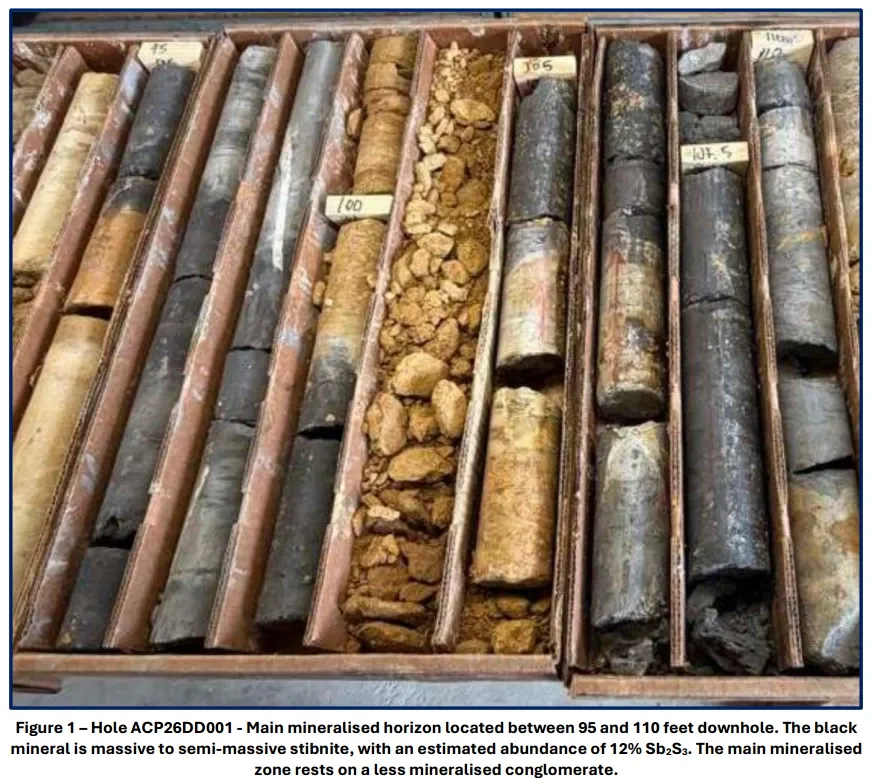
In its ASX update, AT4 said the first two HQ diamond drill holes of its maiden program, ACP26DD001 and ACP26DD002, both hit substantial mineralised zones at the Emma historical working, inside the company’s 100% owned patented claims.
Market Snapshot
The headline numbers are not assay grades. These are visual geological observations while the core is logged and processed, and the company is explicit that assays are pending and visual estimates should not be treated as a substitute for laboratory results.
Source: AT4 ASX Announcement
Still, the intercept descriptions are material because they speak to geometry, continuity and potential scale, which are often the first questions in any maiden drill campaign:
- Hole ACP26DD001: AT4 reports a mineralised zone of ~42m width, featuring a ~19m thick main zone of massive to semi-massive stibnite within a broader altered package that also hosts disseminated stibnite. The company notes these are approximate true thicknesses.
- Hole ACP26DD002: Intersected mineralisation said to be more intense than hole 1, though logging was still incomplete at the time of the release.
The announcement also includes a table of visual stibnite estimates along the hole trace for ACP26DD001, showing multiple intervals logged as massive stibnite and semi-massive stibnite through the broader mineralised package.
Why the “patented claims” point matters
AT4 repeatedly emphasises it is drilling on patented claims, which in the US context typically means the company holds secure tenure covering both surface and mineral rights. The company frames this as an advantage for operating and permitting efficiency while it advances exploration across multiple historical workings on its claim area.
That matters in a practical way: early exploration programs can lose momentum if access, approvals, or land rights become a bottleneck. AT4’s messaging suggests it wants the market to understand that the Emma area sits on a land package where it can move quickly from geological concept to drill testing.
The feeder-structure thesis and why “orpiment and realgar” caught attention
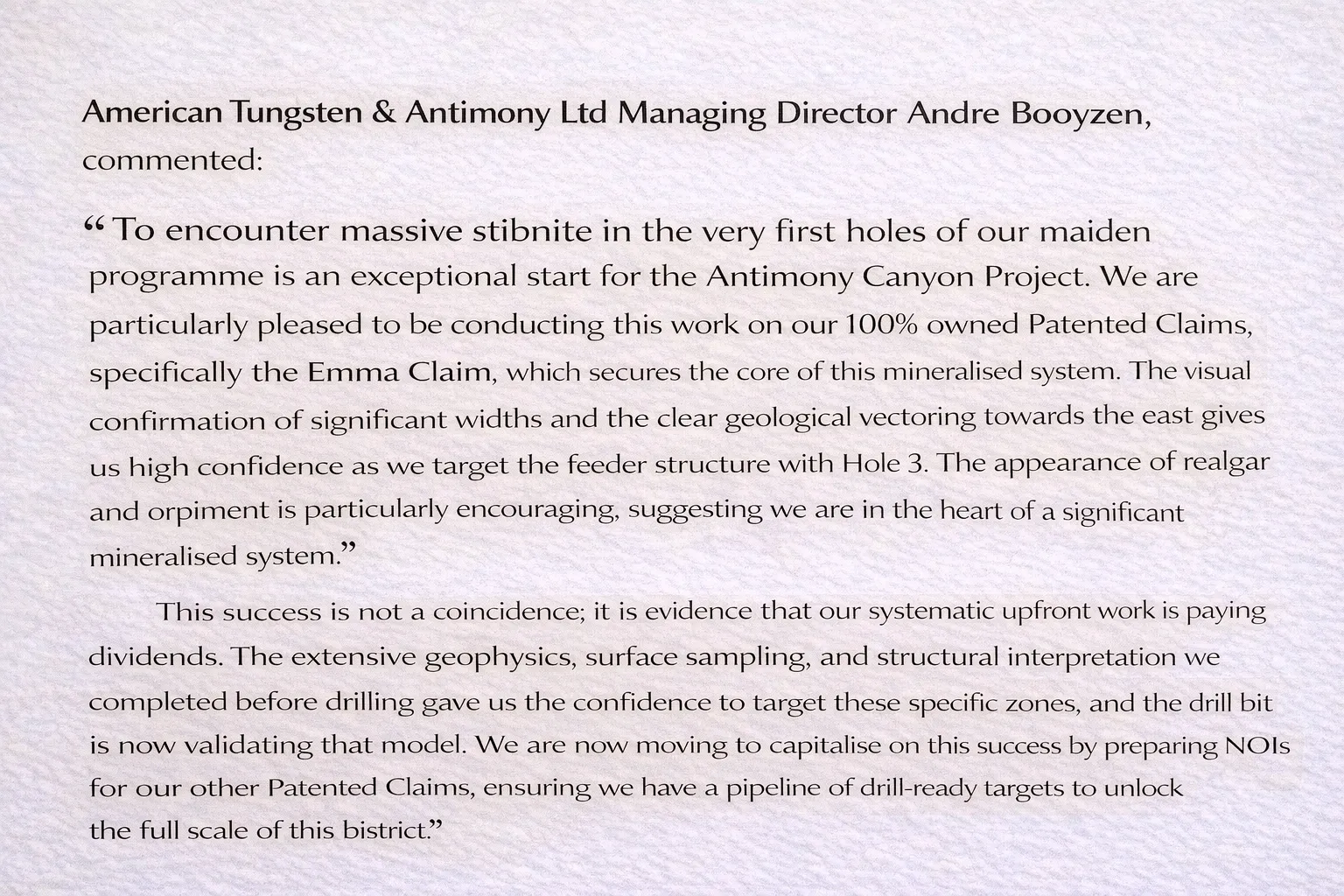
The second pillar of the update is geological direction. AT4 says alteration intensity increases to the east, which supports its model that drilling is moving toward a major feeder structure.
In simple terms: a feeder structure is the pathway that mineralising fluids used to move through the rocks. Finding it can matter because feeder zones can be associated with thicker mineralisation, higher grades, or improved continuity. None of that is guaranteed, but it is often what explorers are trying to map early.
The company adds that ACP26DD002 hit a short zone containing minor orpiment and realgar, and early inspection of Hole 3 shows “notably stronger” zones of these minerals plus significant sulphide intercepts. In many hydrothermal systems, these arsenic sulphides can act as pathfinder minerals that help geologists determine proximity to certain parts of the mineralising system.
Hole 3 is the key near-term catalyst
With holes 1 and 2 designed to establish stratigraphic control at a steep dip of -80 degrees, AT4 has now shifted to a more direct test of its feeder concept.
- Hole ACP26DD003 is being drilled at -45 degrees to target the interpreted feeder system at around 500 feet depth.
- The company cautions that apparent widths in hole 3 may be exaggerated compared to true thickness due to drill angle relative to geology.
The near-term flow from here is straightforward: logging, sampling, and then assays. AT4 says core is being processed and dispatched for expedited lab analysis.
Stay ahead of the market
The most important stories, delivered to your inbox. No noise, just what matters.
By subscribing, you agree to our Privacy Policy.
Source: AT4 ASX Announcement
AT4’s price action fits a familiar pattern in early-stage critical minerals exploration: markets often react to credible early indications that a target is “real” and continuous, even before assays.
In this case, the drivers were:
- Visible mineralisation in the first holes (including “massive stibnite”), which reduces the risk that drilling misses the system entirely.
- Meaningful thickness indications at Emma (19m main zone inside a broader 42m mineralised/altered zone) that suggest the system is not a narrow vein.
- A clear next step that is easy to track: hole 3 targets the feeder concept, and assays are pending.
The key caveat
This update is not reporting grades. AT4 states clearly that visual estimates are qualitative and should not be treated as a proxy for laboratory assays, and that assays are pending.
That is important because the economic value of antimony mineralisation ultimately comes down to assay-confirmed grade, continuity, metallurgy and potential scale, not just visible sulphides.
What to watch next
Over the coming updates, the practical milestones are:
- Assay results from ACP26DD001 and ACP26DD002.
- Completion and logging of ACP26DD003, including whether the feeder-target concept is supported by core observations and then assays.
- NOI submissions for other patented-claim targets (the company names Pluto, Star and Emily among historical workings it plans to progress).
What is your take on this story?
This is user sentiment & not financial advice.
Disclaimer - Skrill Network is designed solely for educational and informational use. The content on this website should not be considered as investment advice or a directive. Before making any investment choices, it is crucial to carry out your own research, taking into account your individual investment objectives and personal situation. If you're considering investment decisions influenced by the information on this website, you should either seek independent financial counsel from a qualified expert or independently verify and research the information.