

Anson’s (ASX: ASN) 773kt Lithium Surge Reshapes the US Supply Narrative

Team Skrill Network
Team Skrill Network comprises seasoned professionals from diverse fields including Finance, Mining, Technology, Investing, and Digital Strategy. They bring a deep knowledge and understanding of financial markets and behavioural patterns to every story, ensuring credibility and precision in every piece. Whether analysing emerging market trends or spotlighting small- and mid-cap growth companies across ASX, TSX, or NASDAQ, the team’s editorial approach blends data-driven insights with compelling storytelling. Their expertise enables them to process complex developments into content that resonates with both institutional investors and retail audiences. Backed by experience in content curation, SEO strategy, and investor-focused messaging, the team of writers at Skrill Network are committed to delivering stories that matter—authentic, relevant, and strategically aligned with the evolving landscape of global investing.
Read more
Key Highlights:
- Anson lifts Green River resource to 773,000 tonnes LCE, up 650%
- Indicated category jumps 863%, strengthening project confidence
- Brine pressures and flow dynamics point to potential cost advantages
- Project edges closer to 1 million tonne strategic milestone
Shares in Anson Resources Ltd are drawing attention after the company delivered a substantial upgrade to its Green River Lithium Project in Utah, marking a decisive shift in the scale and confidence of the asset.
The latest resource estimate places Green River at 773,000 tonnes of lithium carbonate equivalent, representing a 650% increase and repositioning the project within the emerging US lithium landscape.
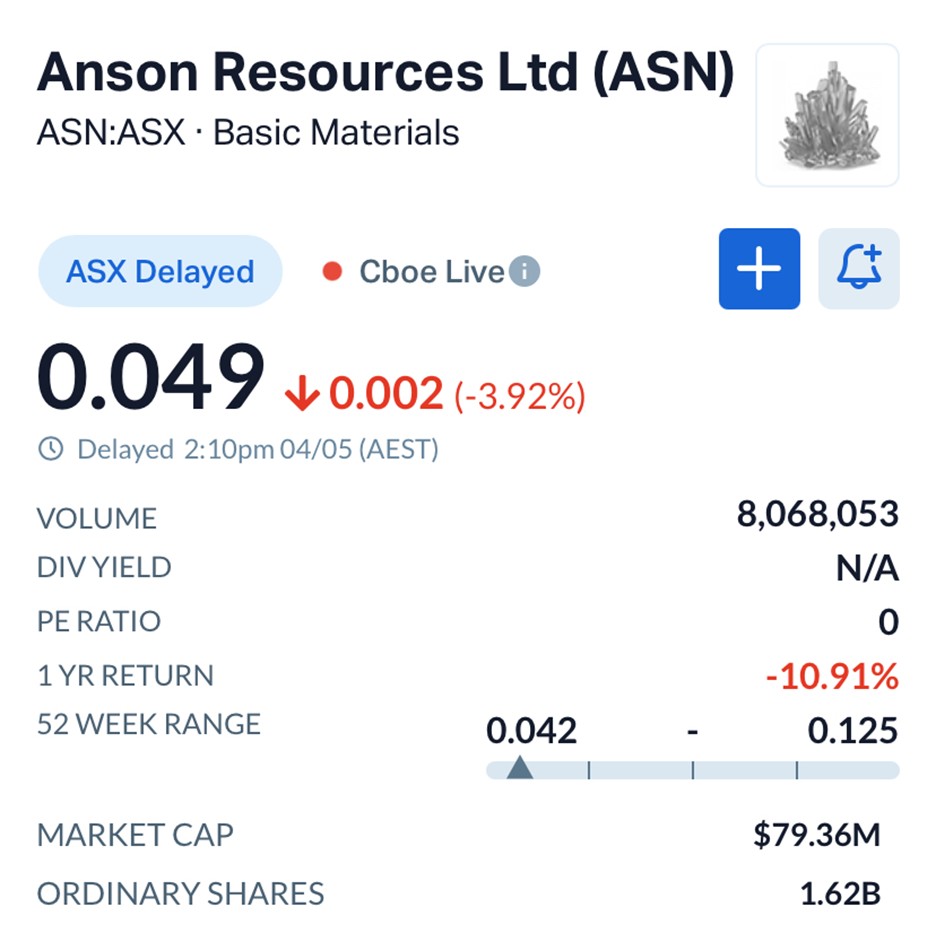
Market Snapshot
Source: MarketIndex
A step change in scale and confidence
The upgrade reflects new drilling data from the Bosydaba and Mt Fuel Skyline Geyser wells, which confirmed both thicker lithium-bearing zones and stronger concentration continuity across the reservoir.
The breakdown shows a notable improvement in resource quality.
- Indicated resource rises to 183,000 tonnes LCE, up 863%
- Inferred resource expands to 590,000 tonnes LCE, up 602%
- Average grade stands at 127.8 mg/L lithium
The sharp increase in the indicated category is particularly significant, as it represents the portion of the resource with higher geological confidence and forms the foundation for future economic studies and project financing.
The Utah advantage
The Green River Project sits within the Paradox Basin, a region with a long history of oil and gas production.
This legacy infrastructure provides access to well data, geological mapping and existing drilling frameworks, reducing exploration uncertainty and accelerating development timelines.
What stands out in the latest results is the physical behaviour of the brine itself.
Anson reported that lithium-rich brine flowed naturally to the surface under pressure exceeding 5,000 psi, with temperatures above 150°F. These characteristics suggest that pumping requirements could be reduced, potentially lowering operating costs compared to conventional brine operations.
The resource currently covers only the Mississippian Unit, with drilling yet to fully penetrate the formation. Additional acreage applications are also underway, pointing to further expansion potential.
Technology meets geology
The project is being advanced using Direct Lithium Extraction, a method increasingly seen as a solution to the environmental and logistical constraints of traditional evaporation ponds.
DLE allows lithium to be extracted directly from brine using selective processes, reducing land use and improving recovery times.
This approach is gaining traction across North America, particularly as regulators and policymakers focus on sustainable extraction methods.
The US has been actively pursuing domestic lithium production to reduce reliance on overseas supply chains, particularly from South America and China. Projects such as Green River are emerging as potential contributors to this shift.
Management perspective: momentum building
Executive Chairman and CEO Bruce Richardson highlighted the scale of the upgrade and the company’s forward trajectory.
“The upgrade of the JORC Resource estimate by 650% is a significant step forward. Our objective is to achieve an Indicated and Inferred JORC Resource estimate of over 1 million tons of LCE at Green River, which we are close to achieving. The investment in this work has paid off for the Company’s shareholders.”
The emphasis on reaching a one million tonne resource reflects a broader industry benchmark, often associated with long-life, globally relevant lithium assets.
Industry context: a tightening supply chain
The lithium market is undergoing a structural shift.
Demand continues to be driven by electric vehicles, grid storage and broader electrification trends, while supply growth is increasingly constrained by permitting timelines, capital intensity and geopolitical considerations.
Stay ahead of the market
The most important stories, delivered to your inbox. No noise, just what matters.
By subscribing, you agree to our Privacy Policy.
In the US, the push for domestic production has accelerated following policy support tied to energy security and manufacturing independence.
Projects that can demonstrate scale, resource confidence and viable extraction methods are attracting greater attention as potential cornerstone assets in this evolving supply chain.
Positioning within the global landscape
While Green River’s grade of 127.8 mg/L sits within the moderate range for lithium brine projects, its advantages lie in scale, infrastructure access and flow dynamics.
Compared to established South American salars, where evaporation can take months, DLE-based projects in North America aim to deliver faster processing cycles and more consistent output.
The combination of resource growth and operational characteristics places Anson in a competitive position among emerging US lithium developers.
The bottom line
Anson’s latest resource update marks a transition point for the Green River Project.
The move from a relatively modest exploration footprint to a 773,000 tonne resource signals growing confidence in both geology and development potential.
With the one million tonne milestone now within reach, the focus shifts toward feasibility studies, extraction optimisation and commercial partnerships.
In a market increasingly defined by supply security and execution capability, scale alone is not enough. The ability to convert resource into production will determine whether Green River evolves into a strategic asset within the US lithium supply chain.
What is your take on this story?
This is user sentiment & not financial advice.
Disclaimer - Skrill Network is designed solely for educational and informational use. The content on this website should not be considered as investment advice or a directive. Before making any investment choices, it is crucial to carry out your own research, taking into account your individual investment objectives and personal situation. If you're considering investment decisions influenced by the information on this website, you should either seek independent financial counsel from a qualified expert or independently verify and research the information.