
🇺🇸 USA






The S&P/ASX 200 is trading higher at midday, even as Australian households face the weakest confidence levels in more than half a century.
Overnight, Wall Street delivered a mixed lead. The Dow edged higher while the Nasdaq slipped, reflecting ongoing uncertainty around inflation and energy prices.
Brent crude remains elevated above $US106 a barrel, while gold continues to rally as a safe haven.
By midday, the ASX 200 had climbed 73.8 points, or 0.87%, to 8,534.8. The broader All Ordinaries followed closely, up 0.86%, while the tech-heavy index surged 2.29%.
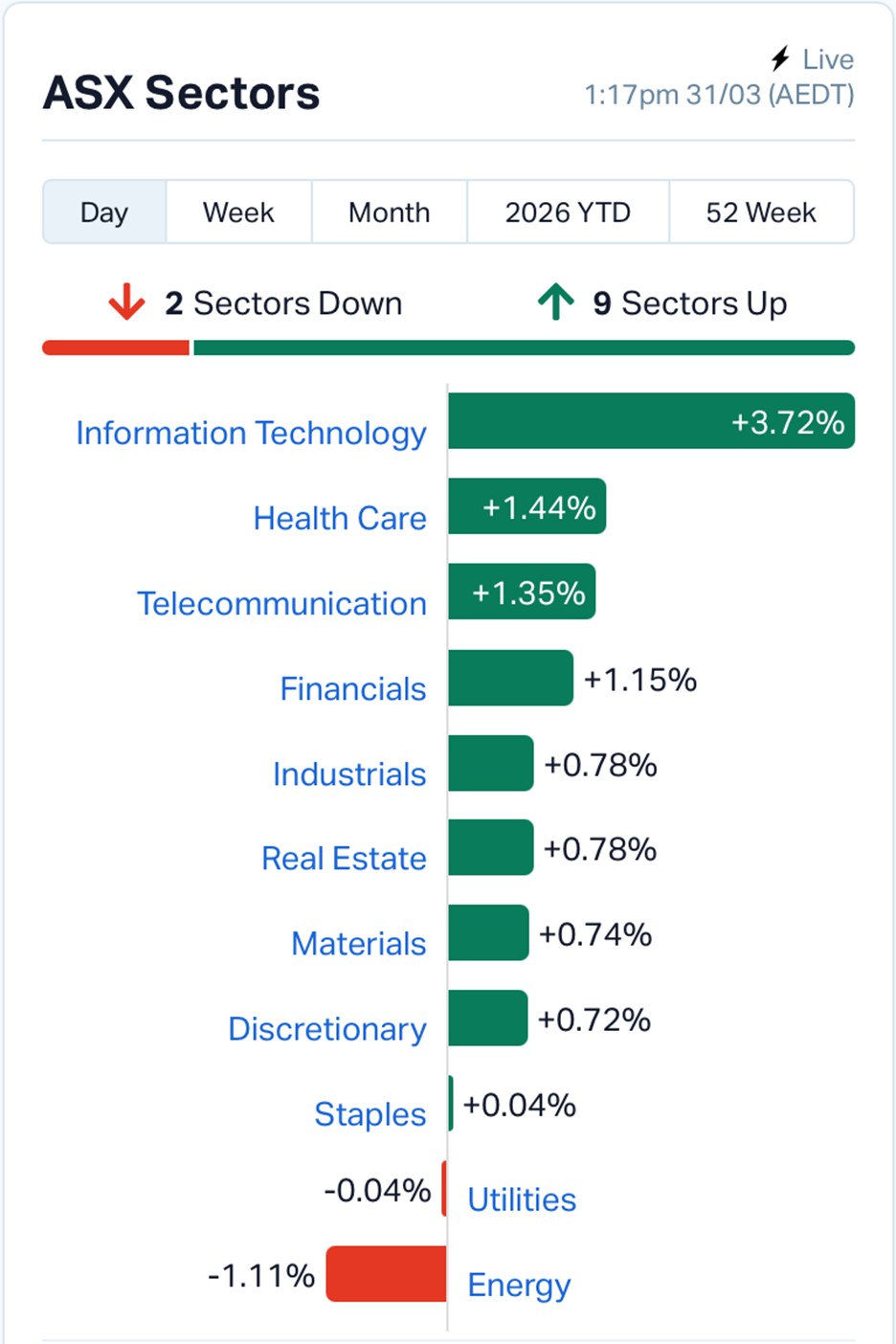
Sector Breakdown | Source: MarketIndex
It is a strong showing on paper.
But beneath the surface, the mood across households tells a very different story.
Australia’s ANZ-Roy Morgan Consumer Confidence index has fallen to 58.8 points, the lowest reading since records began in 1973.
To put that into perspective, confidence is now weaker than during the early 1990s recession, the Global Financial Crisis, and even the early pandemic shock.
This divergence between market performance and everyday reality is becoming the defining theme of 2026.
On one hand, equities are being supported by global liquidity, sector rotation, and bargain hunting.
On the other, households are grappling with rising living costs and shrinking purchasing power.
ANZ economist Sophia Angala summed it up plainly, noting that confidence has dropped to “a new all-time low,” with expectations that household spending will weaken as inflation and interest rates erode disposable income.
Weekly inflation expectations have surged to 7.3%, another record high.
At the same time, petrol prices have jumped sharply, rising 15.4 cents in a single week to 253.4 cents per litre.
For many families, that is not just a number. It is a weekly shock at the pump.
Despite the macro gloom, certain sectors are pushing higher.
Technology stocks are leading the rally, with Xero Ltd climbing 4.81% to $73.89, helping drive the broader tech index up more than 2%.
Gold stocks are also in demand, with the ASX gold sub-index jumping over 3%, reflecting the global move toward safe-haven assets as uncertainty builds.
Financials, healthcare, and industrials are also in positive territory, suggesting broad-based buying rather than a narrow rally.
The session’s standout performers highlight where momentum is building.
The contrast reflects a market rotating toward growth and defensives, while speculative and cyclical names face pressure.
Beyond the economic data, policymakers are reshaping the landscape.
The Fair Work Commission has ruled that junior pay rates for workers aged 18 and above will be phased out, effectively granting full adult wages to a large segment of the workforce.
This is expected to boost incomes for younger workers but increase cost pressures for employers, particularly in retail and hospitality.
Meanwhile, the Reserve Bank of Australia has announced that card surcharges will be scrapped from October 2026.
RBA Governor Michelle Bullock said, “We will publish merchant fees to make it easier for businesses to check if they are paying high fees.”
The move is expected to save consumers around $1.6 billion annually.
Payment company Tyro Payments welcomed the reform, with CEO Nigel Lee describing it as a “win for consumers and small business” and predicting a shift toward more transparent pricing.
International markets are offering little clarity.
In the United States, gas prices have climbed above $US4 per gallon for the first time in three years, adding pressure to inflation expectations.
Asian markets are under strain, with Japan’s Nikkei down 2.79% and South Korea’s KOSPI sharply lower.
Yet commodities are telling another story.
Gold has surged 1.63% to $US4,588 an ounce, while copper continues to edge higher, pointing to ongoing demand in industrial sectors.
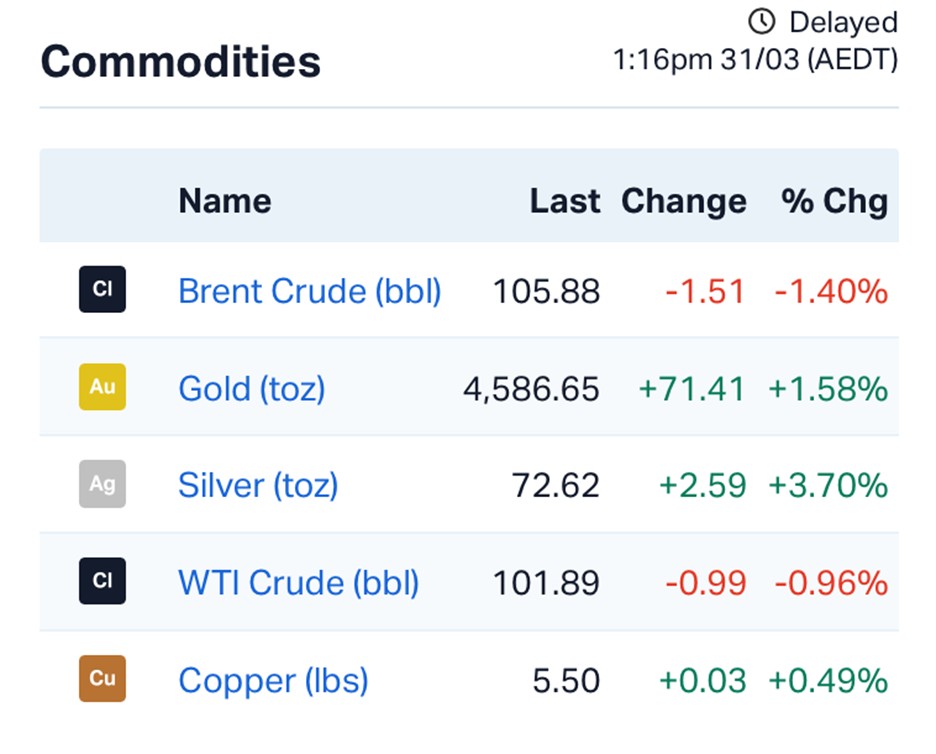
Commodities Price Index | Source: MarketIndex
Attention is now turning to the upcoming release of the Reserve Bank’s March meeting minutes.
HSBC chief economist Paul Bloxham has flagged a growing tension in policy settings, noting that it is becoming “particularly difficult” to balance inflation control with employment stability.
The key question is whether the central bank will prioritise easing pressure on households or continue its fight against inflation.
For now, markets appear to be betting on resilience.
The current market strength suggests confidence among traders.
But the underlying economic signals point to a more fragile reality.
When consumer confidence hits a 50-year low, it typically leads to reduced spending, slower growth, and eventually weaker corporate earnings.
The market may be looking ahead.
Households, however, are dealing with the present.
Disclaimer - Skrill Network is designed solely for educational and informational use. The content on this website should not be considered as investment advice or a directive. Before making any investment choices, it is crucial to carry out your own research, taking into account your individual investment objectives and personal situation. If you're considering investment decisions influenced by the information on this website, you should either seek independent financial counsel from a qualified expert or independently verify and research the information.
Tags:
RECENT POSTS
TAGS
Subscribe to the Skrill Network Newsletter today and stay informed
Recommended Articles
