
🇺🇸 USA






The Australian share market edged lower on Tuesday as fresh military tensions in the Middle East unsettled trading and pushed oil prices higher, overshadowing stronger leads from Asia and upbeat US futures.
The S&P/ASX 200 fell 0.35% to 8,661.7 points by midday, with weakness spreading across technology, energy and property stocks. The broader All Ordinaries index also slipped 0.36%, while the Australian dollar eased to 71.67 US cents.
The cautious tone arrived despite Wall Street futures pointing higher in Asian trade after the US Memorial Day holiday closure. Dow Jones and S&P 500 futures were both up about 0.9%, while Nasdaq futures climbed 1.2%.
Instead, traders spent much of the morning digesting reports of overnight US military strikes targeting Iranian boats and missile launch sites, reigniting concerns about energy security across the Strait of Hormuz, one of the world’s most critical shipping corridors for oil and liquefied natural gas.
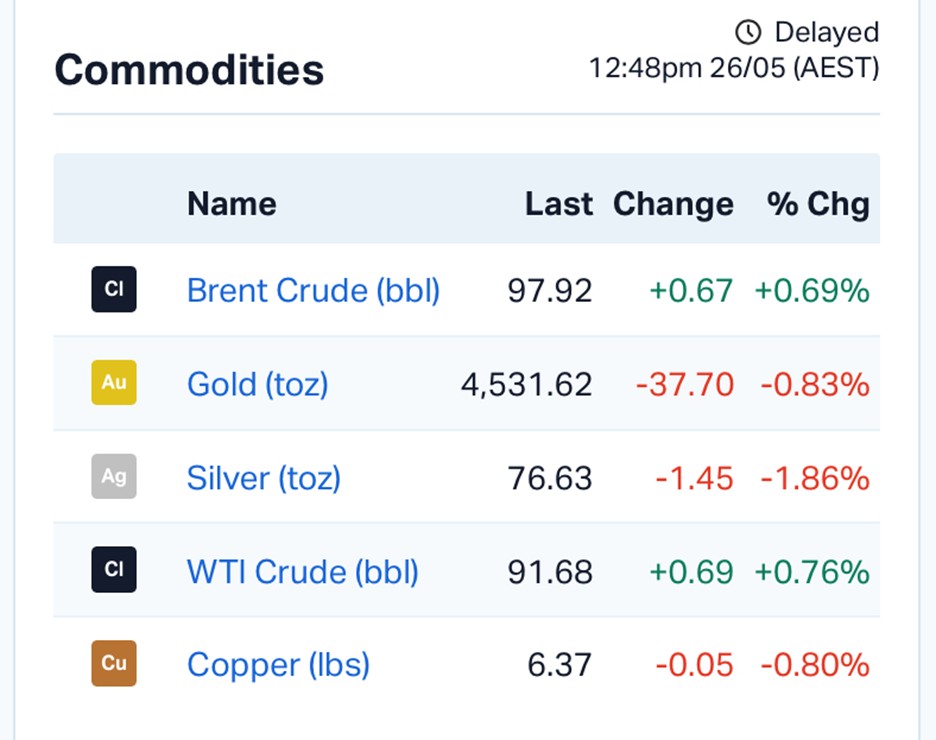
Brent crude rose 1.12% to $US97.92 a barrel, reversing part of Monday’s decline and putting fuel prices back into focus globally.
The move also filtered quickly into local petrol markets, with Australia’s average unleaded price lifting to 185.8 cents per litre.
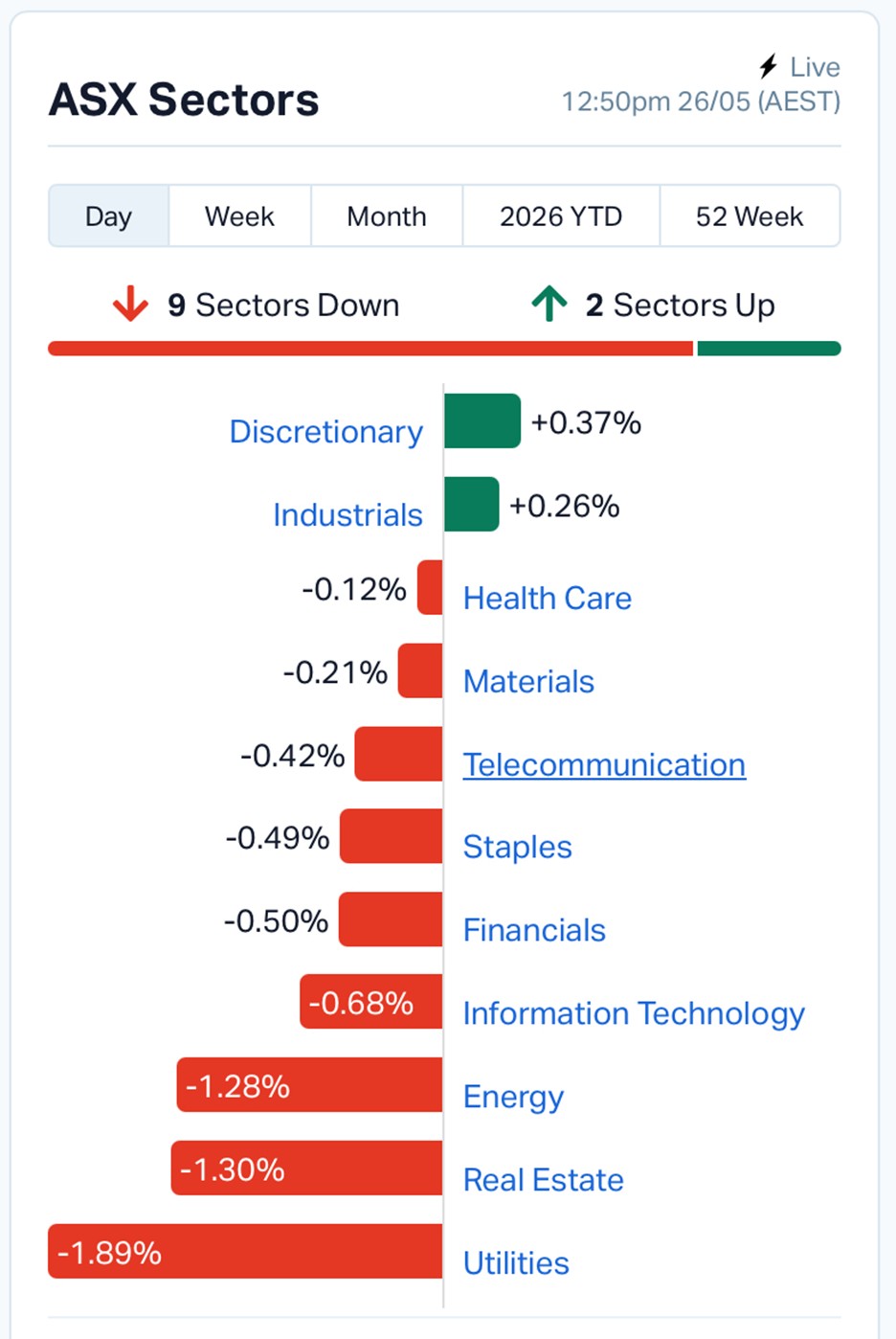
ASX Sector Snapshot | Source: MarketIndex
The sharpest decline on the local market came from ASX Ltd, with shares plunging 9.45% to $53.25 after the exchange operator warned of a steep increase in future spending.
The company said it expects capital expenditure to rise to between $180 million and $200 million in FY27 as it works through long-standing technology and infrastructure upgrades.
In a statement, ASX said the revised guidance reflected “the investments ASX needs to continue to make as a steward of critical market infrastructure,” following scrutiny from ASIC over historical underinvestment compared with global peers.
The sell-off weighed heavily on the broader financial sector, with the major banks also trading lower. NAB dropped 1.5%, while Westpac, Commonwealth Bank and ANZ all drifted into negative territory.
Infrastructure and software-linked names were also under pressure, with Pexa Group Ltd falling 5.84% and Infratil Ltd losing 6.28% after its full-year results.
Away from equities, several broader economic themes shaped the session.
Rabobank’s latest winter crop forecast painted a softer outlook for Australian agriculture, with total winter cropping area expected to shrink 8% during the 2026-27 season.
Wheat planting alone is forecast to drop more than 20% to 9.8 million hectares as rising diesel and fertiliser costs pressure farm economics.
RaboResearch senior grains analyst Vitor Pistoia said the growing strain from global commodity inputs was beginning to alter planting behaviour.
“Australia enters the 2026/27 winter cropping season with a more uneven and weather-dependent cropping area than in recent years,” he said.
“Higher global fertiliser and diesel prices due to the Middle East conflict are encouraging shifts towards lower-input crops and contributing to a reduction in total cropping area.”
At the same time, households and small businesses received some relief on the energy front after the Australian Energy Regulator confirmed cuts to electricity default market offers.
Retail electricity caps will fall by up to 10.7% for households and as much as 20.9% for small businesses under the updated pricing framework.
Retailer Kogan.com Ltd emerged as one of the market’s strongest performers, surging 15.12% to $3.96 after reporting a 32% rise in adjusted EBITDA for the ten months to April 30.
The online retailer credited margin improvements and stronger contributions from acquired New Zealand marketplace Mighty Ape.
Healthcare heavyweight Fisher & Paykel Healthcare Corporation Ltd climbed 6.79% following its preliminary final report, while GrainCorp gained nearly 4% despite the softer agricultural backdrop.
Gold miners, however, struggled as bullion prices eased 0.8% to $US4,532 an ounce.
The ASX All Ordinaries Gold Index slipped 1.16%, with several recent exploration winners retreating after strong runs earlier in the month.
Commodities Price Index | Source: MarketIndex
The resources sector also faced renewed ESG scrutiny after leaked internal documents raised questions around BHP Group Ltd’s long-term emissions strategy.
According to reporting by ABC and Guardian Australia, internal memos suggested BHP’s Western Australian iron ore operations may cut emissions by just 1% by 2030 despite the company’s public net-zero ambitions. ABC report on BHP climate documents.
Climate Energy Finance director Tim Buckley said the documents highlighted a widening disconnect between corporate targets and operational reality.
“BHP is not currently on track to meet net zero operational emissions by 2050,” he said.
The debate arrives as global markets increasingly move toward carbon border taxes and stricter emissions-linked trade requirements.
Despite Tuesday’s softer session, volatility expectations remain subdued. The ASX volatility index sat at 12.8, signalling traders still expect relatively calm conditions over the next month even as geopolitical headlines continue to drive day-to-day swings.
Disclaimer - Skrill Network is designed solely for educational and informational use. The content on this website should not be considered as investment advice or a directive. Before making any investment choices, it is crucial to carry out your own research, taking into account your individual investment objectives and personal situation. If you're considering investment decisions influenced by the information on this website, you should either seek independent financial counsel from a qualified expert or independently verify and research the information.
Tags:
RECENT POSTS
TAGS
Subscribe to the Skrill Network Newsletter today and stay informed
Recommended Articles
