

ASX Market Update: Gold shines, tech stumbles as tariff jitters ripple through a quieter Wall Street lead

Team Skrill Network
Team Skrill Network comprises seasoned professionals from diverse fields including Finance, Mining, Technology, Investing, and Digital Strategy. They bring a deep knowledge and understanding of financial markets and behavioural patterns to every story, ensuring credibility and precision in every piece. Whether analysing emerging market trends or spotlighting small- and mid-cap growth companies across ASX, TSX, or NASDAQ, the team’s editorial approach blends data-driven insights with compelling storytelling. Their expertise enables them to process complex developments into content that resonates with both institutional investors and retail audiences. Backed by experience in content curation, SEO strategy, and investor-focused messaging, the team of writers at Skrill Network are committed to delivering stories that matter—authentic, relevant, and strategically aligned with the evolving landscape of global investing.
Read more
Key highlights
- ASX 200 down 0.5% in afternoon trade as tariff headlines and China’s mixed data kept risk appetite restrained.
- Gold and silver hit fresh records as safe haven demand surged, lifting local gold exposures even as broader equities eased.
- Tech was the clear drag, with the All Technology index down 2.55%, while Utilities, Materials and Energy held up.
- A2 Milk tumbles into a trading halt after a sharp sell off, coinciding with new data showing China’s births fell to the lowest level in decades.
Australian shares spent Monday moving in a familiar rhythm: a cautious open, a softening through the session, and a market that looked increasingly selective about what it wanted to own. By mid afternoon, the S&P/ASX 200 was down 0.49% to 8,860.6, with the All Ordinaries off 0.50% to 9,180.4.
The Small Ordinaries barely budged (down 0.02%), a sign the day’s mood was less about a broad capitulation and more about sector rotation and headline risk.
If there was a single theme, it was this: when global politics turns noisy, markets tend to default to the basics. On Monday, that meant precious metals and defensive pockets found bids, while high valuation growth stocks and parts of the consumer complex wore the pressure.
Market Snapshot
The day’s mood: tariff jitters return, and the ASX listens
The lead into Australia was not dramatic on paper. On Friday, Wall Street finished only marginally lower: the S&P 500 slipped 0.06%, the Nasdaq edged down 0.06%, and the Dow fell 0.17%. In other words, not a panic.
But markets are rarely just about the last close. The bigger swing factor was the return of trade and geopolitical uncertainty. The latest headlines included a White House threat to revive punitive tariffs against European nations over Greenland, and the market treated that as a reminder that trade policy can shift quickly and without much warning. That kind of instability typically pushes money toward assets that do not need a strong growth story to justify their price.
It also helped explain why Bitcoin was weaker on the day, sliding about 3.3% to US$92,222 in the live market snapshot, while traditional havens did the opposite.
Sector scoreboard: utilities up, tech sinks, gold runs
The sector tape told the story clearly.
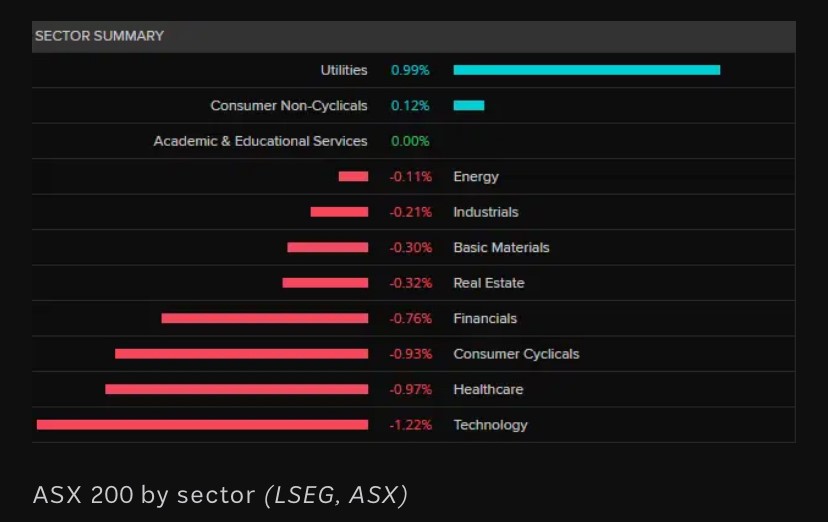
Source: ASX, LSEG
- Utilities led the market, up 1.07%, helped by defensives such as pipeline operators holding their ground while cyclicals eased.
- Materials gained 0.40% and Energy added 0.30%, both supported by commodity strength in parts of the complex.
- On the other side, Information Technology fell 3.18%, the steepest sector drop. Telecommunications was down 1.25%, and Health Care slid 0.97%. Financials were off 0.80%, consistent with a more cautious risk tone.
The divergence was sharp enough to show up in the indices. The ASX All Technology Index fell 2.55% to 3,283.2, a meaningful move for a single session. Meanwhile, the ASX All Ordinaries Gold index jumped 2.91% to 20,420.5, reflecting how aggressively the market leaned into the gold bid.
That gold strength had a clear macro driver. Spot gold rose 1.44% to about US$4,661/oz, and spot silver surged 3.40% to around US$93/oz in afternoon pricing. When both metals are breaking records on the same day, it usually signals something deeper than simple jewellery demand. It is a price response to uncertainty, and a market trying to hedge the edges of geopolitical risk.
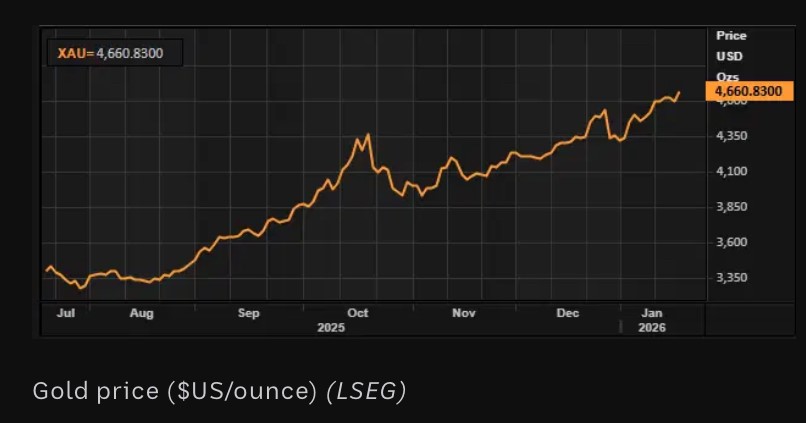
Source: LSEG
Top gainers: decarbonisation, uranium and hard assets push higher
The best performers list looked like a snapshot of where momentum is living right now: energy transition themes, miners, and anything tethered to hard assets.
Among the day’s top gainers:
- Calix (CXL) up 18.35% to $1.645
- Energy Transition Minerals (ETM) up 16.13% to $0.18
- Boss Energy (BOE) up 12.03% to $1.77
- St George Mining (SGQ) up 11.36% to $0.1225
- European Lithium (EUR) up 11.11% to $0.30
- Lotus Resources (LOT) up 10.98% to $0.2275
- Silver Mines (SVL) up 10.98% to $0.2275
- Silex Systems (SLX) up 8.00% to $7.02
- Sun Silver (SS1) up 7.88% to $2.19
It is worth noting what sits behind those names. Uranium exposures like Boss and Lotus tend to move quickly when macro risk re-enters the conversation, partly because the sector attracts thematic flows and partly because investors look for supply constrained commodities with strategic importance. Silver linked names benefited from the metal’s sharp jump, while Calix and Energy Transition Minerals sit inside the broader decarbonisation narrative that still attracts capital even when equities wobble.
Biggest fallers: A2 Milk halts, tech heavyweights retreat
Losses were concentrated in a few large, widely held names and a cluster of tech exposures. The biggest fallers list included:
- Energy Resources of Australia (ERA) down 16.67% to $0.0025
- A2 Milk (A2M) down 10.64% to $8.40 before a trading halt
- Life360 (360) down 8.21% to $26.83
- Pro Medicus (PME) down 6.58% to $189.56
- WiseTech Global (WTC) down 5.54% to $63.31
- Qoria (QOR) down 6.73% to $0.485
A2 Milk’s move was the day’s standout. The company requested a trading halt after a sharp afternoon fall, and the timing coincided with new Chinese demographic data. According to China’s National Bureau of Statistics, births fell to 7.92 million in 2025, down from 9.54 million in 2024, the lowest level in decades. It is the kind of data point that hits consumer facing businesses hardest when their growth thesis relies on long term demand in China. A2 Milk is due to release interim results on February 26, and Monday’s price action underscored how quickly macro data can re-price a story when the market is already nervous.
Meanwhile, the slump in tech names echoed the broader rotation away from expensive growth stocks on days when safe haven assets are rallying. It is not necessarily a verdict on earnings. It is often a simple risk management response.
China: growth hits target, but the domestic engine still looks tired
A big part of the day’s macro conversation centred on China. The headline was neat: China’s economy grew 5% in 2025, right on Beijing’s target. Quarterly growth was 1.2%, translating to 4.5% year on year.
But the details were mixed, and that is where markets live:
Stay ahead of the market
The most important stories, delivered to your inbox. No noise, just what matters.
By subscribing, you agree to our Privacy Policy.
- Retail sales growth slowed, rising 0.9% over the month in December, down from 1.3% in November and below expectations.
- Industrial production was stronger, up 5.2% in December, accelerating from November.
- Fixed asset investment fell 3.8% for the year, the first annual decline since the series began in 1996. Property investment slumped 17.2%.
The interpretation offered in the live coverage was blunt: China’s external economy is strong, highlighted by a record US$1.2 trillion trade surplus in 2025, but domestic demand remains under pressure. For Australian markets, that tension matters because it influences commodity demand, export volumes, and confidence around the growth outlook for China exposed sectors.
Source: ABC-Reuters
Commodities and currencies: a classic risk-off mix
Outside equities, Monday looked like a standard day in a market that is quietly hedging.
- Brent crude was modestly higher at US$64.27/bbl, up 0.22%.
- WTI ticked up to US$59.53/bbl.
- Copper rose 1.17% to US$5.90/lb, offering a more constructive read on industrial demand.
- The Australian dollar was steady around US$0.6684.
The metals move was the headline. Gold pushing through US$4,600/oz and silver through the low US$90s at the same time is not subtle. It implies investors want protection, and they are prepared to pay for it.
Volatility stays low, but that can change quickly
One of the more interesting cross-currents was the volatility read. The ASX 200 VIX index sat around 10.7, which is considered low and typically suggests calm conditions over the next 30 days.
The catch is that low volatility can sometimes hide an uneasy market. When volatility is cheap, hedging is also cheap. And when geopolitics starts driving headlines again, it does not take much for risk pricing to re-set. Monday’s action, with tech selling off and gold rallying hard, looked like a market quietly buying insurance.
What is trending now
A few narratives stood out as “today’s conversation” across markets:
- Trade risk is back in the frame. Tariff threats, even before anything becomes policy, can shift equity positioning quickly.
- Precious metals are sending a message. Gold and silver at record highs are less about enthusiasm and more about caution.
- China is meeting targets, but not necessarily fixing confidence. Strong exports can mask weaker domestic demand, but markets tend to focus on the health of the consumer and the property cycle.
- Tech leadership is fragile. When the macro tone hardens, leadership can rotate away from growth in a single session.
Closing thought
Monday’s market did not feel like a panic. It felt like a market that is listening carefully, and choosing its exposure with more intention. Gold miners and defensive sectors found support. High multiple growth names were trimmed. China delivered the headline number, but the detail still looked like an economy searching for its next clean growth engine.
That combination can produce choppy days like this. Not dramatic, but meaningful.
What is your take on this story?
This is user sentiment & not financial advice.
Disclaimer - Skrill Network is designed solely for educational and informational use. The content on this website should not be considered as investment advice or a directive. Before making any investment choices, it is crucial to carry out your own research, taking into account your individual investment objectives and personal situation. If you're considering investment decisions influenced by the information on this website, you should either seek independent financial counsel from a qualified expert or independently verify and research the information.