

ASX Market Wrap: Aggressive US Bond Sell-Off and War-Driven Inflation Drag ASX 200 Down 1.1%

Team Skrill Network
Team Skrill Network comprises seasoned professionals from diverse fields including Finance, Mining, Technology, Investing, and Digital Strategy. They bring a deep knowledge and understanding of financial markets and behavioural patterns to every story, ensuring credibility and precision in every piece. Whether analysing emerging market trends or spotlighting small- and mid-cap growth companies across ASX, TSX, or NASDAQ, the team’s editorial approach blends data-driven insights with compelling storytelling. Their expertise enables them to process complex developments into content that resonates with both institutional investors and retail audiences. Backed by experience in content curation, SEO strategy, and investor-focused messaging, the team of writers at Skrill Network are committed to delivering stories that matter—authentic, relevant, and strategically aligned with the evolving landscape of global investing.
Read more
Key Highlights
- ASX 200 falls 1.12% as global bond yields surge
- US 30-year Treasury yield climbs to highest level since 2007
- Brent crude holds above US$111 amid Iran conflict fears
- Gold miners and cyclical stocks lead market losses
- Catapult Sports (ASX: CAT) jumps nearly 18% on strong earnings
The Australian share market slid sharply on Wednesday as a global government bond sell-off rattled equity markets and renewed Middle East tensions kept inflation fears firmly in focus.
The S&P/ASX 200 closed down 1.12% at 8,508.8 points, while the broader All Ordinaries lost 1.11% to 8,731.7. Technology stocks proved comparatively resilient, with the ASX All Technology Index slipping just 0.36%.
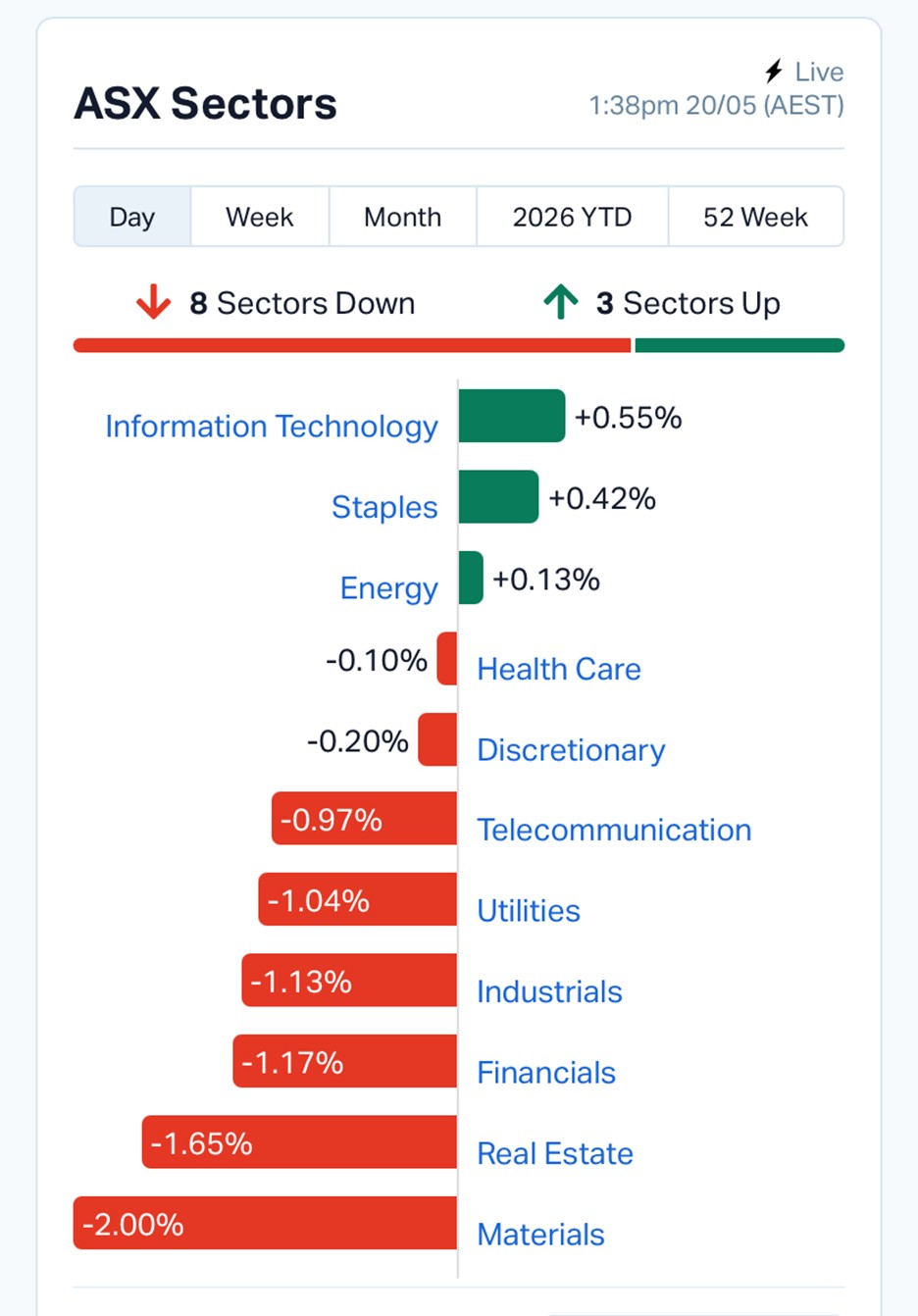
Market Snapshot
ASX Sector Snapshot | Source: MarketIndex
Overnight weakness on Wall Street set the tone early. The Dow Jones fell 0.65%, the S&P 500 lost 0.67%, and the Nasdaq dropped 0.84% as traders dumped long-dated government bonds and repositioned around expectations for higher global interest rates.
Brent crude remained elevated near US$111 a barrel as the US-Iran conflict continued to disrupt shipping channels around the Strait of Hormuz, one of the world’s most critical oil corridors.
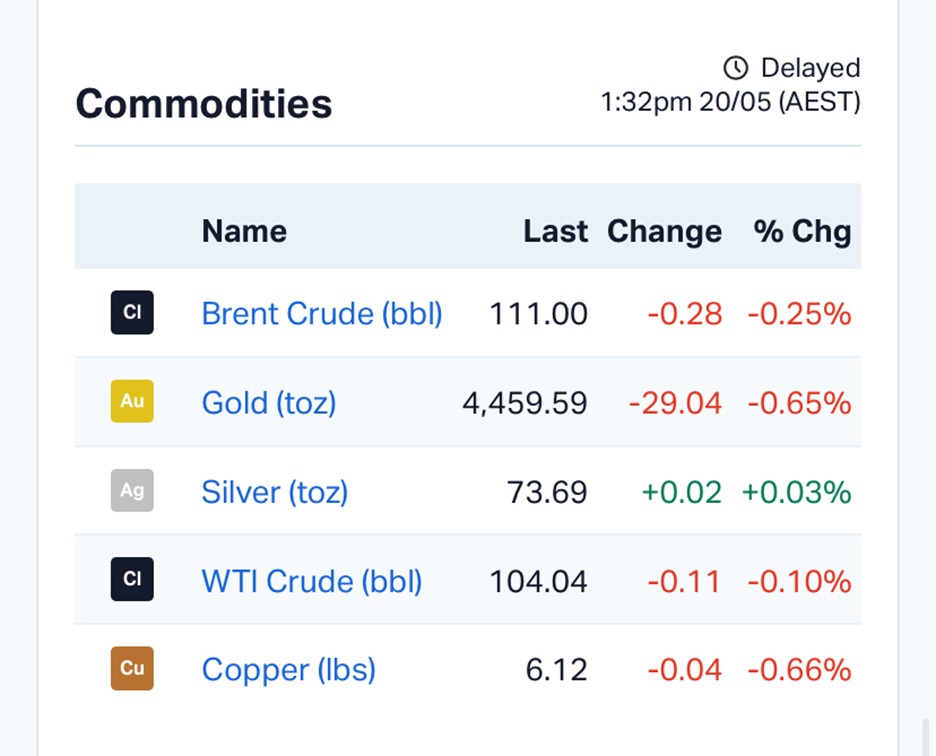
Commodities Snapshot | Source: MarketIndex
Bond markets become the centre of attention
The sharper move came in fixed income markets.
The US 30-year Treasury yield climbed to 5.2%, its highest level since the Global Financial Crisis in 2007. The benchmark US 10-year yield rose to 4.69%, while Australia’s 10-year government bond yield pushed beyond 5.11%, levels not seen since 2011.
The sell-off reflected growing concern that war-driven energy inflation could keep central banks locked into restrictive policy settings for longer than markets had expected earlier this year.
Higher bond yields tend to pressure share markets because they raise borrowing costs while making safer income-producing assets more attractive relative to equities.
That dynamic weighed heavily on mining stocks, industrial developers and gold producers across the ASX.
Gold miners retreat as yields climb
The ASX All Ordinaries Gold Index dropped 3.95%, making it the weakest major sector of the session.
Gold prices slipped 0.38% to US$4,471.50 an ounce after reaching record territory earlier this month.
Mining names tied to precious metals came under pressure as rising bond yields reduced short-term demand for non-yielding defensive assets.
Iron ore prices remained subdued near US$109 a tonne, while broader materials stocks also struggled amid concerns that slower global growth and tighter credit conditions could weigh on future commodity demand.
Inflation concerns spread through the domestic economy
Locally, several policy and economic issues added to the cautious tone.
The Australian Council of Trade Unions formally pushed for a 6% increase to the minimum wage during the Fair Work Commission’s annual review process, arguing inflation pressures were continuing to erode household purchasing power.
ACTU Secretary Sally McManus said, “We want to see award workers go forward but inflation and low wages are holding them back. For workers, this is absolutely necessary to keep their heads above water.”
Meanwhile, the Australian Communications and Media Authority finalised a A$7.32 billion valuation framework for expiring telecommunications spectrum licences, creating another large future cost burden for the sector.
At the same time, debate around the Federal Government’s capital gains tax reforms intensified after startup founders publicly criticised proposed changes tied to small business equity incentives.
Tech and infrastructure stocks resist the downturn
Despite the broader weakness, several growth and infrastructure names attracted strong buying interest.
Catapult Sports (ASX: CAT) surged 17.88% to $3.395 after reporting record US$141 million revenue and a sharp jump in operating profit. The sports analytics software group highlighted strong recurring revenue growth and expanding operating leverage across its global SaaS platform.
TechnologyOne (ASX: TNE) gained 8.27% to $30.10 as investors continued rotating toward enterprise software companies with recurring revenue models and resilient demand profiles.
Stay ahead of the market
The most important stories, delivered to your inbox. No noise, just what matters.
By subscribing, you agree to our Privacy Policy.
GenusPlus Group (ASX: GNP) climbed 5.85% to $10.31 after securing A$200 million to fund its transformational MPC Kinetic acquisition, expanding the company’s exposure to energy infrastructure and grid modernisation projects.
Resource developers feel the pressure
Risk appetite weakened sharply across junior mining and development names.
Wia Gold (ASX: WIA) fell 13% to $0.435 as broader selling pressure swept through speculative resource stocks despite the company recently securing A$92 million to advance its Kokoseb gold project in Namibia.
Building products giant James Hardie Industries (ASX: JHX) also came under pressure after reporting a 75% decline in annual profit to US$104 million, reflecting softer North American renovation demand and higher operating costs.
Chief Financial Officer Ryan Lada said, “The operating environment remains uncertain. We are not assuming a market recovery.”
Markets now watching central banks closely
Currency strategists and economists increasingly believe the next major market move will depend on how aggressively central banks respond to resurging inflation pressures.
Commonwealth Bank currency strategist Carol Kong said recent Federal Reserve commentary had turned increasingly hawkish.
“We expect the Fed minutes to be hawkish, pushing the dollar up further,” Kong said.
For now, markets appear caught between two competing forces: slowing global growth and stubborn inflation linked to energy disruption and rising borrowing costs.
Wednesday’s session suggested the bond market is winning that argument, at least for now.
What is your take on this story?
This is user sentiment & not financial advice.
Disclaimer - Skrill Network is designed solely for educational and informational use. The content on this website should not be considered as investment advice or a directive. Before making any investment choices, it is crucial to carry out your own research, taking into account your individual investment objectives and personal situation. If you're considering investment decisions influenced by the information on this website, you should either seek independent financial counsel from a qualified expert or independently verify and research the information.