

ASX Market Wrap: ASX Shrugs Off US-Iran Missile Strikes as Retail Rally Offsets Tech Weakness

Team Skrill Network
Team Skrill Network comprises seasoned professionals from diverse fields including Finance, Mining, Technology, Investing, and Digital Strategy. They bring a deep knowledge and understanding of financial markets and behavioural patterns to every story, ensuring credibility and precision in every piece. Whether analysing emerging market trends or spotlighting small- and mid-cap growth companies across ASX, TSX, or NASDAQ, the team’s editorial approach blends data-driven insights with compelling storytelling. Their expertise enables them to process complex developments into content that resonates with both institutional investors and retail audiences. Backed by experience in content curation, SEO strategy, and investor-focused messaging, the team of writers at Skrill Network are committed to delivering stories that matter—authentic, relevant, and strategically aligned with the evolving landscape of global investing.
Read more
Key Highlights
• S&P/ASX 200 rises 0.39% to 8,637.3 points by midday despite escalating tensions between the US and Iran
• Consumer Discretionary and Consumer Staples sectors lead gains, climbing 2.33% and 2.08% respectively
• Technology stocks retreat after a weak lead from Wall Street’s Nasdaq
Market Snapshot
• Brent crude remains above US$92 a barrel as investors monitor developments in the Middle East
• Woolworths announces corporate restructuring while Wesfarmers doubles down on AI initiatives
The Australian share market found its footing on Wednesday, brushing aside fresh geopolitical tensions in the Middle East as strength in retail, consumer and financial stocks outweighed weakness across technology and mining sectors.
By 12:16pm AEST, the S&P/ASX 200 had gained 33.1 points, or 0.39%, to 8,637.3, while the broader All Ordinaries added 0.23% to 8,844.8.
The positive session came despite overnight concerns following retaliatory US missile strikes against Iran. Markets initially opened cautiously, but sentiment steadily improved as traders appeared to view the latest developments as a contained escalation rather than the start of a broader regional conflict.
Brent crude oil remained elevated at US$92.27 a barrel, while gold eased 1.14% to US$4,173.54 an ounce. The Australian dollar was little changed at US70.27 cents.
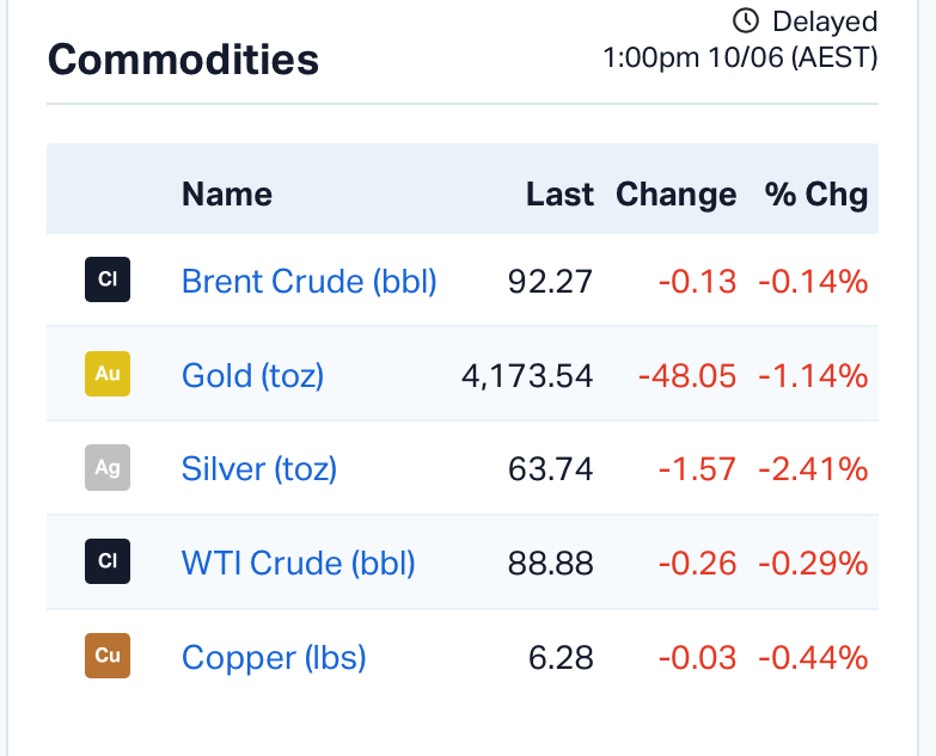
Commodities Price Index | Source: MarketIndex
Wall Street sends mixed signals
Global markets provided a mixed backdrop.
The Dow Jones Industrial Average rose 0.17% overnight, while the technology-heavy Nasdaq fell 0.97%. The broader S&P 500 slipped 0.26% as investors rotated away from high-growth technology names.
The timing of the US military action was notable. Washington announced its strikes shortly after Wall Street’s closing bell, limiting the immediate market reaction and leaving global investors to assess the implications during Asian trading hours.
European markets absorbed much of the initial anxiety, while Asian markets delivered a mixed performance. China’s Shanghai Composite rose 1.28%, while Hong Kong’s Hang Seng slipped 0.37%.
Retailers take centre stage
Consumer-focused stocks emerged as the day’s standout performers.
The Consumer Discretionary sector climbed 2.33%, while Consumer Staples gained 2.08%, reflecting growing confidence that interest rates may remain steady in the near term.
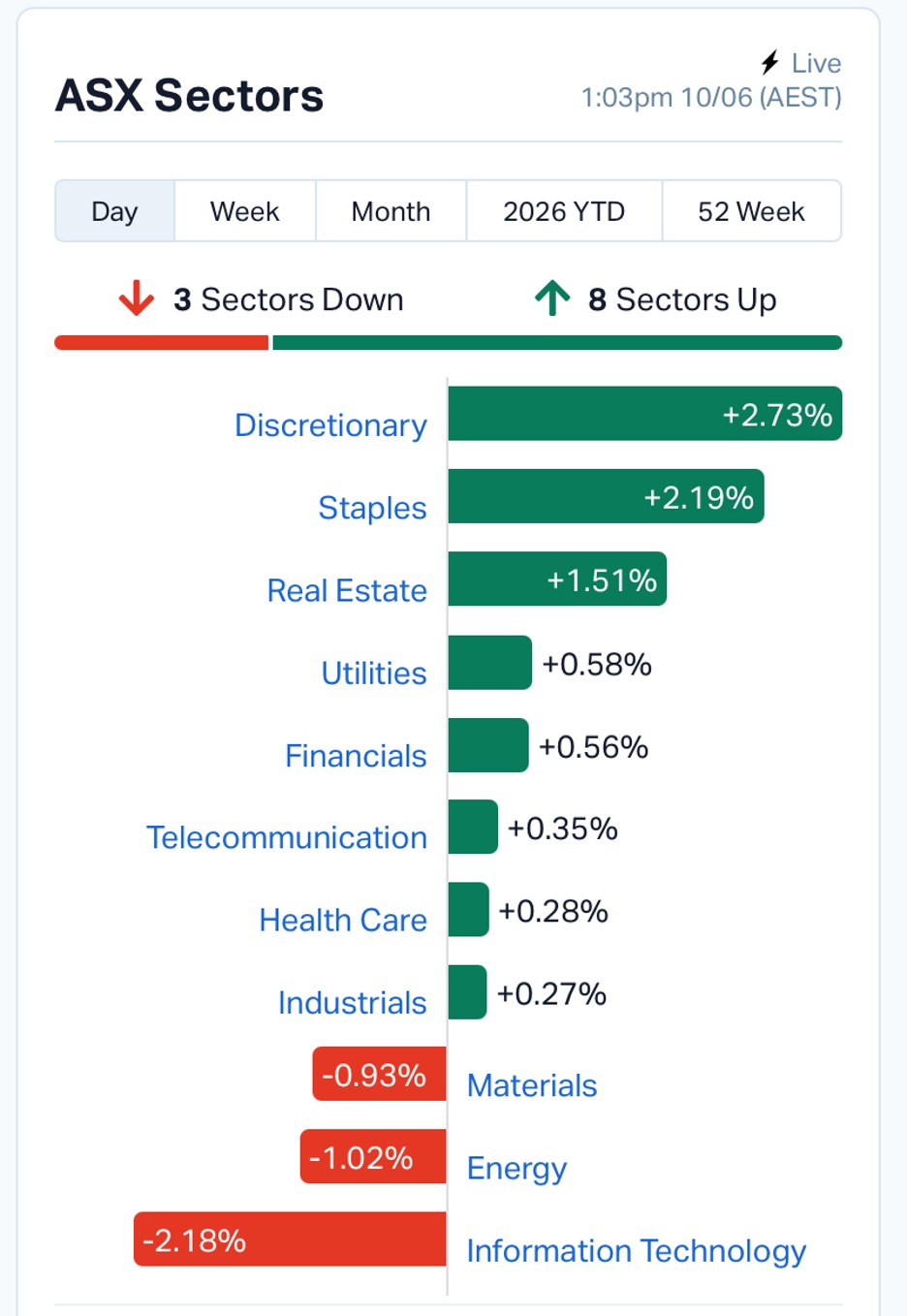
ASX Sector Snapshot | Source: MarketIndex
Super Retail Group (ASX: SUL) advanced 3.96% to $12.09, while plumbing and building supplies giant Reece Ltd (ASX: REH) surged 11.38% to $15.86.
James Hardie Industries (ASX: JHX) also enjoyed strong buying interest, rising 5.22% to $32.96 as investors responded positively to signs of resilience in construction-related markets.
Financial stocks contributed to the advance, with the sector gaining 0.69%. Real estate stocks also moved higher, supported by expectations that the Reserve Bank may remain on hold following signs of softer consumer activity.
Technology and miners drag
The strongest headwind came from technology stocks.
The Information Technology sector fell 1.77%, mirroring the overnight Nasdaq decline. The ASX All Technology Index dropped 1.67% as investors continued to reassess valuations across growth-oriented names.
Mining and energy shares also struggled despite relatively stable commodity prices.
Iron ore hovered around US$101 per tonne while copper remained flat. Gold producers came under pressure as bullion prices retreated from recent highs.
Stay ahead of the market
The most important stories, delivered to your inbox. No noise, just what matters.
By subscribing, you agree to our Privacy Policy.
Among individual stocks, uranium-related names faced selling pressure, with SILEX Systems (ASX: SLX) falling 7.17% to $5.38.
IGO Ltd (ASX: IGO) also weakened after reports of a fire at its Chemical Grade Plant 3 facility at the Greenbushes lithium operation in Western Australia. The company confirmed the incident was safely contained with no injuries, although operational impacts remain under assessment.
Corporate Australia embraces change
Away from market movements, several major companies unveiled strategic shifts.
Woolworths Group (ASX: WOW) began consultations with approximately 10,000 corporate employees as it reviews the outsourcing of selected finance, human resources and technology functions to offshore hubs.
Meanwhile, Wesfarmers (ASX: WES) outlined ambitious plans to expand artificial intelligence capabilities across its retail businesses, including Bunnings and Kmart.
Management revealed that customers engaging with AI-powered shopping tools are spending significantly more than traditional shoppers, highlighting the growing commercial importance of AI across Australia’s retail sector.
Cost-of-living pressures remain front of mind
Despite the market’s resilience, economic sentiment remains fragile.
Recent data highlighted that Australians are reporting lower life satisfaction levels than during parts of the COVID-19 pandemic, reflecting ongoing cost-of-living pressures.
KPMG Urban Economist Terry Rawnsley said the pressure on household finances remains significant.
“Real wages are lower than they were in 2020, median household wealth is actually flat over that five-year period, so it’s no surprise people are less satisfied with their lives because they’re feeling that financial pressure.”
For now, investors appear willing to look through both geopolitical tensions and domestic economic challenges. Wednesday’s session suggested that while headlines may still drive short-term volatility, markets remain focused on interest rates, corporate earnings and signs of resilience in consumer spending.
What is your take on this story?
This is user sentiment & not financial advice.
Disclaimer - Skrill Network is designed solely for educational and informational use. The content on this website should not be considered as investment advice or a directive. Before making any investment choices, it is crucial to carry out your own research, taking into account your individual investment objectives and personal situation. If you're considering investment decisions influenced by the information on this website, you should either seek independent financial counsel from a qualified expert or independently verify and research the information.
%2520Up%2520676%2525%2520in%252012%2520Months%2520Forrest%2520Stake%2520Trade%2520Sparks%252065M%2520Share%2520Buying%2520Frenzy.png&w=3840&q=75)