


ASX Market Wrap: ASX Tech Stocks Rally as Cooling Inflation Defies Wall Street’s Nasdaq Rout

Team Skrill Network
Team Skrill Network comprises seasoned professionals from diverse fields including Finance, Mining, Technology, Investing, and Digital Strategy. They bring a deep knowledge and understanding of financial markets and behavioural patterns to every story, ensuring credibility and precision in every piece. Whether analysing emerging market trends or spotlighting small- and mid-cap growth companies across ASX, TSX, or NASDAQ, the team’s editorial approach blends data-driven insights with compelling storytelling. Their expertise enables them to process complex developments into content that resonates with both institutional investors and retail audiences. Backed by experience in content curation, SEO strategy, and investor-focused messaging, the team of writers at Skrill Network are committed to delivering stories that matter—authentic, relevant, and strategically aligned with the evolving landscape of global investing.
Read more
Key Highlights
- S&P/ASX 200 rises 0.28% to 8,811.8 points despite a sharp US tech sell-off
- Australian technology stocks surge 4.61%, led by WiseTech Global and Xero
- Headline inflation eases to 4.0% in May, below market expectations
- Underlying inflation climbs to 3.6%, keeping rate hike concerns alive
- Falling oil and gold prices pressure energy and resource stocks
Australian shares pushed higher on Wednesday, shrugging off a bruising night on Wall Street as softer-than-expected inflation data encouraged buyers back into local technology and growth stocks.
The S&P/ASX 200 climbed 0.28% to 8,811.8 points, while the broader All Ordinaries added a similar 0.28% to 9,013.2 points.
The standout was the technology sector. The All Technology Index surged 2.89%, a remarkable performance given the tech-heavy Nasdaq plunged 2.21% overnight amid heavy selling across major artificial intelligence and semiconductor stocks.
Market Snapshot
For much of the past two years, Australian technology stocks have largely followed the lead of their US counterparts. Wednesday’s session broke that pattern.
Instead of focusing on Wall Street’s losses, local investors focused on fresh inflation data that offered a glimpse of relief, even if the broader inflation story remains far from resolved.
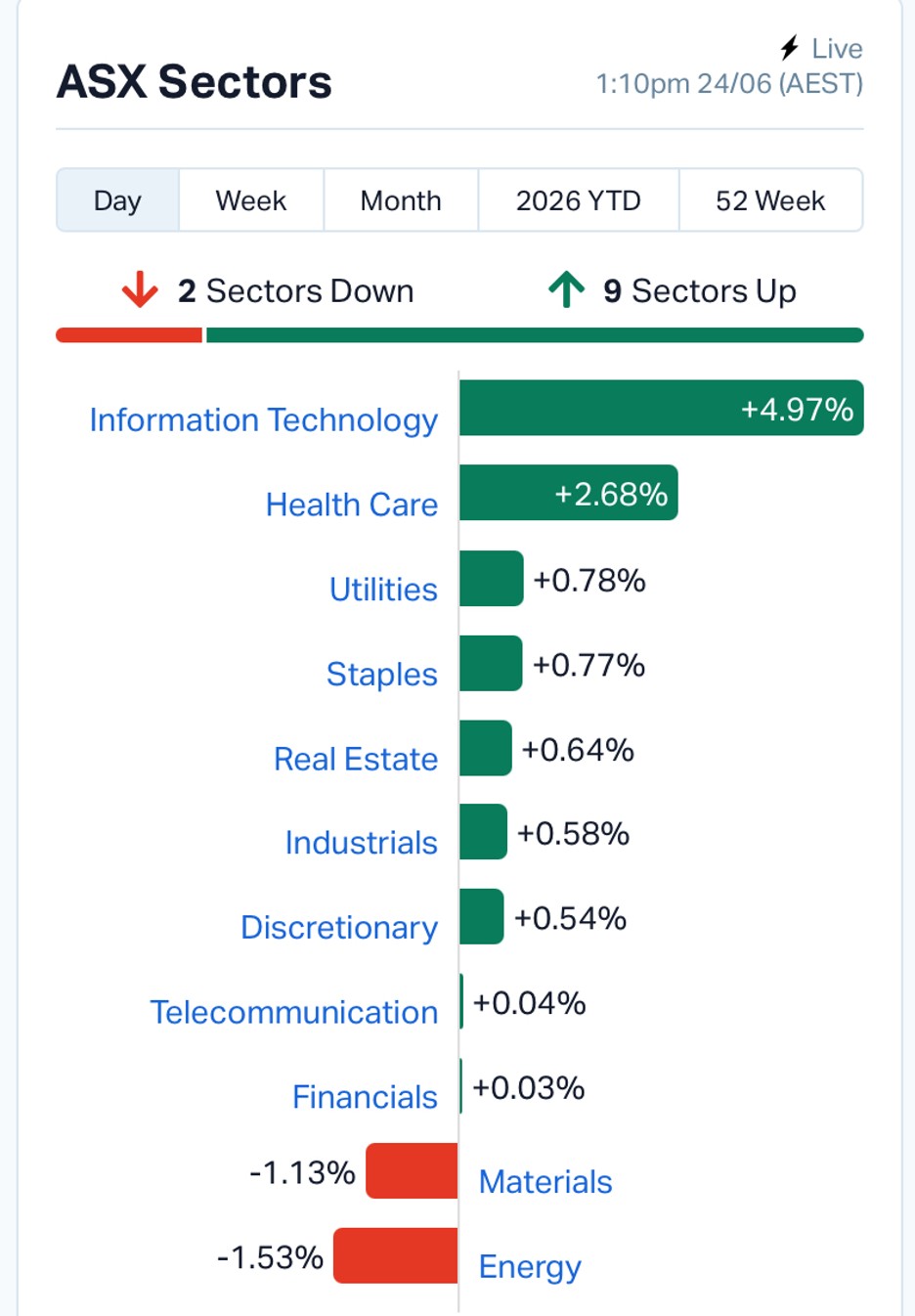
ASX Sector Snapshot | Source: MarketIndex
Inflation cools, but the story is more complicated
Fresh figures from the Australian Bureau of Statistics showed annual headline inflation eased to 4.0% in May, down from 4.2% in April and below market expectations of 4.3%.
At first glance, the data appeared encouraging.
However, beneath the surface, inflation pressures remain stubborn.
The Reserve Bank’s preferred measure of underlying inflation, known as trimmed mean inflation, increased from 3.4% to 3.6%, highlighting persistent domestic cost pressures.
ABS Head of Prices Statistics Rachael McCririck said housing continues to be the largest contributor to inflation.
“Housing remains the single largest driver of annual inflation at 6.5%, heavily impacted by a 21.1% spike in electricity costs as previous federal and state power rebates expired.”
The divergence between headline and underlying inflation immediately sparked debate among economists over the Reserve Bank’s next move.
Stephen Smith, Partner at Deloitte Access Economics, warned the market may be underestimating inflation risks.
“Today’s CPI data is an unwelcome reminder that Australia’s inflation problem is not yet solved, with another rate hike in 2026 still likely. The temporary fuel excise cut has masked the extent to which inflation pressures remain. These pressures will become more visible as the policy is unwound through July.”
Anders Magnusson, Chief Economist at BDO, echoed those concerns.
“Today’s CPI data confirms inflation is becoming more entrenched, with underlying inflation moving higher and increasing the likelihood that the RBA will tighten policy further in August. This reflects a shift from an initial energy-driven shock to broader and more troubling price pressures across the economy.”
Others took a more measured view.
Devika Shivadekar, Economist at RSM Australia, believes policymakers still have room to wait.
“The May inflation report keeps the RBA’s August rates decision finely balanced. The direction of travel on headline inflation is encouraging, but a 4% annual pace is still too high to justify an early pivot to rate cuts. The next CPI release on 29 July 2026 will be the pivotal read.”
Tech rebounds while Wall Street stumbles
The local market’s strongest performers came from sectors most sensitive to interest rates.
WiseTech Global (ASX: WTC) surged 13.42% to $32.62, recovering part of the ground lost during its recent sell-off. The rally followed founder Richard White’s public denial of allegations that had weighed heavily on sentiment earlier in the week.
Cloud accounting giant Xero (ASX: XRO) climbed 7.61% to $69.94 as institutional investors returned to premium software names.
Healthcare also attracted buying, with Telix Pharmaceuticals (ASX: TLX) advancing 6.73% to $15.54.
The strength in Australian technology stocks contrasted sharply with events in the United States.
The Nasdaq tumbled 2.21% overnight, dragged lower by heavy profit-taking across AI-linked companies. The broader S&P 500 fell 1.44%, while the Dow Jones slipped just 0.09%.
Falling commodity prices weigh on miners
While growth stocks enjoyed renewed interest, commodity producers faced a more difficult session.
Stay ahead of the market
The most important stories, delivered to your inbox. No noise, just what matters.
By subscribing, you agree to our Privacy Policy.
Oil prices continued to retreat as traders reduced geopolitical risk premiums amid hopes for a longer-term easing of tensions in the Middle East.
Brent crude slipped to US$76.02 a barrel, marking a four-month low.
Gold prices also weakened, falling 0.81% to US$4,061.94 an ounce, while iron ore remained relatively stable around US$99.90 a tonne.
The softer commodity backdrop pushed the ASX 200 Resources Index down 1.08%.
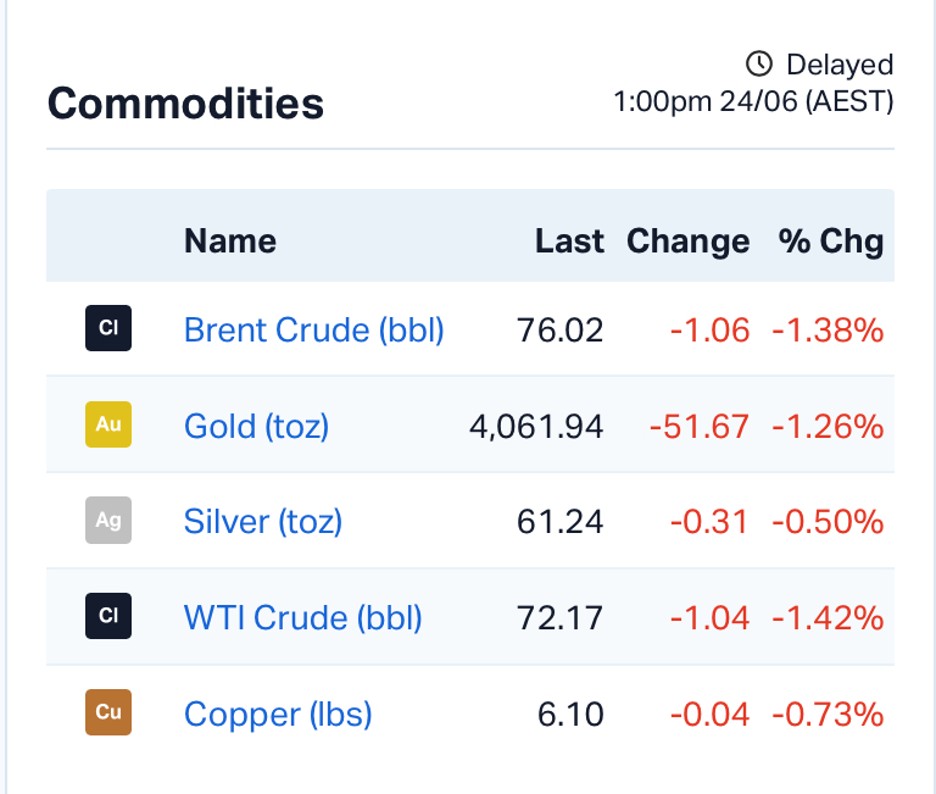
Commodities Price Index | Source: MarketIndex
Beach Energy (ASX: BPT) fell 7.45%, Coronado Global Resources (ASX: CRN) dropped 6.67%, and Ora Banda Mining (ASX: OBM) lost 5.69% as investors rotated away from traditional resource exposures.
A market caught between relief and caution
Wednesday’s session highlighted the increasingly complex environment facing investors.
Lower headline inflation provided enough encouragement to support technology and growth sectors. At the same time, rising core inflation reminded markets that the fight against price pressures is not yet over.
The result was a market that looked past Wall Street’s tech sell-off and focused instead on the possibility that Australia’s economic landing may be softer than feared.
Whether that optimism survives the next inflation reading and the Reserve Bank’s August meeting remains the key question.
Source: Australian Bureau of Statistics (ABS), ASX market data, company announcements, Deloitte Access Economics, BDO Australia, RSM Australia, global market data as of 24 June 2026.
What is your take on this story?
This is user sentiment & not financial advice.
Disclaimer - Skrill Network is designed solely for educational and informational use. The content on this website should not be considered as investment advice or a directive. Before making any investment choices, it is crucial to carry out your own research, taking into account your individual investment objectives and personal situation. If you're considering investment decisions influenced by the information on this website, you should either seek independent financial counsel from a qualified expert or independently verify and research the information.