

ASX Market Wrap: $100 Billion Wipeout as Energy Stocks Surge Against the Tide

Team Skrill Network
Team Skrill Network comprises seasoned professionals from diverse fields including Finance, Mining, Technology, Investing, and Digital Strategy. They bring a deep knowledge and understanding of financial markets and behavioural patterns to every story, ensuring credibility and precision in every piece. Whether analysing emerging market trends or spotlighting small- and mid-cap growth companies across ASX, TSX, or NASDAQ, the team’s editorial approach blends data-driven insights with compelling storytelling. Their expertise enables them to process complex developments into content that resonates with both institutional investors and retail audiences. Backed by experience in content curation, SEO strategy, and investor-focused messaging, the team of writers at Skrill Network are committed to delivering stories that matter—authentic, relevant, and strategically aligned with the evolving landscape of global investing.
Read more
Key Highlights
- ASX 200 falls -1.54% to 8,507, wiping out an estimated $100bn+ in value
- Energy sector jumps +4.89%, the only clear winner
- Unemployment rises to 4.3%, signalling economic strain
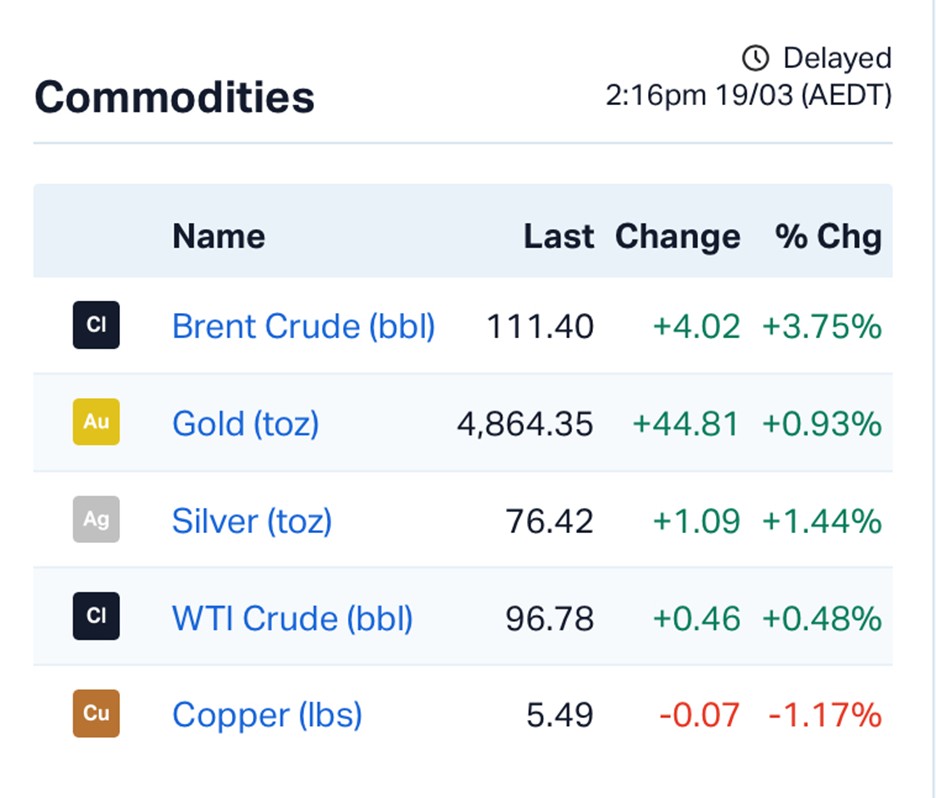
- Brent crude surges to $US111.40, driving market divergence
- Small caps slump -3.10%, showing deep risk-off sentiment
The Australian share market is facing a classic split-screen moment.
On one side, a sharp sell-off is erasing billions in value. On the other, energy stocks are surging as global tensions push oil prices higher. It is a session defined by contradiction, where the same forces hurting households are lifting a handful of companies.
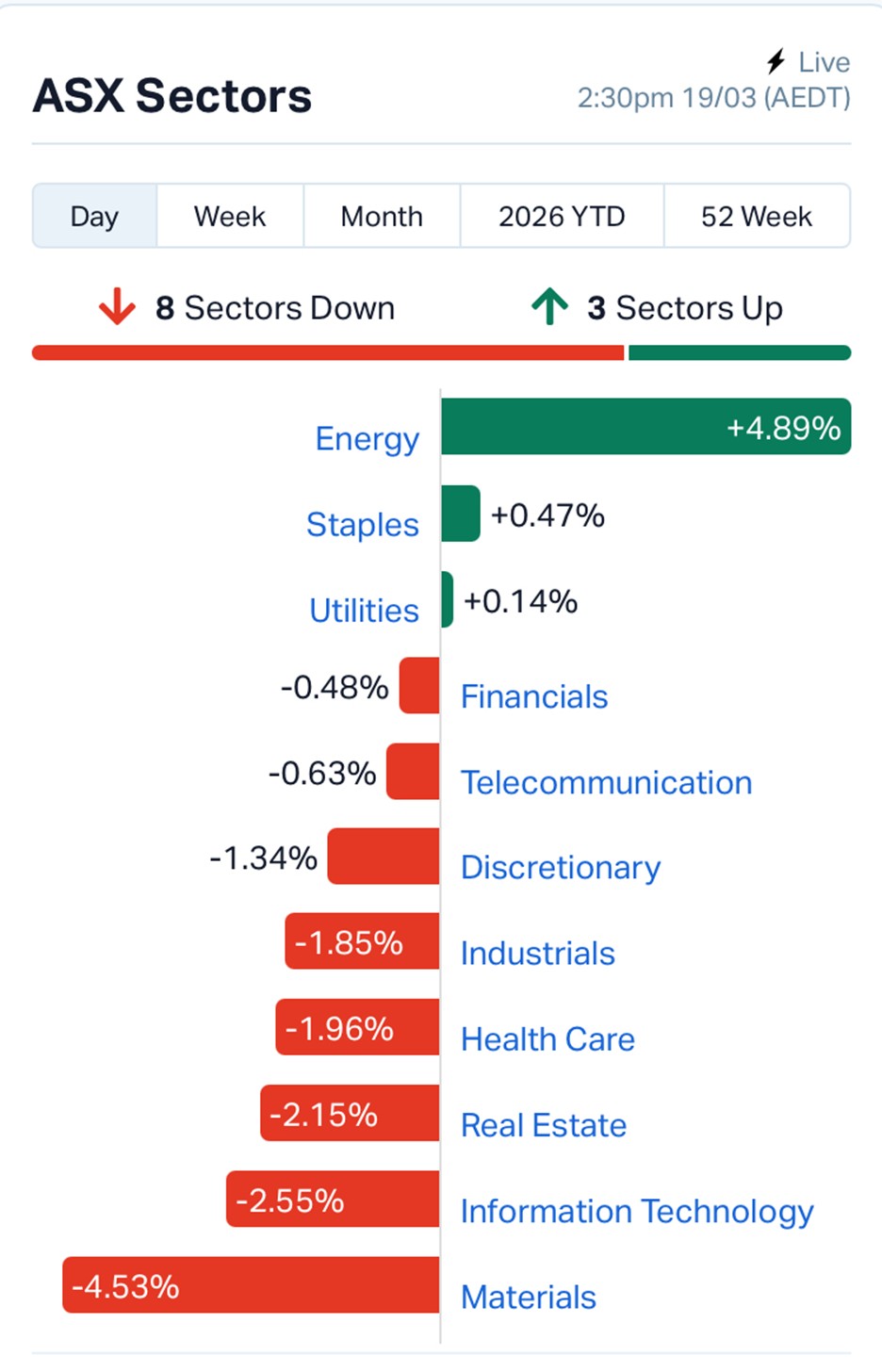
By mid-afternoon, the S&P/ASX 200 dropped 1.54% to 8,507.2, while the broader All Ordinaries fell 1.66%, reflecting a broad-based retreat across sectors.
Market Snapshot
Sector Snapshot | Source: MarketIndex
The $100bn question: what triggered the sell-off?
At the heart of today’s decline is what can best be described as a “cost-of-living collision.”
Three forces are converging at once:
- Rising oil prices
- Weakening labour market
- Hawkish central banks globally
Australia’s unemployment rate climbed to 4.3% in February, driven by a loss of 30,000 full-time jobs, even as part-time roles increased. Economists say this shift reflects households scrambling to maintain income levels.
Dr. Brendan Rynne of KPMG summed it up clearly:
“The labour market outlook is starting to look tenuous. It seems people are looking to secure their household budgets by increasing their participation in the labour market.”
At the same time, mortgage stress is building, with research indicating 1.4 million borrowers are now at risk.
Energy stocks: the unlikely heroes
While most of the market sank, the energy sector surged +4.89%, becoming the day’s clear standout.
The catalyst is geopolitical.
A fresh escalation near the Strait of Hormuz has pushed Brent crude to $US111.40, raising fears of supply disruption. This is no small number. Oil above $100 historically acts as both a profit driver for producers and a tax on consumers.
Stocks tied to energy demand surged:
- Viva Energy up 16.11%
- Woodside Energy up 6.49% to $33.48
- Yancoal up 7.18%
Ironically, some of these same fuel players are now under scrutiny, with the ACCC launching an investigation into Ampol, BP, Mobil and Viva Energy over alleged anti-competitive behaviour.
It is a rare moment where companies benefiting from the crisis are also facing regulatory pressure.
The other side: materials and small caps crushed
If energy stocks were the lifeboats, the rest of the market was taking on water.
The materials sector plunged 4.53%, while gold miners suffered heavy losses despite bullion holding near $US4,864/oz. The ASX Gold Index dropped 8.50%, highlighting how sentiment can diverge sharply from commodity prices.
Stocks like Ora Banda Mining fell heavily, reflecting profit-taking and broader risk aversion.
Meanwhile, the Small Ordinaries index slid 3.10%, signalling deeper stress among smaller, less liquid companies. Historically, this kind of divergence suggests investors are rotating out of risk and into defensive positions.
Global backdrop: the pressure builds
The ASX did not fall in isolation.
Wall Street provided a weak lead, with:
- Dow Jones down 1.63%
- S&P 500 down 1.36%
The U.S. Federal Reserve held rates steady but maintained a hawkish stance, effectively shutting down hopes of near-term rate cuts.
Capital Economics economist Marcel Thieliant warned:
“With crude oil prices hitting fresh highs, the Bank is already concerned that inflation expectations are becoming unanchored. The rise in unemployment won’t prevent further rate hikes.”
In contrast, Asia showed resilience:
- Nikkei up 2.87%
- Hang Seng up 0.61%
This divergence highlights how Australia’s market is currently more sensitive to commodities and domestic economic signals than broader regional momentum.
Stay ahead of the market
The most important stories, delivered to your inbox. No noise, just what matters.
By subscribing, you agree to our Privacy Policy.
Sector snapshot: a market split in two
Top Performers
- Energy: +4.89%
- Utilities: +0.14%
- Staples: +0.47%
Worst Hit
- Materials: -4.53%
- Technology: -2.41%
- Real Estate: -2.55%
Even banks slipped, with the ASX 200 Banks index down 0.51%, reflecting concerns around slowing credit growth and rising defaults.
The bigger picture: inflation vs growth
Treasurer Jim Chalmers acknowledged the growing uncertainty:
“This conflict is a reminder of how fast things can change. Before this war, inflation was already too high. All of this uncertainty is a reason for more reform, not less.”
The key issue now is whether central banks can manage inflation without pushing economies into recession.
Higher oil prices feed directly into transport, manufacturing and everyday goods. At the same time, rising unemployment weakens consumer demand. It is a difficult balance.
Today’s market action tells a clear story.
The ASX is not simply falling. It is being reshaped.
Energy stocks are thriving on global disruption, while the broader market is grappling with slowing growth and rising costs. The result is a widening gap between winners and losers.
With oil above $US110, unemployment rising, and central banks staying cautious, this tension is unlikely to ease quickly.
For now, the market is sending a strong signal.
In this environment, survival depends less on growth and more on resilience.
What is your take on this story?
This is user sentiment & not financial advice.
Disclaimer - Skrill Network is designed solely for educational and informational use. The content on this website should not be considered as investment advice or a directive. Before making any investment choices, it is crucial to carry out your own research, taking into account your individual investment objectives and personal situation. If you're considering investment decisions influenced by the information on this website, you should either seek independent financial counsel from a qualified expert or independently verify and research the information.