

ASX Market Wrap: Inflation Shockwaves Trigger Rate Hike Fever Across Markets

Team Skrill Network
Team Skrill Network comprises seasoned professionals from diverse fields including Finance, Mining, Technology, Investing, and Digital Strategy. They bring a deep knowledge and understanding of financial markets and behavioural patterns to every story, ensuring credibility and precision in every piece. Whether analysing emerging market trends or spotlighting small- and mid-cap growth companies across ASX, TSX, or NASDAQ, the team’s editorial approach blends data-driven insights with compelling storytelling. Their expertise enables them to process complex developments into content that resonates with both institutional investors and retail audiences. Backed by experience in content curation, SEO strategy, and investor-focused messaging, the team of writers at Skrill Network are committed to delivering stories that matter—authentic, relevant, and strategically aligned with the evolving landscape of global investing.
Read more
Key Highlights:
- ASX 200 falls 0.32% to 8,683, marking a potential seventh straight decline
- Inflation surges to 4.6%, highest since September 2023
- Markets price in up to 76% probability of RBA rate hike
- Energy and utilities outperform as oil holds above US$110/barrel
- Materials and financials drag amid tightening liquidity concerns
The Australian share market is trading lower on Wednesday as a sharp inflation print reshapes expectations for interest rates and economic momentum.
The S&P/ASX 200 is down 0.32% at 8,683 points by early afternoon, extending what could become its seventh consecutive day of losses. The decline comes despite relatively stable global markets, as domestic inflation concerns take centre stage.
Overnight, Wall Street closed modestly lower, with the NASDAQ Composite falling 0.9% and the S&P 500 slipping 0.49%, reflecting growing unease around persistent inflation and higher-for-longer interest rates.
Market Snapshot
Meanwhile, Brent crude remains elevated at US$111 per barrel, reinforcing inflationary pressures across global economies.
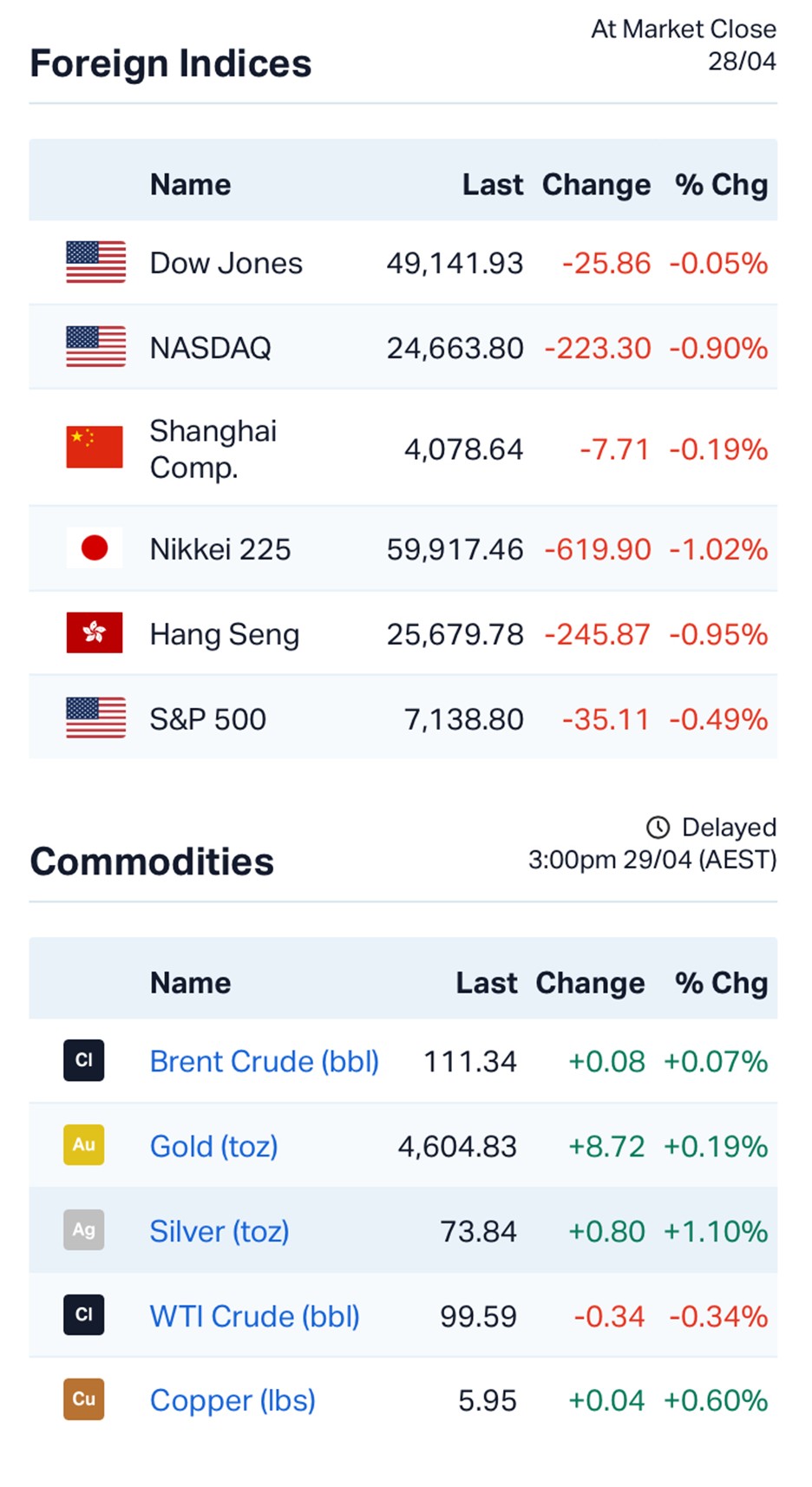
Commodities and Foreign Indices | Source: MarketIndex
Inflation shock resets the policy narrative
The key catalyst is Australia’s March Consumer Price Index, which rose to 4.6%, its highest level in two and a half years.
The driver was energy.
Fuel prices surged 32.8% in March, reflecting geopolitical disruptions tied to tensions in the Middle East and constraints around the Strait of Hormuz. The shock has flowed directly into transport costs and broader consumer prices.
More telling for policymakers, however, is the underlying trend.
The trimmed mean inflation rate, the Reserve Bank’s preferred gauge, held at 3.3%, remaining above the central bank’s 2 to 3% target band. The persistence of core inflation suggests price pressures are embedded rather than temporary.
Markets have responded swiftly.
Interest rate futures are now pricing in a 75% to 76% probability that the Reserve Bank of Australia will lift the cash rate by 25 basis points at its next meeting, taking it to 4.35%.
Oxford Economics economist Harry McAuley described the dilemma clearly:
“Oil price shocks are a central bank’s worst nightmare. They simultaneously boost prices and suppress demand, placing policymakers in a difficult position.”
Sector divergence sharpens
The inflation-driven sell-off has not been uniform.
Energy and defensive sectors are attracting capital, while rate-sensitive and cyclical sectors are under pressure.
Utilities are leading the market, up 2.36%, followed by energy stocks gaining 1.63%, supported by sustained strength in oil prices.
Companies such as Woodside Energy Group Ltd and coal producers including Whitehaven Coal Ltd and New Hope Corporation Ltd have recorded gains, reflecting investor rotation into cash-generative, commodity-linked businesses.
Technology has shown resilience, rising 1.36%, supported by selective buying following recent weakness.
In contrast, materials remain the largest drag on the index, down 1.08%, as miners face a combination of softer commodity sentiment and tightening financial conditions.
Financials have also weakened, falling 0.87%, as rising interest rates raise concerns about credit demand and asset quality.
Stock-specific moves reflect volatility beneath the surface
Beneath the index level, price action has been sharp.
Among the top performers, oOh!media Ltd surged 41.18%, driven by strong speculative momentum. Codan Ltd gained 15.92% after upgrading earnings guidance, while Aurelia Metals Ltd rose 10.71% on renewed interest in mid-cap resources.
On the downside, Terra Metals Ltd fell 14.18%, while Omega Oil & Gas Ltd dropped 11.11% following recent volatility in the energy space. European Lithium Ltd declined 9.64%, giving back some of its recent merger-driven gains.
The divergence highlights a market increasingly driven by macro forces rather than company-specific fundamentals.
Global backdrop adds to pressure
International markets are offering limited support.
Across Asia, indices are broadly lower, with Japan’s Nikkei 225 down 1.02% and Hong Kong’s Hang Seng Index falling 0.95%.
In the United States, the recent rally has begun to lose momentum as investors reassess the trajectory of interest rates and corporate earnings.
At the same time, geopolitical developments continue to influence commodity markets. Reports of potential shifts within OPEC, including speculation around UAE policy direction, have added another layer of uncertainty to oil supply expectations.
Stay ahead of the market
The most important stories, delivered to your inbox. No noise, just what matters.
By subscribing, you agree to our Privacy Policy.
A market caught between growth and tightening
What is unfolding is a classic late-cycle tension.
Economic activity remains resilient, supported by strong commodity demand and corporate earnings. At the same time, inflation is proving sticky, forcing central banks to maintain restrictive policy settings.
Callam Pickering from Indeed noted that domestic factors cannot be overlooked:
“Supply constraints within Australia are continuing to place upward pressure on prices, meaning inflation is not purely an imported issue.”
This dual pressure, rising costs alongside slowing demand, is beginning to shape investor positioning.
Volatility remains contained, for now
Despite the negative tone, market volatility remains subdued.
The ASX volatility index is sitting around 12.8, indicating relatively low levels of market stress. This suggests the current pullback is being viewed as a repricing rather than a disorderly sell-off.
However, the persistence of inflation and the prospect of further tightening could test that stability in the weeks ahead.
The broader takeaway
The latest inflation data has reset expectations.
Markets are no longer debating whether policy will tighten, but how far it will go and how long it will remain restrictive.
For equities, this shifts the focus toward earnings resilience, balance sheet strength and pricing power.
The immediate trajectory of the ASX will likely hinge on the Reserve Bank’s next move. Beyond that, the durability of inflation will determine whether this is a temporary adjustment or the beginning of a more prolonged recalibration.
What is your take on this story?
This is user sentiment & not financial advice.
Disclaimer - Skrill Network is designed solely for educational and informational use. The content on this website should not be considered as investment advice or a directive. Before making any investment choices, it is crucial to carry out your own research, taking into account your individual investment objectives and personal situation. If you're considering investment decisions influenced by the information on this website, you should either seek independent financial counsel from a qualified expert or independently verify and research the information.