

ASX Slips as Oil Holds Firm: Tech Leads Losses Despite Global Relief Rally

Team Skrill Network
Team Skrill Network comprises seasoned professionals from diverse fields including Finance, Mining, Technology, Investing, and Digital Strategy. They bring a deep knowledge and understanding of financial markets and behavioural patterns to every story, ensuring credibility and precision in every piece. Whether analysing emerging market trends or spotlighting small- and mid-cap growth companies across ASX, TSX, or NASDAQ, the team’s editorial approach blends data-driven insights with compelling storytelling. Their expertise enables them to process complex developments into content that resonates with both institutional investors and retail audiences. Backed by experience in content curation, SEO strategy, and investor-focused messaging, the team of writers at Skrill Network are committed to delivering stories that matter—authentic, relevant, and strategically aligned with the evolving landscape of global investing.
Read more
Key Highlights:
- ASX 200 down 0.34% to 8,942.8
- Oil steady above $US96, keeping inflation fears alive
- Tech sector falls over 1%, worst performer
- Wall Street rises, but ASX lags global optimism
- Energy and banks show relative resilience
The Australian share market edged lower on Friday, closing the week on a cautious note despite a positive lead from Wall Street.
The S&P/ASX 200 slipped 0.34% to 8,942.8, with most sectors in the red as investors weighed the reality of persistently high energy prices against hopes of easing geopolitical tensions.
Overnight, US markets pushed higher, with the Dow Jones gaining 0.58% and the Nasdaq rising 0.83%, as traders responded to signs of a fragile ceasefire in the Middle East. But on the ground, the story remains more complex.
Market Snapshot
Brent crude is still holding near $US96.49 a barrel, a level that continues to pressure inflation expectations globally. That, in turn, is feeding into interest rate concerns, particularly in Australia where policymakers remain sensitive to energy-driven price shocks.
The Australian dollar weakened slightly to 70.68 US cents, reflecting a cautious risk environment.
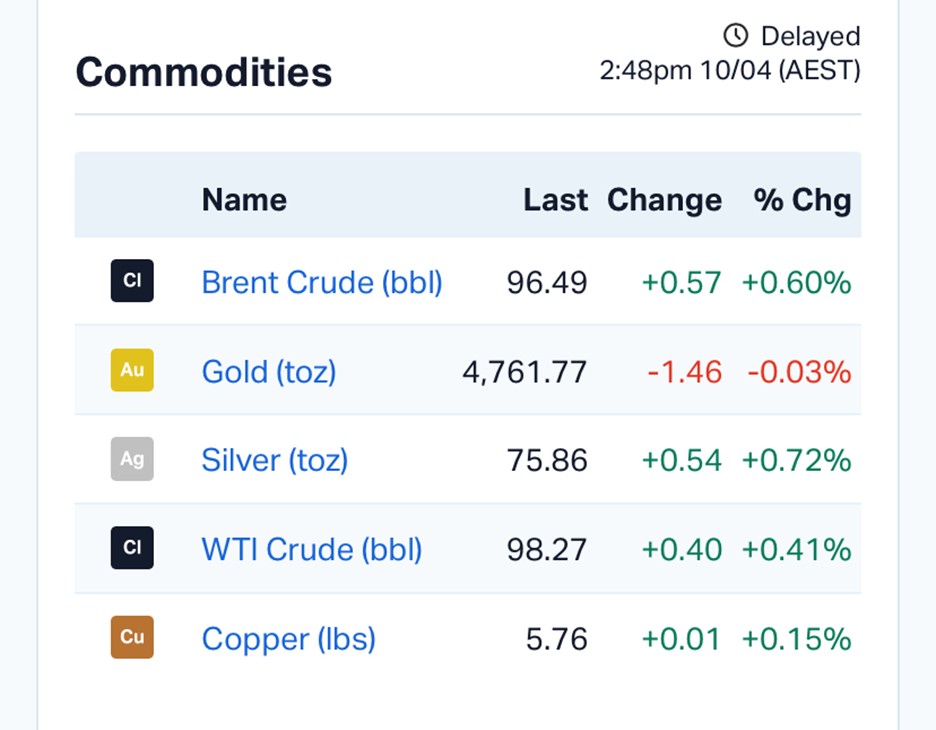
Commodities Snapshot | Source: MarketIndex
A Market Pulled in Two Directions
Friday’s session captured a market caught between optimism and reality.
On one hand, global investors are betting that the worst of the Middle East conflict may be behind us. On the other, supply disruptions continue to ripple through energy markets.
Around 10% of global supertankers remain stuck in the Persian Gulf, raising concerns that diesel shortages could worsen in the weeks ahead. For Australia, which relies heavily on imported fuel, this presents a tangible economic risk.
As one analyst from Barclays noted, “Ceasefires end wars, but they don’t undo them.” The aftershocks, particularly in commodities, tend to linger far longer.
Tech Takes the Hit
The clearest casualty of this environment was the technology sector.
The ASX All Technology Index dropped 1.09% to 2,627.4, making it the worst-performing segment of the market. Stocks like WiseTech Global and Xero extended recent losses, reflecting renewed concerns about “higher for longer” interest rates.
Tech stocks tend to rely on future earnings growth. When interest rates rise or stay elevated, those future earnings are discounted more heavily, dragging valuations lower.
This pattern has played out before. During the 2022 global tightening cycle, tech stocks across the ASX and Nasdaq saw similar sharp corrections as bond yields surged.
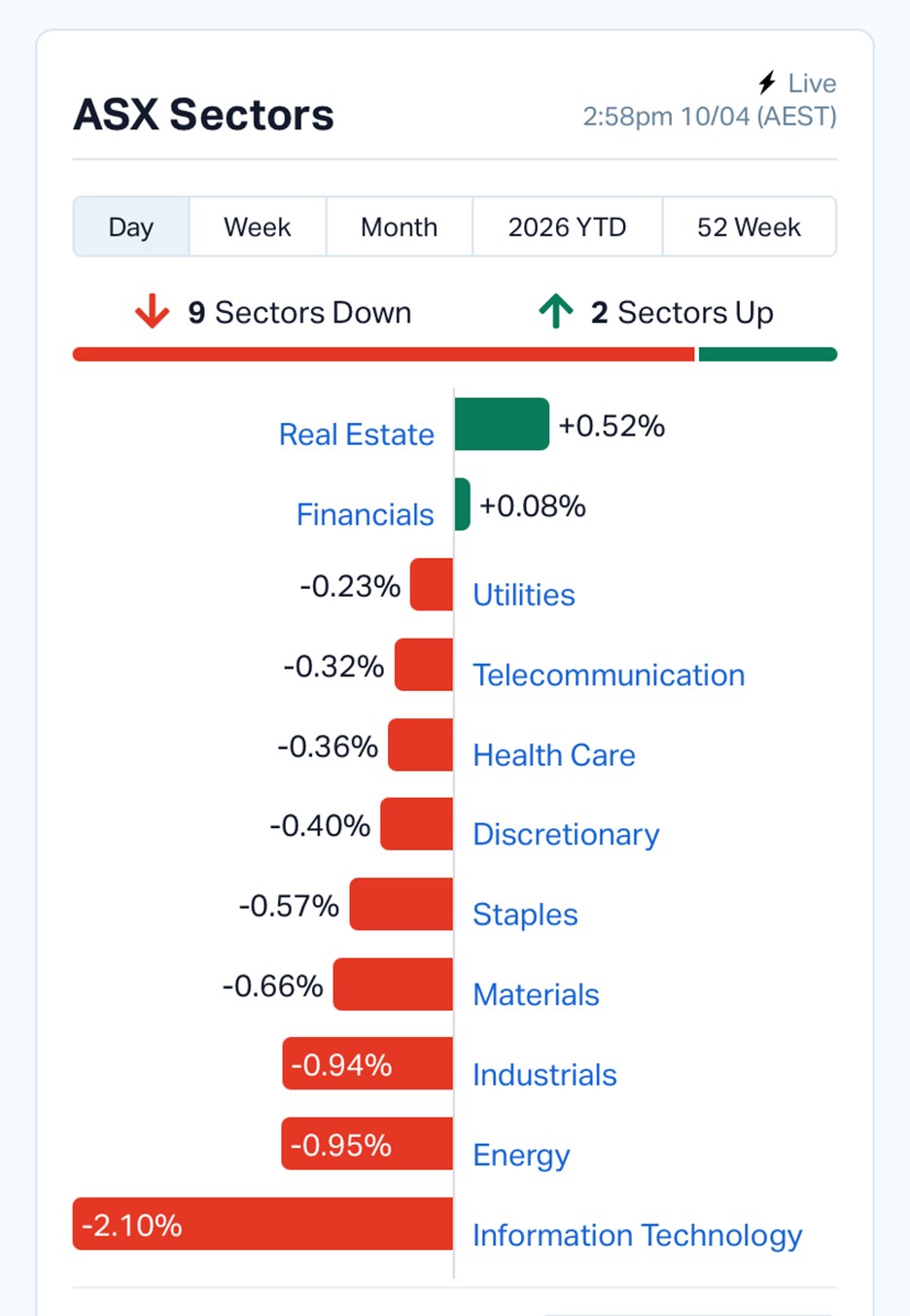
Sector Snapshot | Source: MarketIndex
Energy and Banks Offer Support
While most sectors struggled, a few pockets of resilience emerged.
Financials edged slightly higher, with the ASX 200 Banks Index up 0.09%. Rising interest rates, while a headwind for borrowers, often support bank margins in the short term.
Real estate also posted modest gains, rising 0.52%, suggesting some bargain hunting after recent weakness.
Energy stocks, however, were more mixed. Despite higher oil prices, the sector fell 2.10%, indicating that investors may already be pricing in peak oil scenarios or reacting to volatility in global demand expectations.
Winners and Laggards
Among individual movers, gains were scattered but notable.
Elixir Energy surged nearly 15%, while Energy Resources of Australia climbed over 14%, highlighting continued interest in energy and uranium plays. Amaero also gained 4.9%, building on momentum in advanced manufacturing themes.
On the downside, Beetaloo Energy fell sharply by almost 16%, leading the losers. Orora dropped 7.4% following ongoing concerns around supply chain disruptions linked to the Middle East.
Mining names such as Arafura Rare Earths and Champion Iron also declined, reflecting softer sentiment in the materials sector.
Global Context: The Reality Gap
Globally, markets are showing signs of divergence.
Stay ahead of the market
The most important stories, delivered to your inbox. No noise, just what matters.
By subscribing, you agree to our Privacy Policy.
While US equities continue to rally on optimism around a ceasefire, Asian markets were weaker, with Japan’s Nikkei down 0.73% and Hong Kong’s Hang Seng falling 0.54%.
China’s inflation data added another layer of complexity. Consumer prices rose 1% year-on-year in March, ending a prolonged period of deflation. However, economists at Capital Economics expect the spike to be temporary, suggesting limited long-term pressure from Chinese demand.
Still, the broader message is clear: the global economy is stabilising, but not without friction.
The Bigger Picture
For Australia, the key concern remains inflation.
Westpac’s chief economist Luci Ellis warned that even if oil prices ease, the secondary effects are already flowing through the economy.
“The real question is how much of the energy price shock is being passed through to other goods and services,” she said, pointing to rising construction costs and broader pricing pressures.
This suggests that even in a best-case scenario where geopolitical tensions ease, the Reserve Bank may still need to keep interest rates higher for longer.
The Wrap
Friday’s session reflects a market in transition.
The optimism of a ceasefire is being tempered by the practical realities of disrupted supply chains, elevated oil prices, and sticky inflation.
For now, the ASX appears to be acting more cautiously than its global peers, perhaps offering an early signal of how markets may react if energy prices remain elevated.
Until oil convincingly moves lower and supply chains normalise, the divide between sectors is likely to persist, with energy and defensives holding ground while growth stocks remain under pressure.
What is your take on this story?
This is user sentiment & not financial advice.
Disclaimer - Skrill Network is designed solely for educational and informational use. The content on this website should not be considered as investment advice or a directive. Before making any investment choices, it is crucial to carry out your own research, taking into account your individual investment objectives and personal situation. If you're considering investment decisions influenced by the information on this website, you should either seek independent financial counsel from a qualified expert or independently verify and research the information.