

ASX Slips as Oil Surge Triggers Tech Sell-Off and Sector Divide Deepens

Team Skrill Network
Team Skrill Network comprises seasoned professionals from diverse fields including Finance, Mining, Technology, Investing, and Digital Strategy. They bring a deep knowledge and understanding of financial markets and behavioural patterns to every story, ensuring credibility and precision in every piece. Whether analysing emerging market trends or spotlighting small- and mid-cap growth companies across ASX, TSX, or NASDAQ, the team’s editorial approach blends data-driven insights with compelling storytelling. Their expertise enables them to process complex developments into content that resonates with both institutional investors and retail audiences. Backed by experience in content curation, SEO strategy, and investor-focused messaging, the team of writers at Skrill Network are committed to delivering stories that matter—authentic, relevant, and strategically aligned with the evolving landscape of global investing.
Read more
Key Highlights:
- ASX 200 falls 0.47% as global volatility weighs on sentiment
- Brent crude holds above $US105, lifting energy stocks
- Tech sector drops 1.65%, leading market weakness
- Nuix jumps 12.7% after legal clarity, defying broader trend
- Fortescue, IGO among major laggards despite mixed fundamentals
The Australian share market is trading lower on Friday as rising oil prices and global uncertainty weigh on sentiment.
Overnight, US markets slipped, with the Nasdaq down 0.9% and the S&P 500 easing 0.4%, reflecting concerns around interest rates and a fresh wave of tech sector pressure.
Brent crude remains elevated above $US105 a barrel, reinforcing inflation fears and reshaping sector dynamics across global markets.
Market Snapshot
A market pulled in two directions
By early afternoon, the S&P/ASX 200 had fallen 0.47% to 8,752.5 points, while the All Ordinaries slipped 0.54% to 8,975.8.
The weakness is not uniform.
Instead, the market is splitting into two clear camps.
On one side, energy and defensive sectors are gaining ground. On the other, growth-focused sectors such as technology and materials are retreating.
The ASX All Technology Index has dropped 1.65%, making it the worst-performing segment of the session.
This divergence reflects a broader global shift.
As energy prices rise, capital tends to rotate away from high-growth, rate-sensitive sectors toward cash-generating, commodity-linked businesses.
The “war premium” returns
At the centre of today’s move is oil.
Brent crude is trading around $US105.82 per barrel, supported by ongoing tensions in the Middle East and continued disruption concerns around key shipping routes.
Market strategist Vishnu Varathan noted that expectations of a smooth de-escalation may be misplaced, saying:
“A ceasefire is a funny term to use in conjunction with a blockade and rolling tensions. It is not going to be a linear de-escalation of violence and oil prices.”
The impact is already flowing through to related markets.
Fertiliser prices, particularly urea, are hovering near multi-decade highs, raising concerns about agricultural costs and global food supply pressures.
Energy rises while tech stumbles
The sector breakdown tells the story clearly.
Energy stocks are up 1.16%, while utilities have gained 1.36%, positioning themselves as relative safe havens.
In contrast, information technology has fallen 1.43%, while materials are down 1.13%.
This rotation mirrors global patterns, where rising input costs and higher interest rate expectations tend to compress valuations in growth sectors.
Interestingly, not all tech names are under pressure.
Data#3 Ltd has climbed 5.61%, showing that earnings resilience can still attract buyers even in a risk-off environment.
Stock movers: sharp contrasts
Among the standout performers, Nuix Ltd surged 12.73% after a Federal Court decision removed a long-standing legal overhang.
An RBC Capital Markets note suggested the ruling could ease pressure on the stock, although any financial recovery remains uncertain.
Financials also found some support, with Suncorp Group Ltd rising 4.84% in a weak broader sector.
On the downside, losses were more severe.
Energy Resources of Australia Ltd plunged 25%, marking one of the steepest declines on the board.
IGO Ltd dropped 13.12%, reflecting ongoing pressure on battery metals despite long-term demand narratives.
Fortescue Ltd fell 5.25%, even after reporting shipments of 48.4 million tonnes, slightly below market expectations.
Global cues and shifting priorities
Global markets are offering little support.
Wall Street closed lower, weighed down by ongoing layoffs in the tech sector and uncertainty around interest rate trajectories.
In Asia, performance has been mixed.
Japan’s Nikkei edged higher, while Chinese and Hong Kong markets declined amid regional tension concerns.
Stay ahead of the market
The most important stories, delivered to your inbox. No noise, just what matters.
By subscribing, you agree to our Privacy Policy.
At the same time, a new theme is emerging within technology.
While traditional software and growth stocks are under pressure, capital is increasingly flowing toward AI infrastructure.
Large-scale investments, including Intel’s recent rally and reports of multi-billion-dollar funding rounds for AI projects, suggest a shift from speculative growth to tangible infrastructure spending.
Regulation and policy in focus
Locally, regulatory pressure is also building.
ASIC has stepped up scrutiny on financial influencers and continues to pursue high-profile cases, adding another layer of uncertainty for market participants.
Meanwhile, attention is turning toward the upcoming federal budget in May.
Economists suggest a growing focus on intergenerational equity, which could influence taxation and spending priorities in the months ahead.
Currency and commodities
The Australian dollar is holding relatively steady around 71.22 US cents.
Gold prices have softened slightly to $US4,671 per ounce, while copper has slipped 1.38%, reflecting weaker sentiment toward industrial metals.
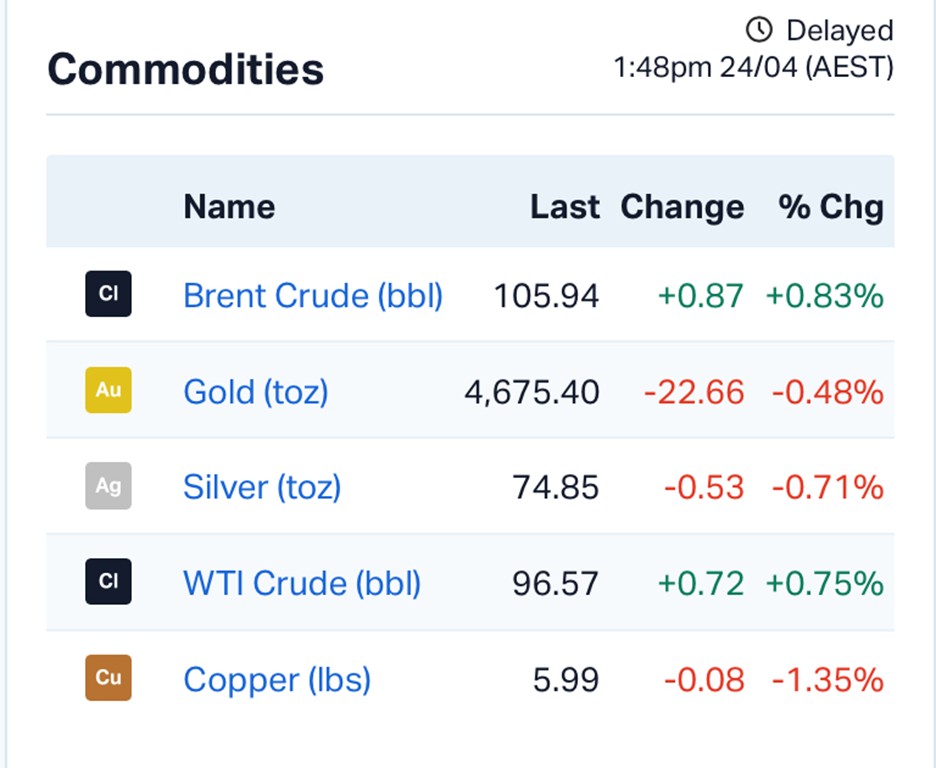
Commodities Price Index
The broader commodity picture remains mixed, but energy continues to dominate the narrative.
The Bigger Picture
The current market dynamic highlights a familiar pattern in times of uncertainty, where rising energy prices act as both a signal and a catalyst. They signal geopolitical stress while simultaneously reshaping capital flows across sectors. What is unfolding is not a broad-based sell-off, but a selective rotation, where investors are prioritising stability, cash flow, and pricing power over long-duration growth stories. In this environment, companies that can navigate cost pressures while maintaining earnings visibility are likely to stand out, while those reliant on future expectations face increasing scrutiny as global conditions remain fluid.
What is your take on this story?
This is user sentiment & not financial advice.
Disclaimer - Skrill Network is designed solely for educational and informational use. The content on this website should not be considered as investment advice or a directive. Before making any investment choices, it is crucial to carry out your own research, taking into account your individual investment objectives and personal situation. If you're considering investment decisions influenced by the information on this website, you should either seek independent financial counsel from a qualified expert or independently verify and research the information.