
🇺🇸 USA







The ASX 200 is trading slightly lower on Monday, giving up early gains as renewed tensions in the Middle East overshadow the optimism that drove Wall Street to record highs at the end of last week.
Over the weekend, hopes of de-escalation faded after the Strait of Hormuz was re-closed and the United States seized an Iranian cargo ship, reigniting concerns about global energy supply routes.
The benchmark index is hovering at 8,939.3, down 0.08%, after falling as much as 0.5% in early trade. The broader All Ordinaries is also marginally lower, slipping 0.05%.
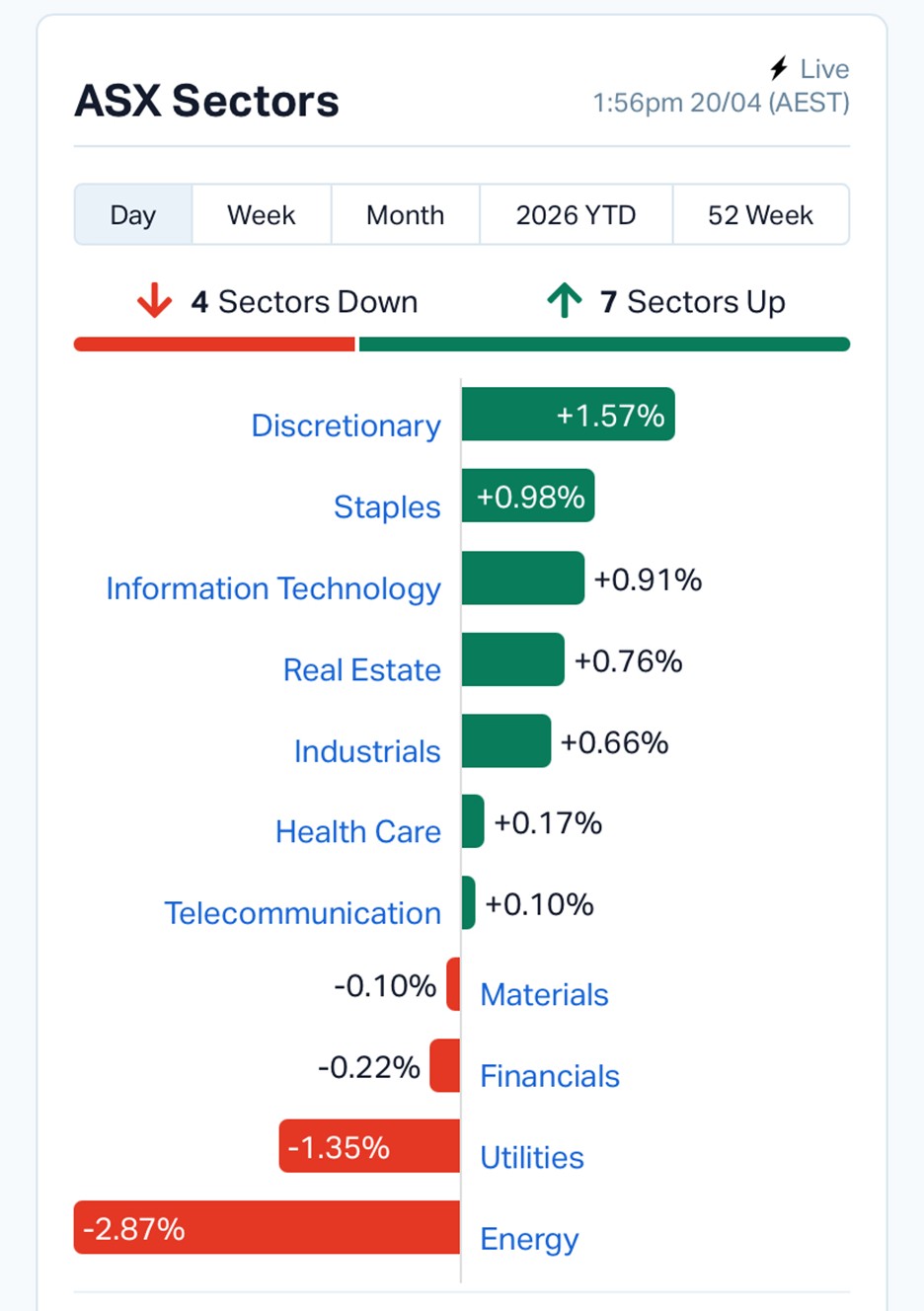
Sector Snapshot | Source: MarketIndex
Despite the headlines, market volatility remains subdued, with the VIX sitting at 13.2, suggesting investors are not yet pricing in a sustained risk-off environment.
The shift in sentiment is stark.
On Friday, US markets surged on hopes of easing geopolitical tensions, with the S&P 500 rising 1.2% to a record high, while the Nasdaq gained 1.52% and the Dow Jones climbed 1.79%.
Oil prices had dropped sharply, falling between 9% and 11% on expectations of improved supply conditions.
By Monday morning, that narrative had reversed. Oil rebounded between 5% and 8%, reflecting renewed uncertainty around one of the world’s most critical shipping routes.
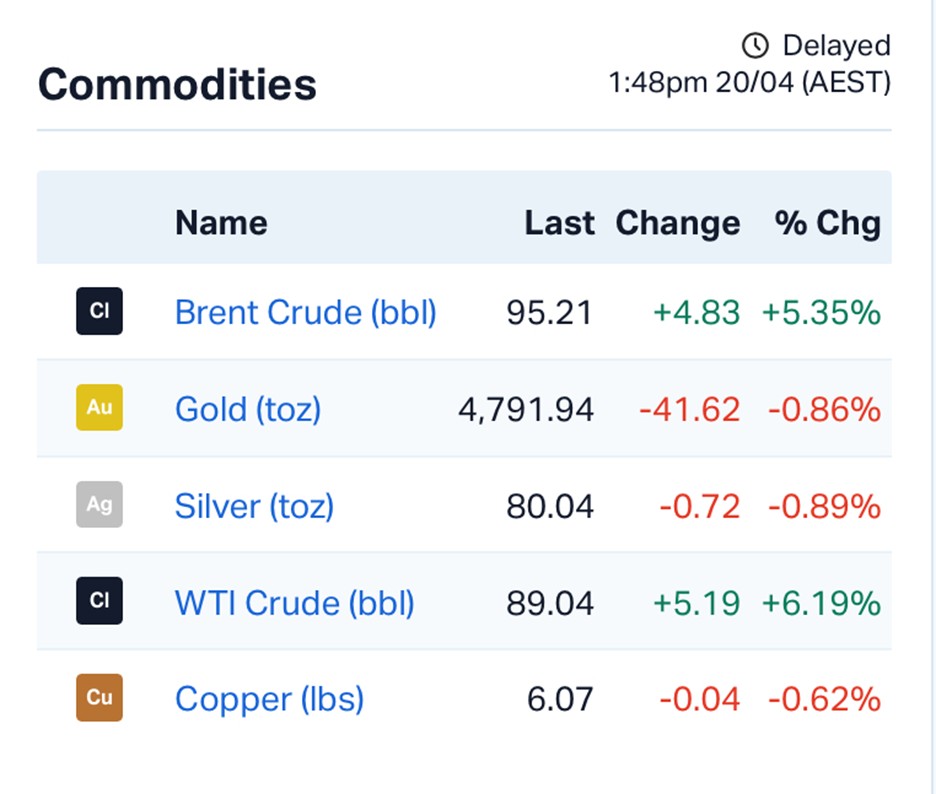
Commodities | Source: MarketIndex
For Australian markets, the lag meant absorbing Friday’s optimism and Monday’s reality at the same time, creating a sense of whiplash across sectors.
The financial sector was among the hardest hit, falling 1.29% after National Australia Bank warned of a sharp increase in credit impairments.
NAB revealed it had raised provisions by $706 million, citing market volatility and potential stress in sectors exposed to fuel costs and global disruptions.
The update sent its shares down 3.48% to $41.07, dragging the broader banking sector lower.
NAB Chief Economist Sally Auld pointed to shifting monetary expectations, noting, “Pricing for a May hike from the RBA edged higher… RBA officials delivered comments which appeared to have a hawkish lean.”
Those comments followed appearances by Reserve Bank officials in Washington, where policymakers signalled concern about inflation risks tied to energy shocks.
RBA Deputy Governor Andrew Hauser reinforced that stance, saying, “You can’t do that so far that you actually let inflation expectations get out of control.”
The message is clear. If energy prices remain elevated, interest rates may stay higher for longer, adding pressure to borrowers and banks alike.
In a market defined by contradictions, Viva Energy stood out.
The company reported that refining margins had nearly trebled, rising from US$7.9 to US$22 per barrel in the March quarter, a significant tailwind for earnings.
Yet its shares fell 5.34% to $2.395.
The reason lies in operations rather than pricing.
A fire at its Geelong refinery has forced a 60% reduction in petrol refining capacity, limiting its ability to capitalise on stronger margins.
In a company statement, Viva said, “Refining margins have almost trebled in the three months to March 31… but capacity is cut to 60% after surveying the damage of last week’s blaze.”
The situation highlights a recurring theme in energy markets. Strong prices do not always translate into profits if production is disrupted.
The broader energy sector dropped 2.66%, despite higher oil prices.
Companies such as Worley and Qube added to the pressure after flagging earnings impacts tied to Middle East disruptions.
Worley expects a $30 million to $40 million hit to underlying earnings due to project delays, while Qube downgraded profit by $10 million to $20 million as fuel costs and shipping disruptions weigh on operations.
This divergence reflects a more complex reality.
Higher oil prices can boost producers, but they also raise costs for transport, logistics, and infrastructure companies, creating uneven outcomes across the sector.
As risk sentiment softened, gold stocks moved higher, with the sector gaining 1.71%.
The move aligns with historical patterns.
During periods of geopolitical uncertainty, investors often turn to gold as a store of value, particularly when energy markets are volatile and inflation risks rise.
This trend has played out repeatedly, from the Gulf War to more recent supply disruptions, reinforcing gold’s role as a defensive asset.
Among individual movers, Energy Resources of Australia surged 14.29%, continuing its volatile run, while SKS Technologies climbed 12.88% on strong momentum in infrastructure technology.
Zip Co also gained 9.87%, reflecting resilience in consumer-facing tech names.
On the downside, Monash IVF dropped 7.84%, while Paladin Energy fell 4.95% as part of the broader energy sell-off.
The day’s trading captures a market caught between conflicting forces.
On one side is the optimism of global growth and strong US equity performance. On the other is the reality of geopolitical instability, rising energy costs, and tightening monetary policy.
Australian companies are increasingly reflecting that tension, with profit warnings and operational disruptions emerging alongside pockets of strength.
Periods of geopolitical uncertainty often create uneven market conditions, where sectors move in different directions and company-specific factors become more important than broad trends.
What stands out is the growing importance of resilience.
Companies that can manage costs, maintain operations, and adapt to shifting conditions are likely to outperform, while those exposed to external shocks may continue to face pressure.
In that sense, Monday’s session is less about a single event and more about a changing environment, one where stability is no longer assumed, and adaptability is becoming the defining edge.
Disclaimer - Skrill Network is designed solely for educational and informational use. The content on this website should not be considered as investment advice or a directive. Before making any investment choices, it is crucial to carry out your own research, taking into account your individual investment objectives and personal situation. If you're considering investment decisions influenced by the information on this website, you should either seek independent financial counsel from a qualified expert or independently verify and research the information.
Tags:
RECENT POSTS
TAGS
Subscribe to the Skrill Network Newsletter today and stay informed
Recommended Articles
