
🇺🇸 USA







The Australian share market suffered one of its sharpest selloffs of the year on Monday as a sudden surge in oil prices and worsening geopolitical tensions rattled global investors.
By early afternoon trading, the S&P/ASX 200 had fallen 3.94 percent to 8,502.5, wiping an estimated $120 billion from the value of Australian equities. The broader All Ordinaries Index dropped nearly the same amount, while the ASX All Technology Index slid more than 4 percent.
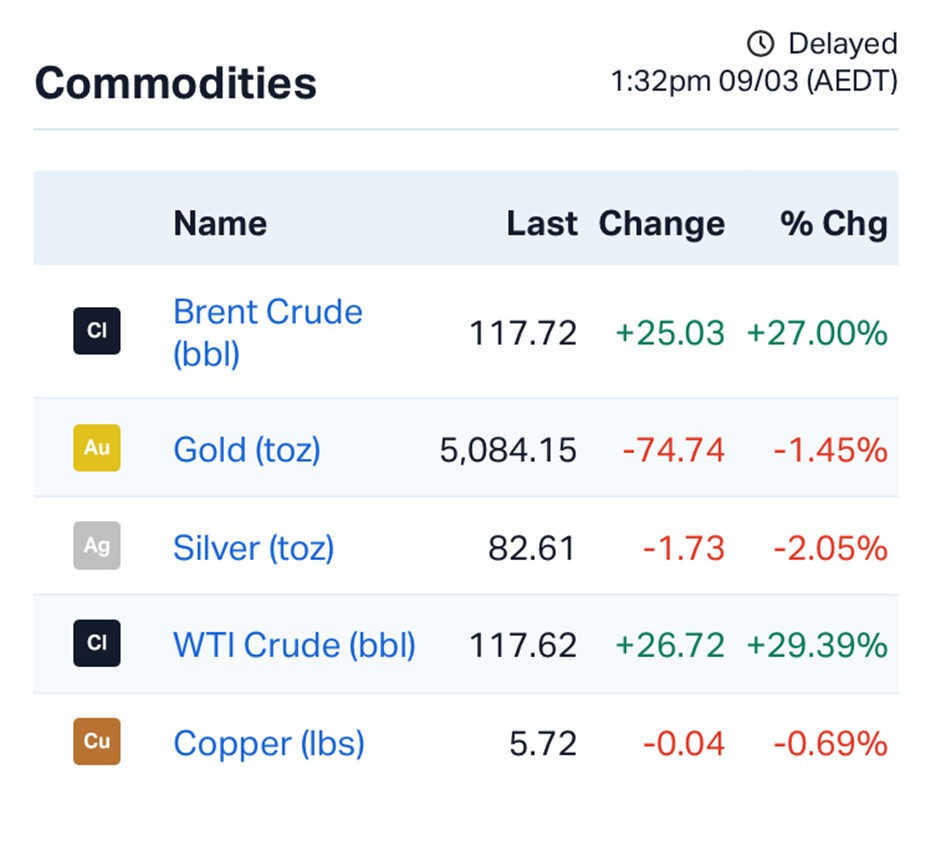
The catalyst was an extraordinary surge in global oil prices. Brent crude jumped to around $117 per barrel, up roughly 27 percent, as markets grappled with the risk that conflict in the Middle East could disrupt global energy supplies.
For traders, the message was clear. This was not simply another volatile trading day. It looked increasingly like the early stages of an economic scenario markets fear most: stagflation, where high inflation collides with slowing growth.
Energy prices have become the dominant force shaping markets in early 2026.
Source: MarketIndex
The latest spike followed fears that supply through the Strait of Hormuz could be disrupted. Nearly 20 percent of the world’s oil shipments pass through this narrow waterway between the Persian Gulf and the Gulf of Oman.
When supply concerns emerge in this region, oil markets tend to react quickly. The last comparable shock occurred during the early stages of the 1973 Oil Crisis, when geopolitical tensions triggered price spikes that helped ignite global inflation.
Today’s situation is different in many ways. But the immediate economic impact can feel familiar. Rising fuel costs feed into almost every sector of the economy, from transport to manufacturing to household spending.
In Sydney, petrol prices have already climbed to about $2.23 per litre, according to retail fuel trackers.
Economists often describe this type of surge as a “stealth tax” on consumers because it reduces spending power without any change to official taxation.
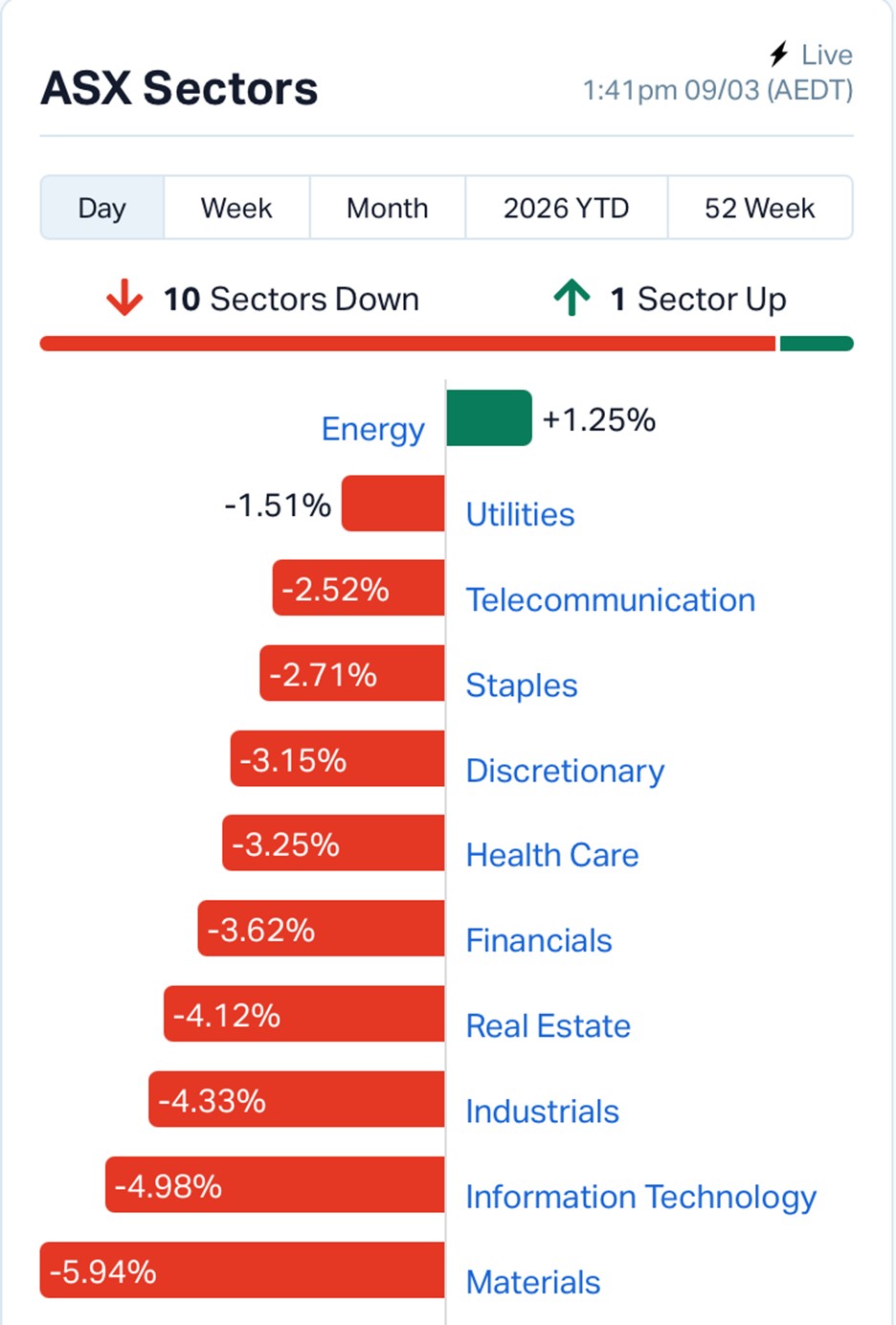
Almost every sector of the market trading deep in the red.
Source: MarketIndex
Ten out of eleven industry groups on the ASX declined, with the materials sector falling nearly 6 percent and the technology sector down almost 6 percent. Financial stocks also took heavy losses as concerns about economic growth mounted.
Bank stocks dropped sharply, dragging the S&P/ASX 200 Banks Index down more than 3.6 percent.
Mining giants including BHP Group and Rio Tinto also declined between 4 and 5 percent as traders worried that soaring energy costs could weaken global industrial demand.
Travel and consumer facing companies suffered another wave of selling. Airlines were particularly vulnerable because fuel is one of their largest operating costs.
Shares in Qantas Airways fell more than 5 percent, reflecting the combined pressure of rising jet fuel prices and weakening consumer sentiment.
Amid the sea of red numbers, one sector stood out.
Energy stocks climbed as higher oil prices translated directly into stronger profit expectations.
Coal producer Yancoal Australia Ltd surged more than 10 percent to $6.98, making it one of the strongest performers on the market.
Oil and gas producer Karoon Energy Ltd jumped almost 9 percent to about $1.98, helped by its offshore Brazilian production assets.
Meanwhile, major LNG player Santos Ltd rose nearly 3 percent, benefiting directly from higher crude prices.
These gains highlight a classic pattern during energy shocks. While most industries struggle with higher input costs, companies producing energy often see their margins expand.
The weakness on the ASX followed a difficult session on Wall Street late last week.
The S&P 500 fell about 1.33 percent, while the Nasdaq Composite dropped 1.59 percent.
Markets were rattled by a disappointing US labour report showing the American economy lost 92,000 jobs in February, pushing unemployment up to 4.4 percent.
Normally, weaker economic data raises hopes that central banks will cut interest rates to stimulate growth.
But with oil prices soaring, that option becomes far more complicated.
If central banks cut rates while inflation is accelerating, it risks pushing prices even higher.
That policy dilemma is exactly what defines stagflation.
For Australia’s central bank, the situation presents a complex balancing act.
The Reserve Bank of Australia had been expected to consider interest rate cuts later this year as economic growth slowed.
But the sharp rise in oil prices could delay that timeline.
Higher energy costs push up inflation, which central banks usually try to control by keeping interest rates elevated.
If that happens, businesses and households may face a longer period of higher borrowing costs.
For now, the central issue is not simply the level of oil prices but how long they remain elevated.
If geopolitical tensions ease quickly, markets could recover just as rapidly.
But if the supply disruption persists, economists warn that the world could be entering a new phase of energy driven inflation similar to past commodity shocks.
In that scenario, the sharp selloff seen across the ASX on Monday might only be the first chapter in a much larger economic story.
Source: ASX market data, global commodity prices and international market updates, March 9, 2026.
Disclaimer - Skrill Network is designed solely for educational and informational use. The content on this website should not be considered as investment advice or a directive. Before making any investment choices, it is crucial to carry out your own research, taking into account your individual investment objectives and personal situation. If you're considering investment decisions influenced by the information on this website, you should either seek independent financial counsel from a qualified expert or independently verify and research the information.
Tags:
RECENT POSTS
TAGS
Subscribe to the Skrill Network Newsletter today and stay informed
Recommended Articles
