

ASX Wrap: ASX 200 (^XJO) Drops as Trump Iran Threat Triggers $94 Oil Shock

Team Skrill Network
Team Skrill Network comprises seasoned professionals from diverse fields including Finance, Mining, Technology, Investing, and Digital Strategy. They bring a deep knowledge and understanding of financial markets and behavioural patterns to every story, ensuring credibility and precision in every piece. Whether analysing emerging market trends or spotlighting small- and mid-cap growth companies across ASX, TSX, or NASDAQ, the team’s editorial approach blends data-driven insights with compelling storytelling. Their expertise enables them to process complex developments into content that resonates with both institutional investors and retail audiences. Backed by experience in content curation, SEO strategy, and investor-focused messaging, the team of writers at Skrill Network are committed to delivering stories that matter—authentic, relevant, and strategically aligned with the evolving landscape of global investing.
Read more
Key Highlights
• ASX 200 falls 0.34% as escalating US-Iran tensions rattle global markets
• Brent crude oil surges above US$94 a barrel amid fears over Strait of Hormuz disruptions
• Energy and healthcare stocks outperform while technology and financials retreat
Market Snapshot
• Wall Street weakness spills into local trade, with the Nasdaq down nearly 2% overnight
• Geopolitical uncertainty overshadows softer-than-expected US inflation data
The Australian share market moved lower on Thursday as geopolitical tensions in the Middle East overshadowed encouraging inflation data from the United States.
By midday, the S&P/ASX 200 (^XJO) was down 0.34% to 8,623.5 points, after opening sharply lower and briefly touching 8,563 points. The broader All Ordinaries (^XAO) slipped 0.39% to 8,822.4 points, while the ASX All Technology Index (^XTX) fell 0.86% to 2,939.2 points.
The latest decline extends a difficult stretch for Australian equities, with the ASX 200 now down 1.4% over the past five trading sessions and 1.7% lower year-to-date.
Oil shock fears return to centre stage
Markets spent much of the past month hoping tensions between Washington and Tehran would gradually ease.
Those hopes were shaken overnight.
Investors reacted to reports that US President Donald Trump had authorised military strikes on Iranian assets after negotiations reportedly stalled. Iran responded with drone and missile activity targeting US naval interests before announcing the closure of the strategically critical Strait of Hormuz.
The Strait handles roughly a fifth of global oil shipments, making it one of the world’s most important energy chokepoints.
Oil traders responded immediately.
Brent crude surged above US$94.48 per barrel, while WTI crude climbed to US$91.72, fuelling concerns that a prolonged conflict could trigger a fresh inflation shock across major economies.
The move helped lift energy stocks but weighed heavily on broader market sentiment.
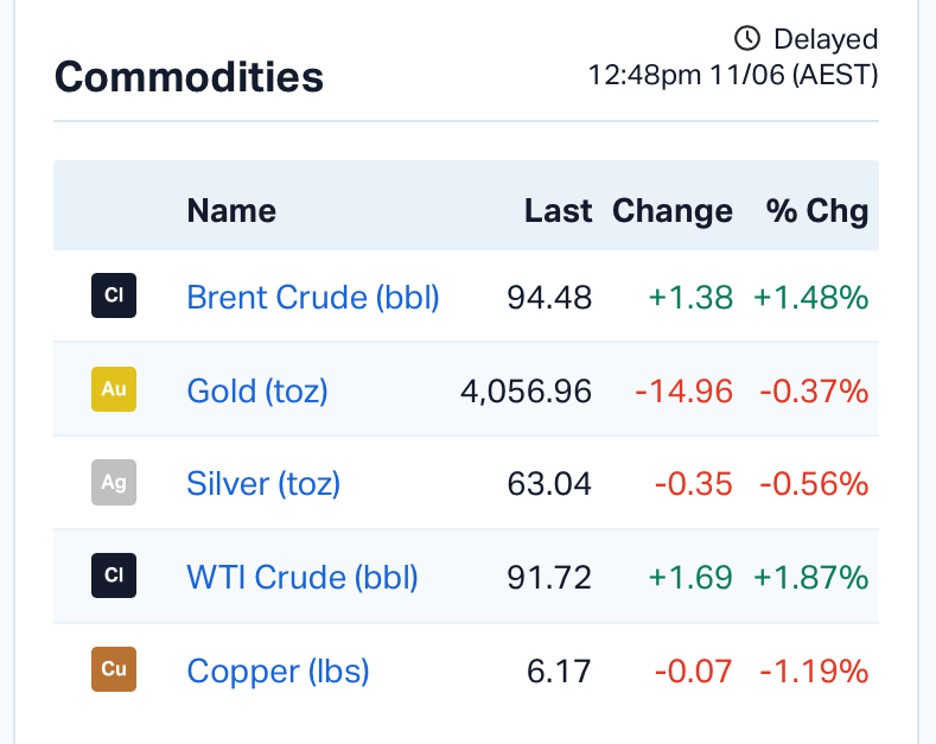
Commodities Price Index | Source: MarketIndex
Energy rises while technology retreats
The market split into two distinct camps.
Companies linked to energy production and defensive sectors attracted buyers, while growth-focused sectors faced renewed selling pressure.
Leading Sectors | Performance |
Energy | +1.42% |
Health Care | +1.14% |
Consumer Staples | +0.55% |
Lagging Sectors | Performance |
Information Technology | -1.29% |
Financials | -0.96% |
Materials | -0.55% |
Technology stocks were particularly vulnerable after another difficult session on Wall Street. Higher oil prices raise concerns about inflation remaining elevated, potentially delaying future interest rate cuts and reducing appetite for higher-growth companies.
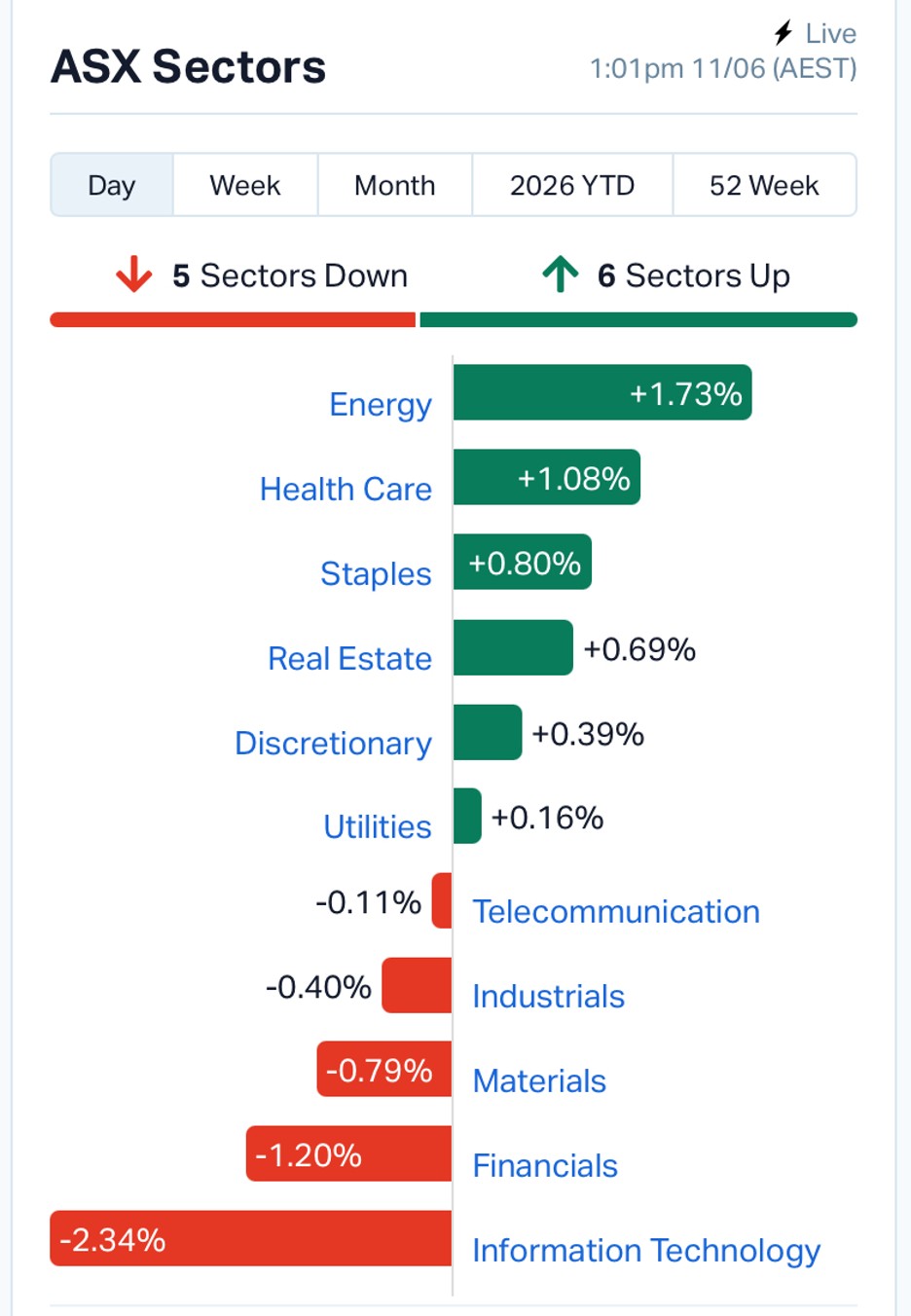
ASX Sector Snapshot | Source: MarketIndex
Winners and losers
Among the stronger performers, Karoon Energy (ASX: KAR) rose 4.34% to $2.045, benefiting directly from the jump in oil prices.
QBE Insurance (ASX: QBE) climbed 4.55% to $24.485 after announcing the appointment of independent non-executive director Christopher Harris.
Healthcare giant CSL (ASX: CSL) also provided support to the benchmark index, gaining 4.17% to $107.24.
On the downside, Alcoa Corporation (ASX: AAI) fell 7.77% to $94.48 as industrial metals weakened alongside a stronger US dollar.
Southern Cross Media (ASX: SXL) lost 5.09% to $0.56 after issuing a disappointing operational update that included significant job cuts and lower revenue guidance.
Corporate Australia faces mounting pressure
Away from geopolitics, several domestic stories highlighted the challenges facing Australian businesses.
Stay ahead of the market
The most important stories, delivered to your inbox. No noise, just what matters.
By subscribing, you agree to our Privacy Policy.
Southern Cross Media confirmed plans to remove between 250 and 300 positions before the end of June, citing weaker advertising conditions following its acquisition of Seven Network assets.
Chief Executive Officer Rohan Lund said:
“We must reset our cost base to meet current market conditions and capture the full benefits of scale across our trusted platforms. Every one of our businesses is outperforming in their markets, but we need to be honest with ourselves that those markets are under immense pressure. We are navigating a demanding market, with a tightening advertising sector.”
Meanwhile, JB Hi-Fi agreed to compensate customers after the ACCC raised concerns regarding promotional pricing practices.
In the banking sector, Commonwealth Bank shareholders launched a High Court action alleging the lender failed to disclose a potential $700 million regulatory penalty in a timely manner.
Global markets struggle to find footing
The ASX decline mirrored weakness across global markets.
Overnight, the Dow Jones fell 953 points or 1.87%, while the Nasdaq dropped 1.98% and the S&P 500 lost 1.62%.
European markets also struggled, with Germany’s DAX falling 1%, although London’s FTSE managed a modest gain.
Westpac economist Luka Belobrajdic noted that geopolitical developments quickly overwhelmed positive inflation data.
“Markets declined despite a softer than expected US core CPI print in May, as geopolitical tensions dominated after President Trump pledged to attack Iran.”
For now, investors appear less focused on inflation and more concerned about what happens next in the Middle East.
If oil prices remain elevated and tensions continue to escalate, energy markets could become the dominant force shaping global investment sentiment through the second half of 2026.
What is your take on this story?
This is user sentiment & not financial advice.
Disclaimer - Skrill Network is designed solely for educational and informational use. The content on this website should not be considered as investment advice or a directive. Before making any investment choices, it is crucial to carry out your own research, taking into account your individual investment objectives and personal situation. If you're considering investment decisions influenced by the information on this website, you should either seek independent financial counsel from a qualified expert or independently verify and research the information.
%2520Up%2520676%2525%2520in%252012%2520Months%2520Forrest%2520Stake%2520Trade%2520Sparks%252065M%2520Share%2520Buying%2520Frenzy.png&w=3840&q=75)