

ASX Wrap: Oil Surges, Tech Rallies, Cochlear Collapse Deepens Amid Market Sell-Off

Team Skrill Network
Team Skrill Network comprises seasoned professionals from diverse fields including Finance, Mining, Technology, Investing, and Digital Strategy. They bring a deep knowledge and understanding of financial markets and behavioural patterns to every story, ensuring credibility and precision in every piece. Whether analysing emerging market trends or spotlighting small- and mid-cap growth companies across ASX, TSX, or NASDAQ, the team’s editorial approach blends data-driven insights with compelling storytelling. Their expertise enables them to process complex developments into content that resonates with both institutional investors and retail audiences. Backed by experience in content curation, SEO strategy, and investor-focused messaging, the team of writers at Skrill Network are committed to delivering stories that matter—authentic, relevant, and strategically aligned with the evolving landscape of global investing.
Read more
Key Highlights:
- ASX 200 falls 0.85% as broad-based selling grips the market
- Cochlear extends losses, down over 70% from peak levels
- Oil climbs above $US103, lifting energy stocks
- Tech shows resilience despite global uncertainty
- Microsoft’s $25B AI investment boosts long-term outlook
The ASX 200 is trading lower on Thursday, as rising oil prices and lingering geopolitical risks weigh on sentiment.
Overnight, Wall Street pushed higher on strong technology gains, with the Nasdaq rising 1.64% and the S&P 500 up 1.05%.
Brent crude has surged past $US103 a barrel, adding to inflation concerns and reinforcing volatility across global markets.
Market Snapshot
Market under pressure as losses widen
By early afternoon, the S&P/ASX 200 had slipped 0.85% to 8,768.5 points, while the All Ordinaries declined 0.79% to 9,002.8.
The sell-off was broad, with 10 of 11 sectors trading lower.
Energy stocks stood out as the only pocket of strength, rising 2.64% as higher oil prices boosted margins for producers.
The Australian dollar hovered around 71.5 US cents, reflecting cautious positioning among global investors.
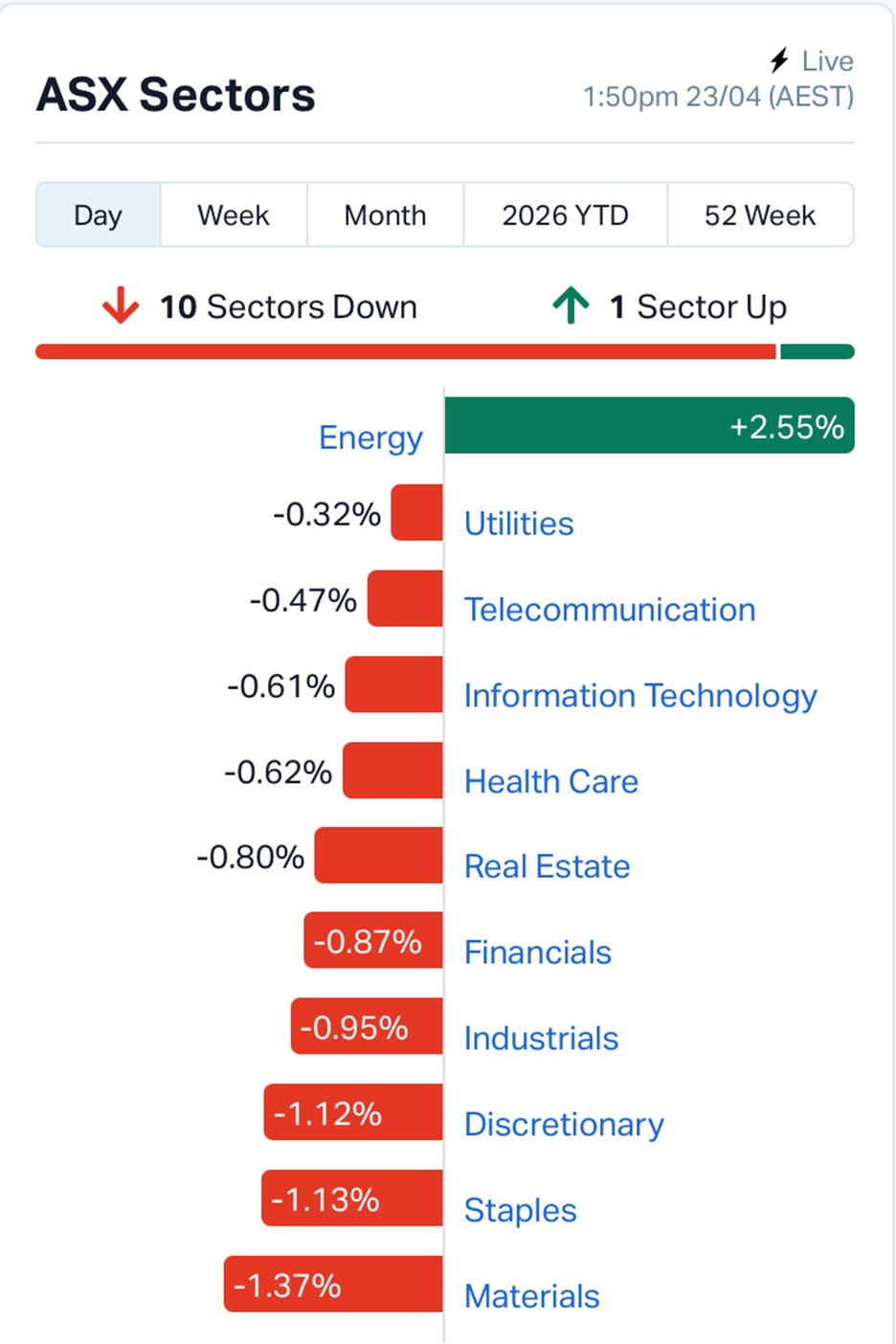
ASX Sector Snapshot
Cochlear’s slide deepens
The most striking move came from Cochlear Limited, which extended its sharp decline following a major downgrade to its 2026 outlook.
Shares are now trading near $94.80, marking a dramatic fall of more than 64% from their 2025 highs.
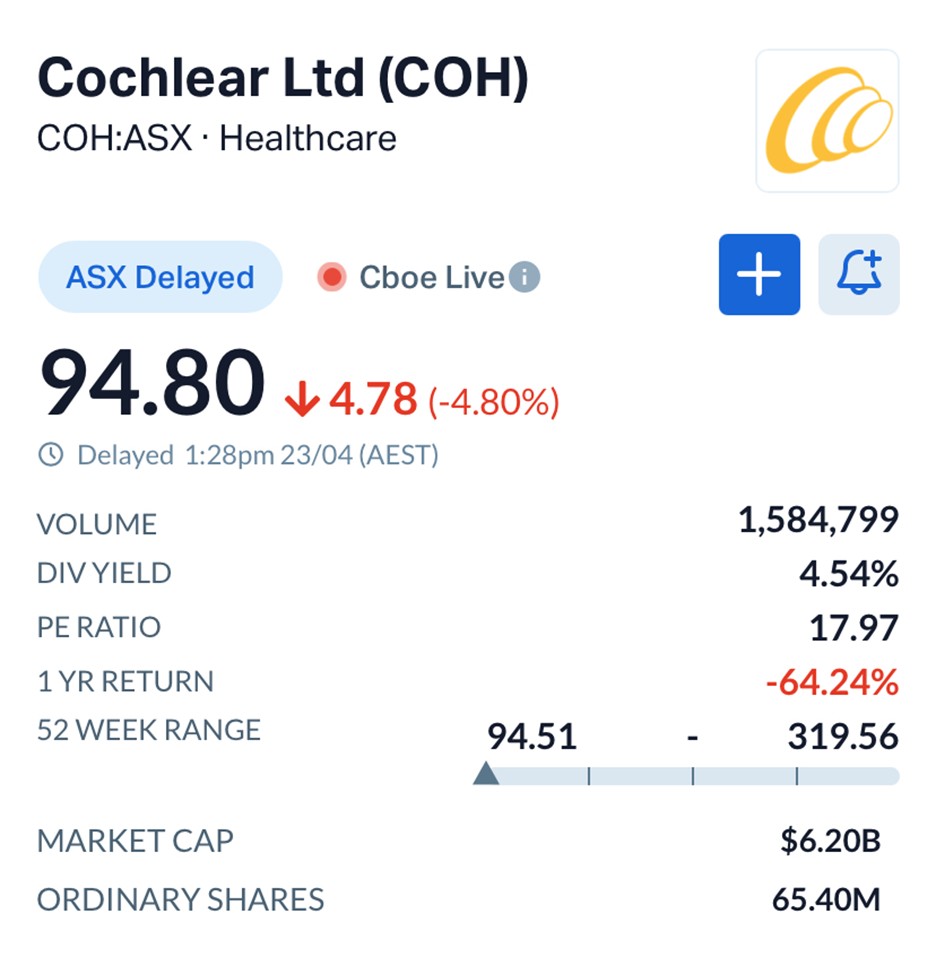
COH Share Price Chart | Source: MarketIndex
The speed and scale of the decline have caught market attention.
Henry Jennings from Marcus Today described the move as “like a slasher movie,” highlighting how broker targets have rapidly reset from around $300 to below $100.
Michael McCarthy from MooMoo noted the company is now in “dire straits,” as concerns build around competition and geopolitical exposure.
The episode serves as a reminder that even long-standing market favourites can reprice quickly when growth expectations shift.
Oil strength lifts energy sector
While much of the market struggled, energy stocks moved higher, supported by a sharp rise in crude prices.
Brent crude climbed to $US103.84 per barrel, while WTI crude rose above $US95.
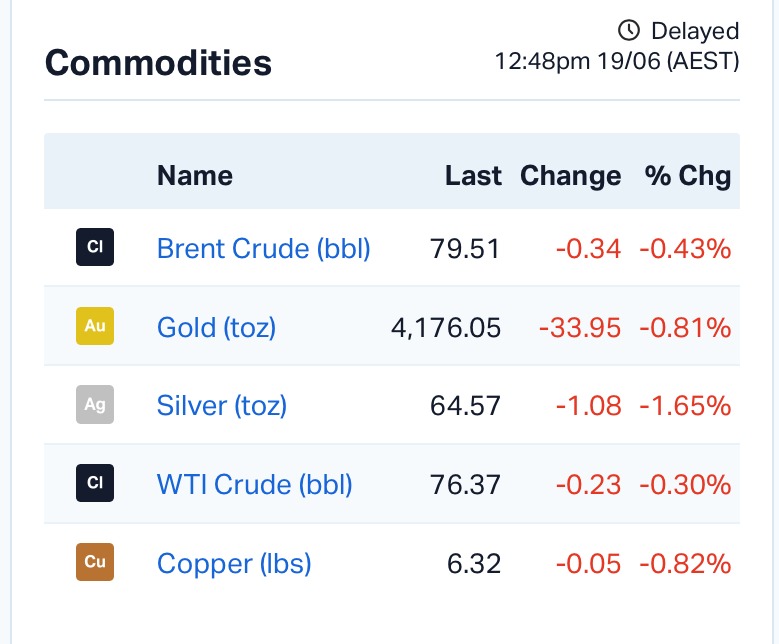
Commodities Price Index
Companies such as Santos Limited gained around 2.35%, benefiting from improved pricing dynamics.
Mid-cap players also rallied, with Omega Oil & Gas leading gains, up nearly 13%.
The move reflects a familiar pattern.
When oil prices rise, energy producers often outperform, even as broader markets weaken due to inflation concerns.
Tech resilience offers a counterbalance
Despite the broader decline, technology stocks showed relative resilience.
The ASX All Technology Index eased only slightly, down 0.30%, outperforming most sectors.
This stability comes as global tech sentiment remains supported by continued investment in artificial intelligence.
A key development came from Microsoft, with CEO Satya Nadella announcing a $25 billion investment in Australian AI infrastructure.
The scale of the commitment underscores the growing importance of digital infrastructure in driving future productivity.
For the ASX tech sector, this signals longer-term opportunity, even as short-term volatility persists.
Stay ahead of the market
The most important stories, delivered to your inbox. No noise, just what matters.
By subscribing, you agree to our Privacy Policy.
Winners and laggards
Among the session’s strongest performers were:
- Omega Oil & Gas, up 12.79%
- Regis Healthcare, gaining 12.42%
- Bannerman Energy, rising 10.47%
On the downside:
- Black Cat Syndicate fell 9.09%
- Core Lithium dropped 8.11%
- Lynas Rare Earths declined 5.61%
The divergence highlights a market increasingly driven by sector-specific catalysts rather than broad momentum.
Macro pressures remain in focus
Beyond individual stocks, several macro trends continue to shape sentiment.
Oil’s rise above $US100 is adding to inflation concerns, particularly as supply disruptions in key shipping routes persist.
At the same time, Australia’s productivity growth remains under scrutiny, having slowed significantly over the past two decades.
The combination of rising costs and subdued productivity creates a challenging backdrop for policymakers.
In the housing market, rental growth is beginning to plateau as affordability constraints emerge, despite historically low vacancy rates.
Meanwhile, job advertisements dipped slightly in March, though wage growth remains elevated at 4.1% year-on-year.
Global divergence becomes clearer
One of the more striking themes is the growing gap between global and local markets.
While US equities continue to push higher on tech optimism, the ASX is facing pressure from domestic factors and sector-specific declines.
Laura Cooper from Nuveen noted that markets are “remarkably effective at looking through risks,” but warned that persistent pressures such as high oil prices and geopolitical tensions may eventually weigh more heavily on valuations.
The Bigger Picture
The day’s trading highlights a market caught between competing forces. Rising oil prices are supporting energy stocks but also reinforcing inflation risks, while technology continues to draw long-term capital despite short-term uncertainty. At the same time, the sharp repricing of Cochlear shows how quickly sentiment can shift when expectations are reset. In this environment, performance is becoming increasingly selective, with capital flowing toward sectors that offer either immediate pricing power or clear future growth. It reflects a broader trend where markets are no longer moving in unison, but instead fragmenting along structural themes that will likely define the next phase of the cycle.
What is your take on this story?
This is user sentiment & not financial advice.
Disclaimer - Skrill Network is designed solely for educational and informational use. The content on this website should not be considered as investment advice or a directive. Before making any investment choices, it is crucial to carry out your own research, taking into account your individual investment objectives and personal situation. If you're considering investment decisions influenced by the information on this website, you should either seek independent financial counsel from a qualified expert or independently verify and research the information.