

The Taps Are Turning: Australian Oil Co Sets First Revenue Milestone at Emu Apple

Key Highlights:
- First oil lifting scheduled for March 31, 2026 at Emu Apple field
- Around 800 barrels to be transported and refined into diesel
- Marks transition from explorer to revenue-generating producer
- Iodine anomalies point to potential larger hydrocarbon system
- Shares surge 75% as market reacts to first cashflow milestone
Australian Oil Co Sets Date for First Revenue Milestone
Micro-cap energy player Australian Oil Company Limited has confirmed it will achieve its first oil revenue within days, with an initial crude lifting scheduled for March 31 at its Emu Apple field in Queensland’s Surat Basin.
For a company trading at fractions of a cent, the development marks a turning point. It is the shift from exploration promise to actual cash flow.
From concept to cashflow
The company expects to transport approximately 800 barrels of crude oil under its agreement with IOR Energy.
That oil will be refined into products including diesel, feeding into Australia’s domestic energy market.
In isolation, 800 barrels is modest. Large producers like Woodside Energy Group Ltd operate at a scale thousands of times larger.
But scale is not the story here.
For Australian Oil Co, this is its first tangible revenue event, a critical step that many early-stage explorers never reach.
Managing Director Kane Marshall described the milestone in practical terms:
“The first lifting of oil from Emu Apple represents an initial production milestone for the Company within the Surat Basin. The lifting is undertaken under the existing production and sales arrangements and provides a reference point for current production levels.”
In simple terms, the company now has a baseline. It can measure, scale, and build.
Why this milestone matters
The ASX is filled with early-stage resource companies. Many spend years raising capital without generating revenue.
This is where Australian Oil Co’s update stands out.
The company is now transitioning from a cash-burning explorer to a revenue-generating producer.
That shift tends to change how the market values a business.
- Exploration companies are priced on potential
- Producers are priced on cash flow
Even small volumes can signal viability.
Historically, early production milestones have often acted as inflection points for micro-cap energy stocks, particularly when combined with exploration upside.
The bigger story beneath the surface
While the first oil lifting is the headline, the more intriguing development lies underground.
The company has identified iodine anomalies across its broader acreage in PL30.
That might sound technical, but the implication is simple.
Iodine can act as a geochemical tracer, often indicating the presence of hydrocarbons beneath the surface.
In this case, the anomalies are aligning with seismic data, suggesting the possibility of a larger oil system than previously mapped.
Key observations include:
- Iodine anomalies near the Annabelle structure, a high-risk, high-reward target
- Strong alignment between iodine signals and seismic amplitude features
- Potential extensions along the Boxvale sandstone formation
In exploration terms, this is often described as “stacking evidence.”
It does not guarantee discovery, but it improves the probability.
Surat Basin context
The Surat Basin is not new territory.
It is one of Australia’s established onshore energy regions, supplying both gas and liquids to the east coast market.
What makes it relevant today is supply pressure.
Australia continues to face tight domestic energy markets, particularly on the east coast, where demand for gas and refined products remains strong.
Small producers can play a meaningful role in this environment.
Even incremental supply can find a ready buyer.
Market reaction signals interest
The market has responded quickly.
Shares in Australian Oil Co surged 75% to $0.004, with trading volumes exceeding 12 million shares.
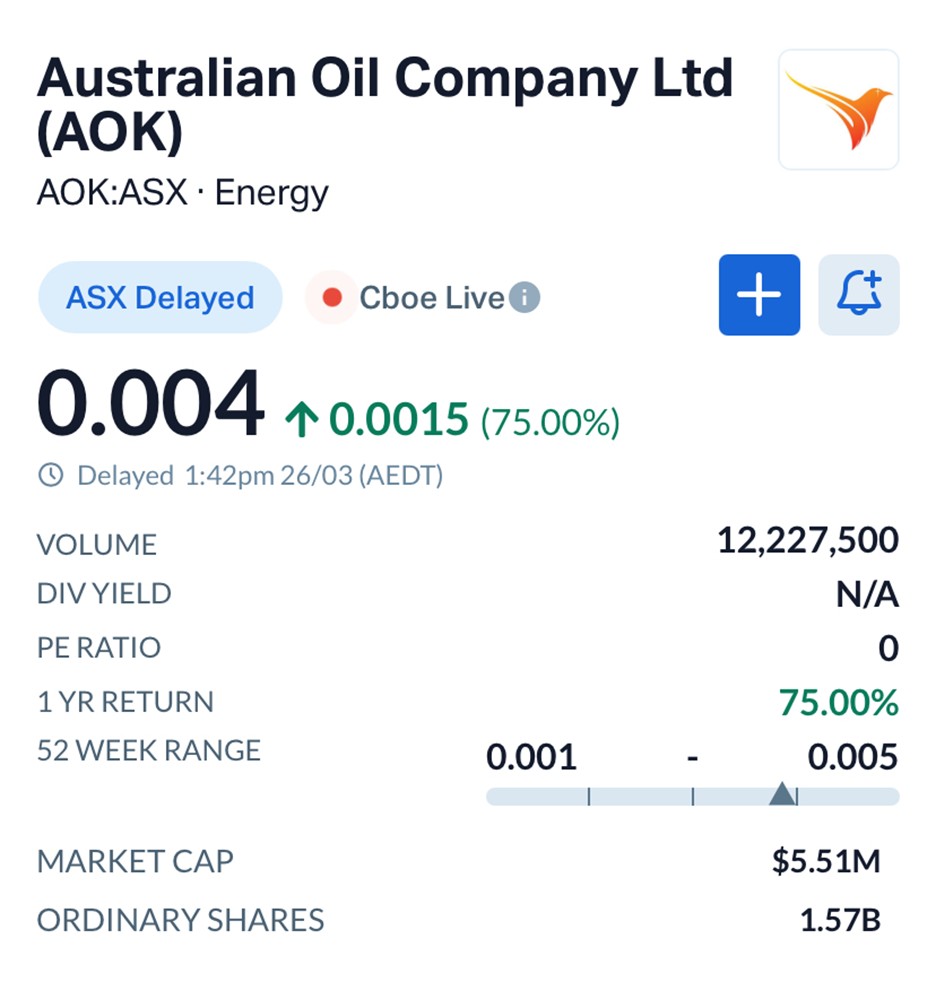
AOK Share Price Data | Source: MarketIndex
That kind of move reflects speculative interest, but also recognition of a key milestone.
Stay ahead of the market
The most important stories, delivered to your inbox. No noise, just what matters.
By subscribing, you agree to our Privacy Policy.
At a market capitalisation of just $5.5 million, the company remains firmly in micro-cap territory.
This means volatility is likely to remain high, but so is leverage to positive developments.
What comes next
The first oil lifting is not the end of the story. It is the beginning.
The company has outlined several near-term priorities:
- Identifying opportunities to increase production at Emu Apple
- Advancing exploration targets across PL264 and PL30
- Conducting further geophysical and geochemical analysis
- Assessing new venture opportunities in other basins
This suggests a broader strategy.
Rather than relying on a single asset, Australian Oil Co is positioning itself as a portfolio builder in the energy space.
A familiar micro-cap narrative
There is a pattern here that seasoned market watchers will recognise.
Early-stage resource companies often follow a three-step journey:
- Exploration and data gathering
- Initial production milestone
- Scaling operations and expanding assets
Australian Oil Co is now moving from stage one to stage two.
The key question is whether it can execute the next phase.
The bottom line
The upcoming oil lifting at Emu Apple may be small in scale, but it is significant in meaning.
It marks the moment Australian Oil Co begins generating revenue, shifting its identity from explorer to producer.
At the same time, early exploration signals suggest there may be more beneath the surface.
For now, the taps are just starting to turn.
What is your take on this story?
Disclaimer - Skrill Network is designed solely for educational and informational use. The content on this website should not be considered as investment advice or a directive. Before making any investment choices, it is crucial to carry out your own research, taking into account your individual investment objectives and personal situation. If you're considering investment decisions influenced by the information on this website, you should either seek independent financial counsel from a qualified expert or independently verify and research the information.