


Beyond the Cyclones: Woodside Energy (ASX: WDS) Eyes 2026 Growth as Scarborough Nears Completion

Team Skrill Network
Team Skrill Network comprises seasoned professionals from diverse fields including Finance, Mining, Technology, Investing, and Digital Strategy. They bring a deep knowledge and understanding of financial markets and behavioural patterns to every story, ensuring credibility and precision in every piece. Whether analysing emerging market trends or spotlighting small- and mid-cap growth companies across ASX, TSX, or NASDAQ, the team’s editorial approach blends data-driven insights with compelling storytelling. Their expertise enables them to process complex developments into content that resonates with both institutional investors and retail audiences. Backed by experience in content curation, SEO strategy, and investor-focused messaging, the team of writers at Skrill Network are committed to delivering stories that matter—authentic, relevant, and strategically aligned with the evolving landscape of global investing.
Read more
Key Highlights:
- Woodside production dips 8% due to cyclones, but revenue rises 7% to $3.26B
- Realised prices jump 11% to $63/boe amid global energy volatility
- Scarborough project reaches 96% completion, on track for Q4 2026 first cargo
- New CEO signals efficiency push and disciplined capital strategy
- Shares rise over 2%, extending strong one-year performance
Woodside Energy Group Ltd has delivered a steady, if weather-affected, start to 2026, with its latest quarterly update revealing a company balancing short-term disruption with long-term growth certainty.
Production slipped in the March quarter as cyclones swept across Western Australia, but stronger oil and gas prices helped cushion the impact and keep revenue moving higher.
Cyclones disrupt output, but pricing steps in
Woodside reported production of 45.2 million barrels of oil equivalent, down 8% from the previous quarter after Cyclones Mitchell and Narelle forced operational interruptions.
Market Snapshot
Average realised prices climbed 11% to US$63 per barrel of oil equivalent, supported by elevated global energy prices tied to ongoing geopolitical tensions.
That pricing strength lifted quarterly revenue 7% to US$3.26 billion, highlighting how commodity exposure continues to act as a natural hedge for energy producers.
Chief Executive Liz Westcott captured the dynamic succinctly, saying:
“We have seen modest increases to our portfolio average realised pricing in the quarter, driven by elevated spot prices. Further benefits of higher spot prices will be realised in subsequent quarters for LNG due to lagged contract pricing.”
Woodside has not yet fully felt the upside from recent LNG price spikes, suggesting earnings momentum could build into later quarters.
Operational resilience holds firm
Despite the weather disruption, Woodside’s core assets including Sangomar, Shenzi and Pluto LNG maintained near-perfect reliability levels of 99% to 100%.
In the energy sector, consistency often matters more than peak output. The ability to restart quickly and operate efficiently after disruptions underpins long-term cash flow stability.
The company also managed to keep sales volumes slightly higher, indicating effective inventory management and trading flexibility during the quarter.
Scarborough emerges as the defining catalyst
The real story sits beyond the quarterly numbers.
Woodside’s flagship Scarborough LNG project is now 96% complete, with first cargo still expected in the fourth quarter of 2026.
At this stage, execution risk is largely removed. The project is no longer about “if” but “when.”
Scarborough is widely viewed as the company’s next major cash flow engine, and its near-completion marks a transition from heavy capital spending to revenue generation.
Alongside Scarborough, Woodside continues to advance its broader pipeline:
- Trion project is 56% complete, targeting first oil in 2028
- Louisiana LNG is progressing, with Train 1 around one-third complete for a 2029 start
This layered project pipeline gives Woodside a multi-year growth runway, something many global peers currently lack.
A new CEO, and a subtle strategic shift
The March quarter also marks the early phase of leadership under CEO Liz Westcott, who stepped into the role following a high-profile transition.
Her early messaging suggests a focus on simplification and efficiency.
Market observers see this as a classic post-investment phase shift. After years of heavy spending on large-scale projects, the emphasis is now turning toward cost control, accountability and margin expansion.
That could mean tighter capital discipline and a closer look at operational efficiency across the portfolio.
Energy markets remain supportive
Woodside’s performance is unfolding against a backdrop of elevated global energy prices.
Oil and LNG markets have remained tight due to geopolitical tensions, particularly in the Middle East, pushing Brent crude above US$100 per barrel in recent months.
Analysts note that LNG producers like Woodside are benefiting from strong demand, especially across Asia and Europe.
Morningstar strategist Lochlan Halloway noted that returns across the LNG sector are becoming increasingly attractive, driven by supply constraints and sustained global demand.
However, the company’s exposure to long-term contracts means price benefits often flow through with a delay, smoothing earnings rather than creating sharp spikes.
Policy risks linger in the background
While operational performance remains solid, the policy environment is becoming more complex.
Recent discussions around potential taxes on new gas export projects have raised concerns within the sector.
Westcott has been vocal on the issue, warning that additional taxation could impact future project development and investment decisions.
Stay ahead of the market
The most important stories, delivered to your inbox. No noise, just what matters.
By subscribing, you agree to our Privacy Policy.
At the same time, Woodside continues to face scrutiny from environmental groups, particularly around its long-term gas projects and emissions profile.
These factors form part of the broader balancing act facing global energy companies today, between meeting demand and navigating regulatory and environmental expectations.
Market response reflects confidence
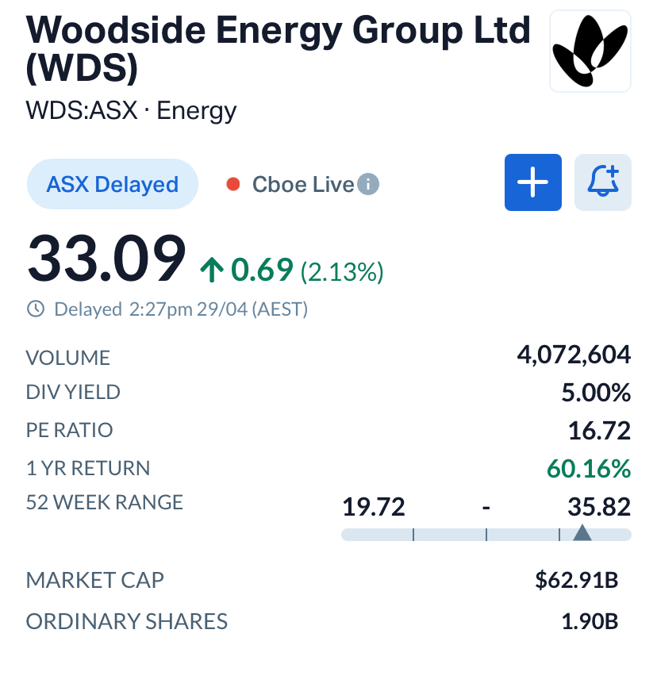
Woodside shares rose 2.18% to $33.10 in afternoon trade, extending a strong run that has seen the stock gain over 60% in the past year.
Source: MarketIndex
With a market capitalisation nearing $63 billion, the company remains one of the ASX’s largest and most influential energy players.
Its dividend yield of approximately 5% continues to attract income-focused investors, particularly in a volatile macro environment.
The Bigger Picture
Woodside’s latest update is not about headline growth. It is about execution.
Despite weather disruptions, the company has maintained operational reliability, captured higher prices, and kept its flagship projects firmly on track.
With Scarborough nearing completion, Woodside is entering a new phase where years of investment begin to translate into sustained cash flow.
In a sector often defined by delays and cost overruns, that consistency stands out.
The coming quarters will not just test production levels, but whether Woodside can convert its near-finished projects into long-term value in an energy market that remains both volatile and full of opportunity.
What is your take on this story?
This is user sentiment & not financial advice.
Disclaimer - Skrill Network is designed solely for educational and informational use. The content on this website should not be considered as investment advice or a directive. Before making any investment choices, it is crucial to carry out your own research, taking into account your individual investment objectives and personal situation. If you're considering investment decisions influenced by the information on this website, you should either seek independent financial counsel from a qualified expert or independently verify and research the information.