

Black Bear Minerals (ASX: BKB) Hits 501g/t Silver in Texas Expansion

Team Skrill Network
Team Skrill Network comprises seasoned professionals from diverse fields including Finance, Mining, Technology, Investing, and Digital Strategy. They bring a deep knowledge and understanding of financial markets and behavioural patterns to every story, ensuring credibility and precision in every piece. Whether analysing emerging market trends or spotlighting small- and mid-cap growth companies across ASX, TSX, or NASDAQ, the team’s editorial approach blends data-driven insights with compelling storytelling. Their expertise enables them to process complex developments into content that resonates with both institutional investors and retail audiences. Backed by experience in content curation, SEO strategy, and investor-focused messaging, the team of writers at Skrill Network are committed to delivering stories that matter—authentic, relevant, and strategically aligned with the evolving landscape of global investing.
Read more
Key Highlights:
- Black Bear hits 501g/t silver in drilling outside existing Shafter resource
- Step-out hole confirms mineralisation beyond 17.5Moz silver resource
- Drill intercept: 9.1m at 240g/t Ag including 1.5m at 501g/t Ag
- Polymetallic potential emerging with zinc, lead and gold credits
- Shares trading around $0.885 on March 6
High-grade silver has once again surfaced in the desert plains of Texas, offering fresh momentum for Black Bear Minerals and its Shafter Silver Project.
The company announced that recent drilling has intercepted strong silver mineralisation outside the project’s existing 17.5-million-ounce resource estimate, suggesting the system could extend further than previously mapped.
At the time of writing, Black Bear shares were trading at $0.885, up slightly on the day.
Market Snapshot
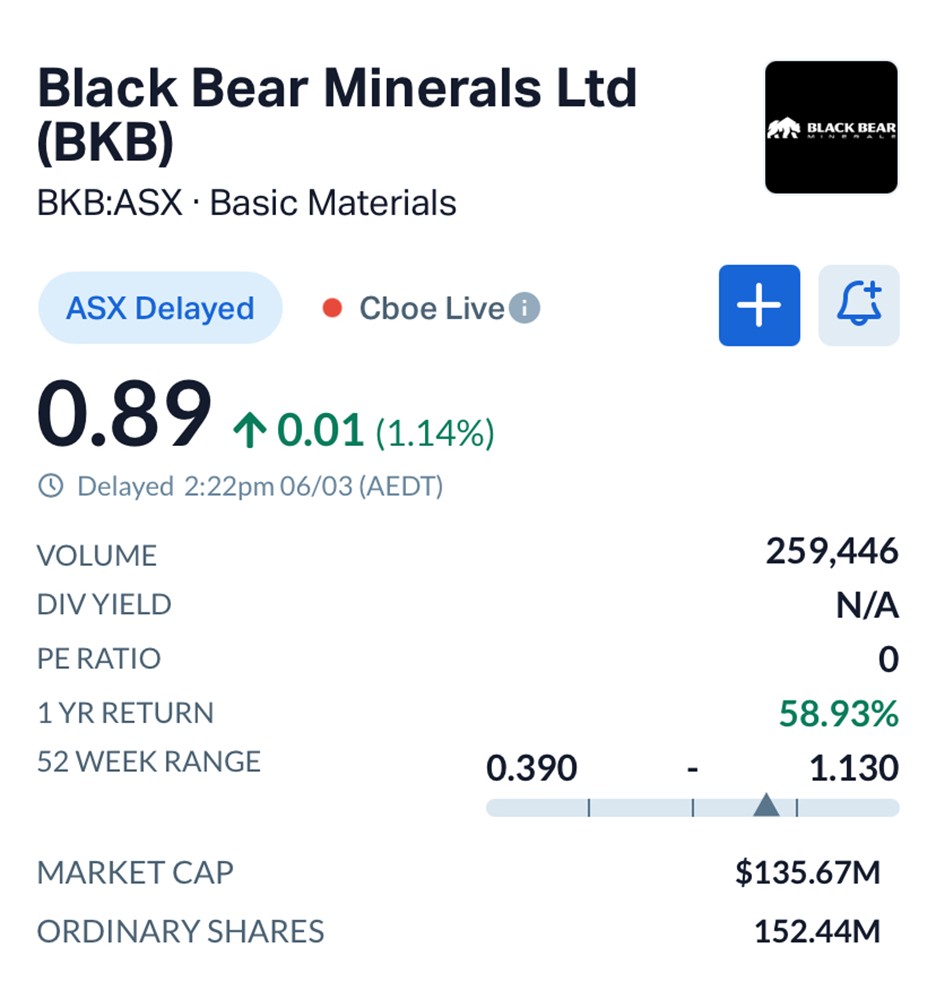
Source: MarketIndex
For explorers working in mature mining districts, discoveries outside established resources can be particularly significant. They hint that the mineral system may still hold untapped extensions that earlier operators overlooked.
A breakthrough drill hole
The headline result comes from drill hole SFD002, which targeted a structural corridor that had received limited testing from previous exploration campaigns.
The hole returned:
- 9.1 metres at 240 grams per tonne silver, from 214.3 metres
- Including 1.5 metres at 501g/t silver
- With 1.1 percent lead and 1.8 percent zinc
The intercept is both wider and higher grade than nearby historical drill holes.
Black Bear Chief Executive Officer Dennis Lindgren said the results support the company’s exploration strategy.
“Great first results highlight the pure silver resource growth potential at Shafter beyond the existing Foreign MRE with SFD002 returning 9.1m at 240g/t Ag, including 1.5m strike at 501g/t Ag, and is wider and higher grade than nearby historic drilling,” Lindgren said.
“At these grades, step-out success has the potential to materially increase the existing Foreign MRE and polymetallic potential, providing strong leverage to an already defined resource base.”
In practical terms, the drill hole suggests the mineralised zone may thicken and strengthen as exploration moves beyond the previously defined boundaries.
A historic silver district
The Shafter project sits in Presidio County in southwest Texas, an area with a long history of silver mining.
The nearby Presidio Mine, which operated between 1883 and 1942, produced more than 35 million ounces of silver at an average grade of 521 grams per tonne, according to historical records cited by the company.
The current discovery echoes those historic grades. The 501g/t intercept recorded in SFD002 sits close to the average grade mined during the district’s peak production years.
Geologically, Shafter lies along the Eastern Sierra Madre Belt, a prolific mineral corridor stretching from northern Mexico into the southern United States. The belt hosts several large silver deposits, including the Peñasquito Mine, one of the world’s largest silver producers operated by Newmont.
Understanding the “manto” style deposit
One reason exploration companies remain interested in Shafter is the type of mineralisation found there.
The deposit hosts manto-style carbonate replacement mineralisation. In simple terms, mineral-rich fluids moving through underground fault systems replace sections of limestone with metal-bearing minerals.
These deposits often form tabular sheets or layers that can extend laterally for long distances.
At Shafter, the mineralised zone already spans around 4 kilometres of strike length, following a structural corridor linked to the MacDaniel Fault and the Mina Grande Fault.
The new drill hole targeted a parallel structural corridor east of the main fault system, and the early results suggest the mineralisation continues along this trend.
A polymetallic twist
While the Shafter resource estimate currently counts only silver, the latest drilling is revealing a more complex mix of metals.
Alongside the silver intercept, the SFD002 hole also contained:
- 4.3 percent zinc
- 2.0 percent lead
- 0.2 grams per tonne gold
Elsewhere in the drilling program, hole SFD011 returned zinc grades as high as 11 percent.
This combination suggests Shafter could evolve from a single-commodity silver project into a broader polymetallic system.
Black Bear has begun re-logging historic drill core to identify the distribution of these additional metals. If confirmed, they could be incorporated into a future resource update.
The company is targeting a maiden JORC-compliant resource estimate in the second quarter of 2026.
Stay ahead of the market
The most important stories, delivered to your inbox. No noise, just what matters.
By subscribing, you agree to our Privacy Policy.
Silver’s changing role
The timing of the discovery also coincides with shifting dynamics in the silver market.
Traditionally viewed as a precious metal alongside gold, silver is increasingly valued for its industrial applications. It is widely used in solar panels, electronics, semiconductors and defence technologies due to its exceptional electrical conductivity.
According to industry data cited by the company, global mine supply has remained largely flat since 2016 while demand from renewable energy and electronics sectors continues to grow.
China’s recent restrictions on silver exports in October 2025 have further tightened supply, while the United States added silver to its critical minerals list in November 2025, highlighting its strategic importance.
For projects like Shafter, located in the United States, the shift could strengthen the case for domestic silver production.
Exploration continues
Black Bear says drilling will continue across several target zones within the project.
The current Phase 1 program is mapping the position of the mineralised Mina Grande Formation and identifying additional feeder faults that may host high-grade silver.
Future drilling will focus on testing these structural corridors and extending mineralisation beyond the current resource area.
The company ended December 2025 with $12.8 million in cash, providing funding for ongoing exploration at both the Shafter project and its Independence Gold Project in Nevada.
For now, the latest drilling suggests that a historic silver district in Texas may still have more stories to tell.
Source: Black Bear Minerals ASX announcement, March 6, 2026.
What is your take on this story?
This is user sentiment & not financial advice.
Disclaimer - Skrill Network is designed solely for educational and informational use. The content on this website should not be considered as investment advice or a directive. Before making any investment choices, it is crucial to carry out your own research, taking into account your individual investment objectives and personal situation. If you're considering investment decisions influenced by the information on this website, you should either seek independent financial counsel from a qualified expert or independently verify and research the information.