


BrainChip Eyes Q3 Production as Commercial Momentum Builds Across Defence and AI Edge Markets

Team Skrill Network
Team Skrill Network comprises seasoned professionals from diverse fields including Finance, Mining, Technology, Investing, and Digital Strategy. They bring a deep knowledge and understanding of financial markets and behavioural patterns to every story, ensuring credibility and precision in every piece. Whether analysing emerging market trends or spotlighting small- and mid-cap growth companies across ASX, TSX, or NASDAQ, the team’s editorial approach blends data-driven insights with compelling storytelling. Their expertise enables them to process complex developments into content that resonates with both institutional investors and retail audiences. Backed by experience in content curation, SEO strategy, and investor-focused messaging, the team of writers at Skrill Network are committed to delivering stories that matter—authentic, relevant, and strategically aligned with the evolving landscape of global investing.
Read more
Key Highlights:
- AKD1500 chip on track for Q3 2026 production with 70,000-unit rollout
- Customer receipts rise 75% quarter-on-quarter to US$0.7M
- Lockheed Martin subsidiary partnership validates defence-grade AI capability
- New global licensing deal with EDGEAI strengthens royalty model
- Cash runway extends to nearly 5 quarters despite higher outflows
BrainChip Holdings Ltd is edging closer to a defining moment in its commercial journey, with its first high-volume AI chip on track for production in the third quarter of 2026.
The company’s latest quarterly update shows a business transitioning from development to deployment, as early revenue signals begin to align with a growing pipeline of strategic partnerships.
From concept to commercial hardware
At the centre of BrainChip’s roadmap is the AKD1500 neuromorphic processor, its first production-scale chip designed for ultra-low power artificial intelligence at the edge.
Market Snapshot
The company confirmed that production remains on track for Q3 2026, with an initial batch of around 70,000 units scheduled for delivery starting in July.
This marks a significant shift.
Until now, BrainChip has largely operated as a technology developer and IP licensor. The move into physical chip production opens the door to direct product revenue alongside its existing royalty streams.
The AKD1500 is built for “always-on” AI applications, where devices process data locally without relying on cloud connectivity. This includes use cases across defence systems, industrial monitoring, robotics, and wearable health devices.
Early signs of commercial traction
Financially, the March quarter reflects early but tangible progress.
Customer receipts rose to US$0.7 million, up from US$0.4 million in the previous quarter, a 75% increase that suggests growing adoption of its technology.
At the same time, operating cash outflows widened to US$5.3 million, reflecting ongoing investment in product development and commercial expansion.
BrainChip ended the quarter with US$25.3 million in cash, giving it an estimated funding runway of just under five quarters.
This balance is important.
It provides enough flexibility for the company to reach its production milestone without immediate reliance on new capital, while still scaling its commercial footprint.
Defence sector validation
One of the most notable developments during the quarter came from the aerospace and defence sector.
BrainChip was selected by ForwardEdge ASIC, a subsidiary of Lockheed Martin, to provide neuromorphic AI technology for future custom semiconductor platforms.
The significance of this partnership lies in the application.
Defence systems require AI that can operate in real time, with minimal power consumption and without dependence on cloud infrastructure.
BrainChip’s architecture is designed specifically for these conditions, making the partnership a strong validation of its technical capability.
The company said the collaboration aims to enable “cognitive sensing and real-time decision-making at the edge, with reduced latency, lower power consumption and minimal data movement.”
Expanding the royalty model
Beyond defence, BrainChip is also strengthening its high-margin licensing business.
A new global agreement with Korea-based EDGEAI allows the integration of Akida 2.0 technology into future system-on-chip products.
The structure of the deal includes milestone payments and ongoing royalties tied to product sales, reinforcing a scalable revenue model that does not rely solely on hardware volumes.
This dual approach, combining chip sales with licensing income, is central to BrainChip’s long-term strategy.
Next-generation development underway
While the AKD1500 moves toward production, the company is already preparing its next iteration.
The AKD2500 development program has been launched using TSMC’s 12-nanometre process, a widely adopted manufacturing standard that improves both performance and energy efficiency.
A prototype is expected in the second half of 2026, with development costs estimated at around US$2.5 million.
At the same time, BrainChip is expanding its ecosystem.
New platforms such as AkidaTag are targeting wearable and battery-powered devices, enabling real-time AI processing for applications like health monitoring and industrial sensing.
Early customer applications emerge
The company also reported initial commercial orders tied to real-world use cases.
One example is an order from Onsor Technologies, which is developing smart glasses designed to predict epileptic seizures using continuous, on-device AI processing.
While the order size remains modest, it highlights how BrainChip’s technology is beginning to move from prototype to practical deployment.
Stay ahead of the market
The most important stories, delivered to your inbox. No noise, just what matters.
By subscribing, you agree to our Privacy Policy.
Market context: the rise of edge AI
BrainChip’s progress comes at a time when the artificial intelligence landscape is shifting.
While cloud-based AI continues to dominate headlines, there is growing demand for edge computing, where data is processed directly on devices rather than in centralised servers.
This approach reduces latency, lowers energy consumption, and improves data privacy, making it particularly attractive for industries such as defence, healthcare, and autonomous systems.
Historically, semiconductor companies have followed a similar path.
Early-stage firms often spend years in development before reaching a critical inflection point when production begins and revenue scales more rapidly.
BrainChip appears to be approaching that transition.
Market reaction
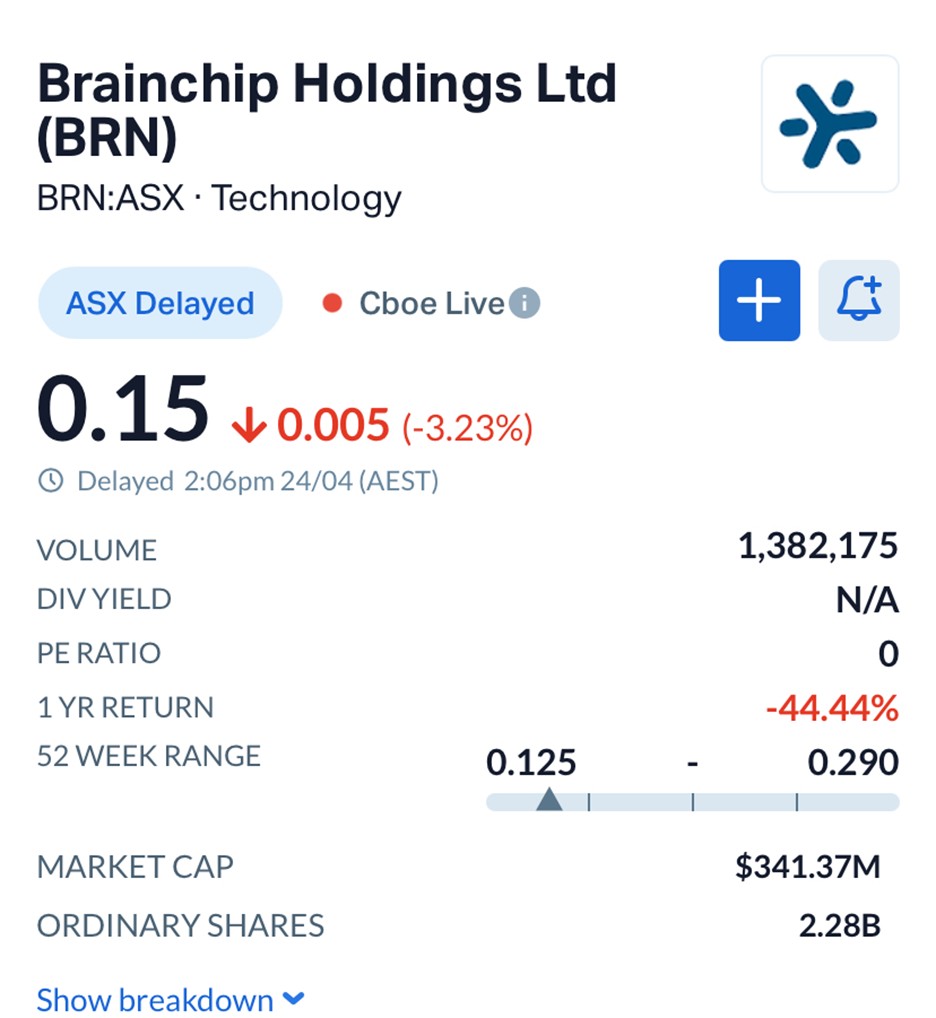
Shares in BrainChip were trading around $0.153 on Friday, down 1.61% for the session.
Over the past year, the stock has declined 43.52%, reflecting broader volatility in early-stage technology names and the long lead times associated with commercialisation.
However, the upcoming production milestone is likely to be a key catalyst for market sentiment.
Source: MarketIndex
The Bigger Picture
BrainChip’s latest update points to a company moving steadily from theory to execution. The upcoming production of the AKD1500 represents more than a product launch, it is the moment where years of research begin to translate into scalable revenue opportunities. At the same time, partnerships in defence, licensing agreements, and expansion into wearable and industrial applications suggest a business building multiple pathways to growth.
In a sector where timing and execution are critical, the next six months will determine whether BrainChip can convert early momentum into sustained commercial traction, positioning itself within the rapidly evolving edge AI landscape.
What is your take on this story?
This is user sentiment & not financial advice.
Disclaimer - Skrill Network is designed solely for educational and informational use. The content on this website should not be considered as investment advice or a directive. Before making any investment choices, it is crucial to carry out your own research, taking into account your individual investment objectives and personal situation. If you're considering investment decisions influenced by the information on this website, you should either seek independent financial counsel from a qualified expert or independently verify and research the information.