


Brazilian Critical Minerals (ASX: BCM) Surges on Outstanding Ema Rare Earth BFS as Project Nears Development

Team Skrill Network
Team Skrill Network comprises seasoned professionals from diverse fields including Finance, Mining, Technology, Investing, and Digital Strategy. They bring a deep knowledge and understanding of financial markets and behavioural patterns to every story, ensuring credibility and precision in every piece. Whether analysing emerging market trends or spotlighting small- and mid-cap growth companies across ASX, TSX, or NASDAQ, the team’s editorial approach blends data-driven insights with compelling storytelling. Their expertise enables them to process complex developments into content that resonates with both institutional investors and retail audiences. Backed by experience in content curation, SEO strategy, and investor-focused messaging, the team of writers at Skrill Network are committed to delivering stories that matter—authentic, relevant, and strategically aligned with the evolving landscape of global investing.
Read more
Key Highlights
- Brazilian Critical Minerals (ASX: BCM) unveiled a Bankable Feasibility Study for its Ema Rare Earth Project with a post-tax NPV of US$1.47 billion.
- The project boasts a 105% post-tax IRR, a six-month payback period and initial capital costs of just US$74 million.
- Ema is positioned as one of the world’s lowest-cost ionic clay rare earth projects outside China.
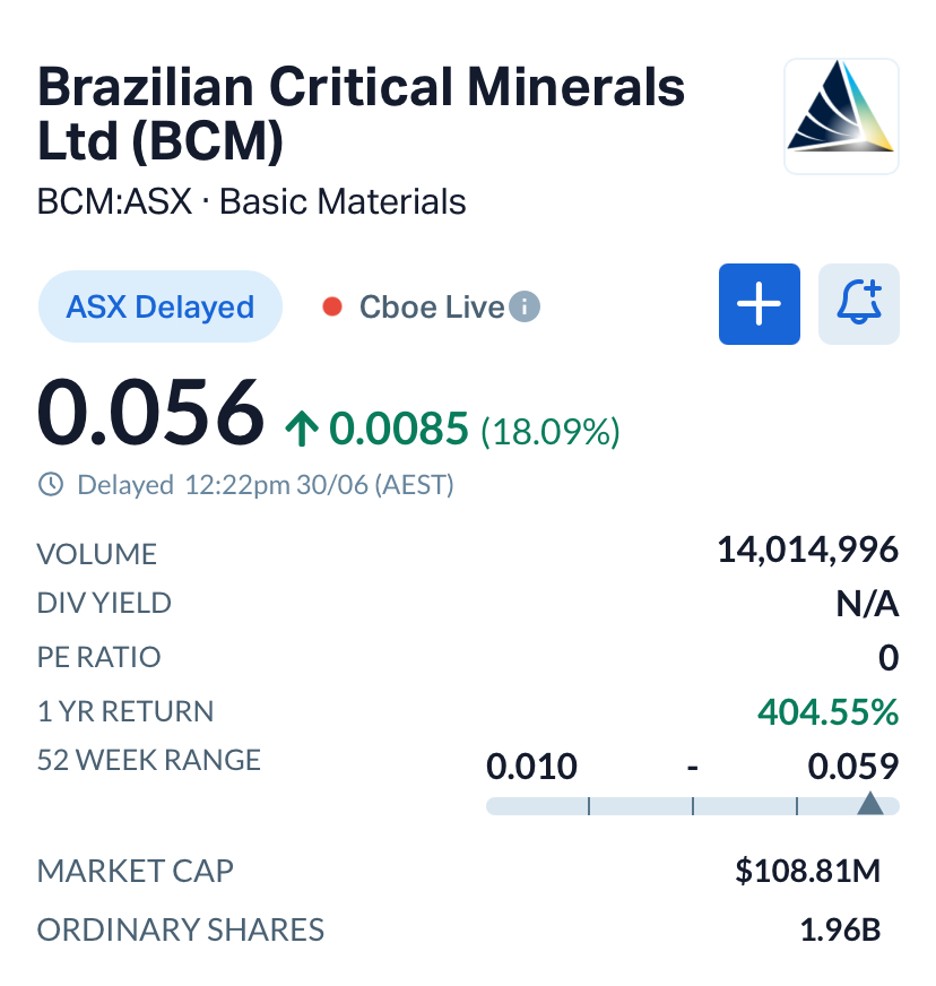
- Shares climbed 18.09% to $0.056 following the announcement, extending the company’s one-year return to almost 391%.
- Management is now focused on permitting, financing and a Final Investment Decision.
Rare earths have become one of the world’s most strategically important commodities as governments race to secure supply chains for electric vehicles, defence systems and renewable energy. Against that backdrop, Brazilian Critical Minerals (ASX: BCM) has delivered what could become the defining milestone in the company’s history.
The company released a Bankable Feasibility Study (BFS) for its Ema Rare Earth Project in Brazil on Tuesday, outlining economics that place the project among the strongest rare earth development opportunities outside China.
The market welcomed the update. BCM shares rose 18.09% to $0.056 by late afternoon, leaving the company with a market capitalisation of approximately $108.1 million after delivering a remarkable 404% gain over the past year.
Market Snapshot
Source: MarketIndex
A project built on strong economics
The BFS forecasts a post-tax Net Present Value (NPV8) of US$1.47 billion and a post-tax Internal Rate of Return (IRR) of 105%, far exceeding the 20% to 35% returns typically targeted by many new mining developments.
Initial capital expenditure is estimated at just US$74 million, while the project is expected to repay that investment within six months of production.
Over a planned 20-year mine life, Ema is forecast to produce an average of 5,500 tonnes of Total Rare Earth Oxides (TREO) annually, generating approximately US$5.44 billion in revenue and US$3.37 billion in post-tax cash flow.
For a company currently valued at just over A$105 million, the study highlights the scale of the opportunity now being presented to the market.
Why rare earths matter
China continues to dominate global rare earth production and processing, particularly the magnet rare earth elements neodymium, praseodymium, dysprosium and terbium. These materials are essential components in electric vehicles, wind turbines, robotics, defence technologies and advanced electronics.
Governments across the United States, Europe, Australia and Japan have been actively encouraging the development of alternative supply chains to reduce dependence on Chinese exports.
Against that backdrop, Ema is positioning itself as a long-term Western source of magnet rare earths using ionic clay mineralisation, a style of deposit that has historically supplied much of southern China’s production.
A different mining approach
Unlike conventional open pit mining, BCM plans to develop Ema using In-Situ Recovery (ISR).
The process injects a magnesium sulphate solution underground, dissolving rare earth minerals before recovering them through production wells. The approach significantly reduces waste, surface disturbance and infrastructure requirements while lowering operating costs.
According to the BFS, average operating costs are expected to be just US$8.84 per kilogram of TREO, placing Ema among the lowest-cost rare earth projects globally.
The study also incorporates a US$19 million carbon capture system that converts captured carbon dioxide into magnesium bicarbonate for reuse in the ISR process. Management believes this will lower reagent costs, reduce emissions and strengthen the project’s environmental credentials.
Room to grow
The updated resource now stands at 1.071 billion tonnes grading 732 parts per million TREO, containing an estimated 785,436 tonnes of rare earth oxides.
Importantly, only 45% of the project area has been explored, leaving substantial exploration upside beyond the current mine plan.
Development will also occur in stages. Initial production of 2,960 tonnes per annum will later expand through a second stage requiring an additional US$27 million in capital, reducing execution risk while allowing production to grow alongside market demand.
Stay ahead of the market
The most important stories, delivered to your inbox. No noise, just what matters.
By subscribing, you agree to our Privacy Policy.
Management looks beyond the study
Managing Director Andrew Reid described the BFS as the beginning of the company’s next chapter rather than the end of the development process.
He said Ema has the potential to become one of the world’s most compelling rare earth development projects, with low capital intensity, globally competitive operating costs and In-Situ Recovery significantly reducing mining intensity, infrastructure requirements and project risk.
Reid also said the study was built using conservative assumptions, leaving further upside through resource expansion, wellfield optimisation, reagent recycling and future production growth. He added that Ema’s strategic role as a non-Chinese supplier of magnet rare earths aligns closely with the growing efforts by Western economies to diversify critical mineral supply chains.
What comes next?
While the BFS substantially reduces project risk, several milestones remain before construction begins.
The environmental permit remains the key regulatory approval outstanding, while BCM also needs to complete project financing and progress toward a Final Investment Decision. Investors will also be watching for potential strategic partners, offtake agreements and further resource growth from the 55% of the project area that has yet to be explored.
For now, the discussion surrounding Brazilian Critical Minerals has shifted. The question is no longer whether the Ema Project can work economically. The focus now turns to how successfully the company can execute its development strategy and transform one of the world’s most promising ionic clay rare earth projects into a commercial producer.
Source: Brazilian Critical Minerals Bankable Feasibility Study (30 June 2026), International Energy Agency (critical minerals market outlook), company announcements.
What is your take on this story?
This is user sentiment & not financial advice.
Disclaimer - Skrill Network is designed solely for educational and informational use. The content on this website should not be considered as investment advice or a directive. Before making any investment choices, it is crucial to carry out your own research, taking into account your individual investment objectives and personal situation. If you're considering investment decisions influenced by the information on this website, you should either seek independent financial counsel from a qualified expert or independently verify and research the information.