

Brickworks Partnership Goes Green: Delorean Locks in 25-Year Renewable Gas Deal with $30M Backing

Team Skrill Network
Team Skrill Network comprises seasoned professionals from diverse fields including Finance, Mining, Technology, Investing, and Digital Strategy. They bring a deep knowledge and understanding of financial markets and behavioural patterns to every story, ensuring credibility and precision in every piece. Whether analysing emerging market trends or spotlighting small- and mid-cap growth companies across ASX, TSX, or NASDAQ, the team’s editorial approach blends data-driven insights with compelling storytelling. Their expertise enables them to process complex developments into content that resonates with both institutional investors and retail audiences. Backed by experience in content curation, SEO strategy, and investor-focused messaging, the team of writers at Skrill Network are committed to delivering stories that matter—authentic, relevant, and strategically aligned with the evolving landscape of global investing.
Read more
Key Highlights:
- Delorean Corporation Ltd secures $30.5M in government grants for NSW project
- Strategic 25-year partnership with Brickworks Limited
- Project to cut Brickworks’ emissions by 38% and halve gas usage
- Facility to process 120,000 tonnes of waste annually
- Expected to generate over $13M in yearly revenue
The Australian share market has been swinging between energy volatility and geopolitical uncertainty, but one small-cap is quietly building a different kind of energy story.
Delorean Corporation Ltd has taken a decisive step forward, confirming a final investment decision for its Horsley Park bioenergy facility in New South Wales, backed by $30.5 million in government funding and a long-term industrial partnership with Brickworks Limited.
Shares in Delorean rose 10% to $0.11 following the announcement, as the market began to price in what many see as a transition from early-stage developer to infrastructure operator.
Market Snapshot
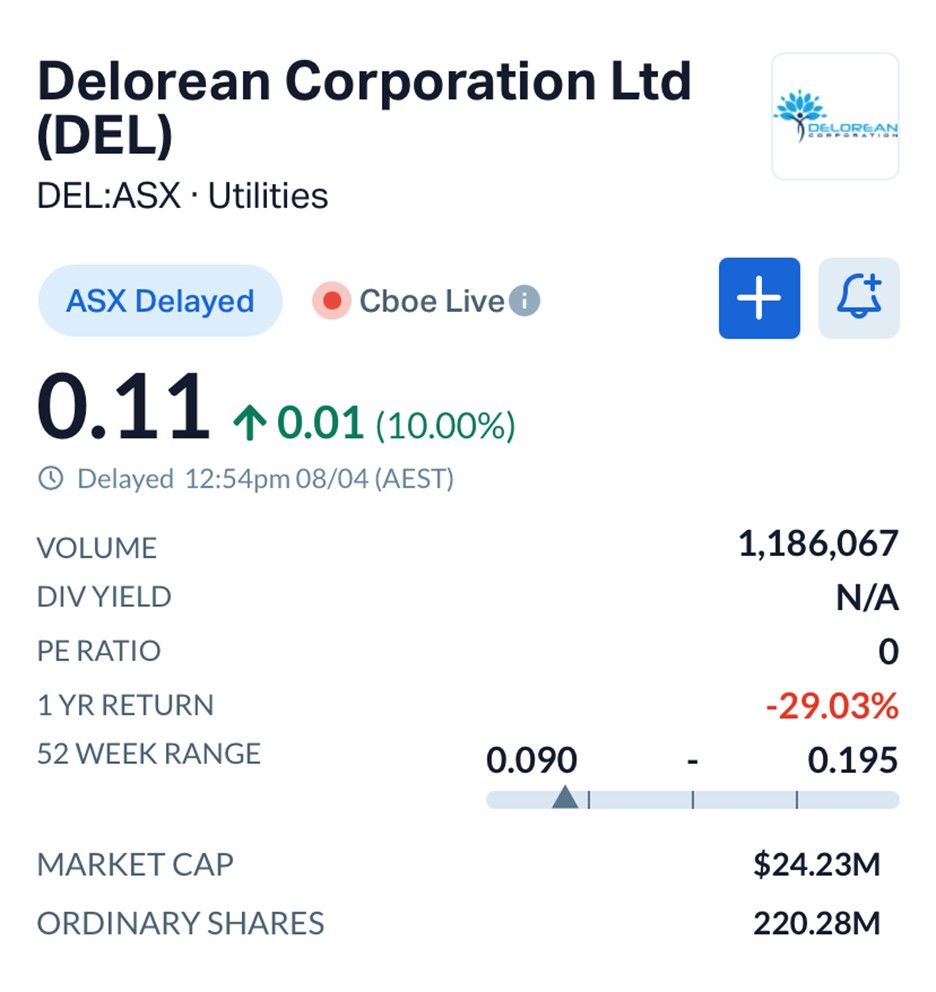
Source: MarketIndex
A Waste-to-Energy Bet Gains Momentum
At its core, the project is simple in concept but significant in scale.
The Horsley Park facility will convert organic waste into biomethane, a renewable gas that can directly replace traditional natural gas in industrial processes.
The plant is designed to process 120,000 tonnes of waste annually, with approvals allowing expansion up to 150,000 tonnes. That waste, instead of going to landfill, will be transformed into around 253,000 gigajoules of renewable gas each year.
In practical terms, this is enough to materially reduce reliance on fossil fuels at Brickworks’ manufacturing site.
The agreement includes a 25-year land lease and a long-term gas offtake arrangement, effectively locking in both supply and demand for decades.
Government Backing Changes the Equation
The financial structure is what makes this project stand out.
Of the total $62.1 million cost, nearly half is covered by grants.
- $20 million from the NSW Government under its Net Zero initiative
- $10.5 million from ARENA through its Industrial Transformation program
This level of support significantly reduces project risk, particularly for a company with a market capitalisation of just over $24 million.
In effect, public funding is underwriting a large portion of Delorean’s most important asset.
The company now needs to secure the remaining $31.6 million within six months, with plans to combine debt financing and new equity to reach financial close by October 2026.
Industrial Decarbonisation in Action
For Brickworks, the partnership is not just about sustainability targets. It is about cost stability and energy security.
The project is expected to reduce Scope 1 emissions at the site by 38% and cut natural gas consumption by half.
That matters in a market where global gas prices remain volatile and supply chains are increasingly exposed to geopolitical risk.
This is where the project moves beyond a typical “green energy” narrative.
It represents a practical shift in how industrial companies manage energy inputs, using locally sourced waste to generate consistent, predictable fuel.
Multiple Revenue Streams, One Asset
For Delorean, the economics extend beyond just selling gas.
The facility is expected to generate more than $13 million in annual revenue through a combination of:
- Waste gate fees for processing organic material
- Biomethane sales under long-term contracts
- Carbon credits under Australia’s ACCU framework
- Potential by-products such as liquid fertilisers
This diversified revenue model provides resilience, particularly in a sector where commodity prices can fluctuate.
From Developer to Operator
Perhaps the most important shift is strategic.
Until now, Delorean has largely been viewed as a project developer. With this final investment decision and secured funding support, it begins transitioning into an asset owner and operator.
Construction is expected to begin in the third quarter of 2026, with commissioning targeted for the second quarter of 2028.
Notably, the company expects to generate initial revenue within 18 months of construction through early waste intake, even before full operations commence.
Stay ahead of the market
The most important stories, delivered to your inbox. No noise, just what matters.
By subscribing, you agree to our Privacy Policy.
A Broader Industry Trend
The move comes at a time when bioenergy is gaining traction globally.
As countries push toward net-zero targets, renewable gas is emerging as a practical solution for sectors that are difficult to electrify, such as heavy manufacturing.
Australia, with its large waste streams and established industrial base, is increasingly seen as a potential leader in this space.
Projects like Horsley Park highlight a shift from theoretical climate solutions to commercially viable infrastructure.
What Comes Next
The immediate focus will be on securing the remaining funding and reaching financial close within the six-month window.
Beyond that, execution becomes key.
If Delorean delivers the project on time and within budget, it could serve as a blueprint for future facilities across the country.
For now, the company has achieved something many small-cap energy players struggle to secure.
It has funding support, a blue-chip partner, and a long-term revenue contract in place.
In a market dominated by short-term volatility, Delorean’s strategy is built around something far more stable.
Turning waste into energy, and doing it for the next 25 years.
What is your take on this story?
This is user sentiment & not financial advice.
Disclaimer - Skrill Network is designed solely for educational and informational use. The content on this website should not be considered as investment advice or a directive. Before making any investment choices, it is crucial to carry out your own research, taking into account your individual investment objectives and personal situation. If you're considering investment decisions influenced by the information on this website, you should either seek independent financial counsel from a qualified expert or independently verify and research the information.