

CBA’s 10% Wipeout: ASX Slumps as Budget Tax Overhaul Hits Banks and Housing

Team Skrill Network
Team Skrill Network comprises seasoned professionals from diverse fields including Finance, Mining, Technology, Investing, and Digital Strategy. They bring a deep knowledge and understanding of financial markets and behavioural patterns to every story, ensuring credibility and precision in every piece. Whether analysing emerging market trends or spotlighting small- and mid-cap growth companies across ASX, TSX, or NASDAQ, the team’s editorial approach blends data-driven insights with compelling storytelling. Their expertise enables them to process complex developments into content that resonates with both institutional investors and retail audiences. Backed by experience in content curation, SEO strategy, and investor-focused messaging, the team of writers at Skrill Network are committed to delivering stories that matter—authentic, relevant, and strategically aligned with the evolving landscape of global investing.
Read more
Key Highlights
- ASX 200 falls 0.44% as banks tumble after federal budget reforms
- Commonwealth Bank plunges 10.66% in one of its sharpest daily declines in years
- Negative gearing and CGT changes rattle housing and mortgage sentiment
- Aristocrat Leisure surges more than 13% after strong half-year earnings
- New home loan commitments fall 6.2% as higher rates begin to bite
The Australian share market slipped on Wednesday as the federal budget landed with more force than many traders expected.
Banks bore the brunt of the selling after sweeping changes to negative gearing and capital gains tax rules triggered fears of a cooler housing market and weaker mortgage growth ahead.
The S&P/ASX 200 closed down 0.44 per cent to 8,632.2 points, while the All Ordinaries fell 0.31 per cent to 8,881.9.
Market Snapshot
At the centre of the sell-off was Commonwealth Bank.
Australia’s largest lender dropped 10.66 per cent to $153.29, wiping billions from its market value in a single session and dragging the broader financial sector down 4.07 per cent.
The fall came after the federal budget restricted negative gearing benefits to new housing developments and replaced the long-standing 50 per cent capital gains tax discount with an inflation-indexed model.
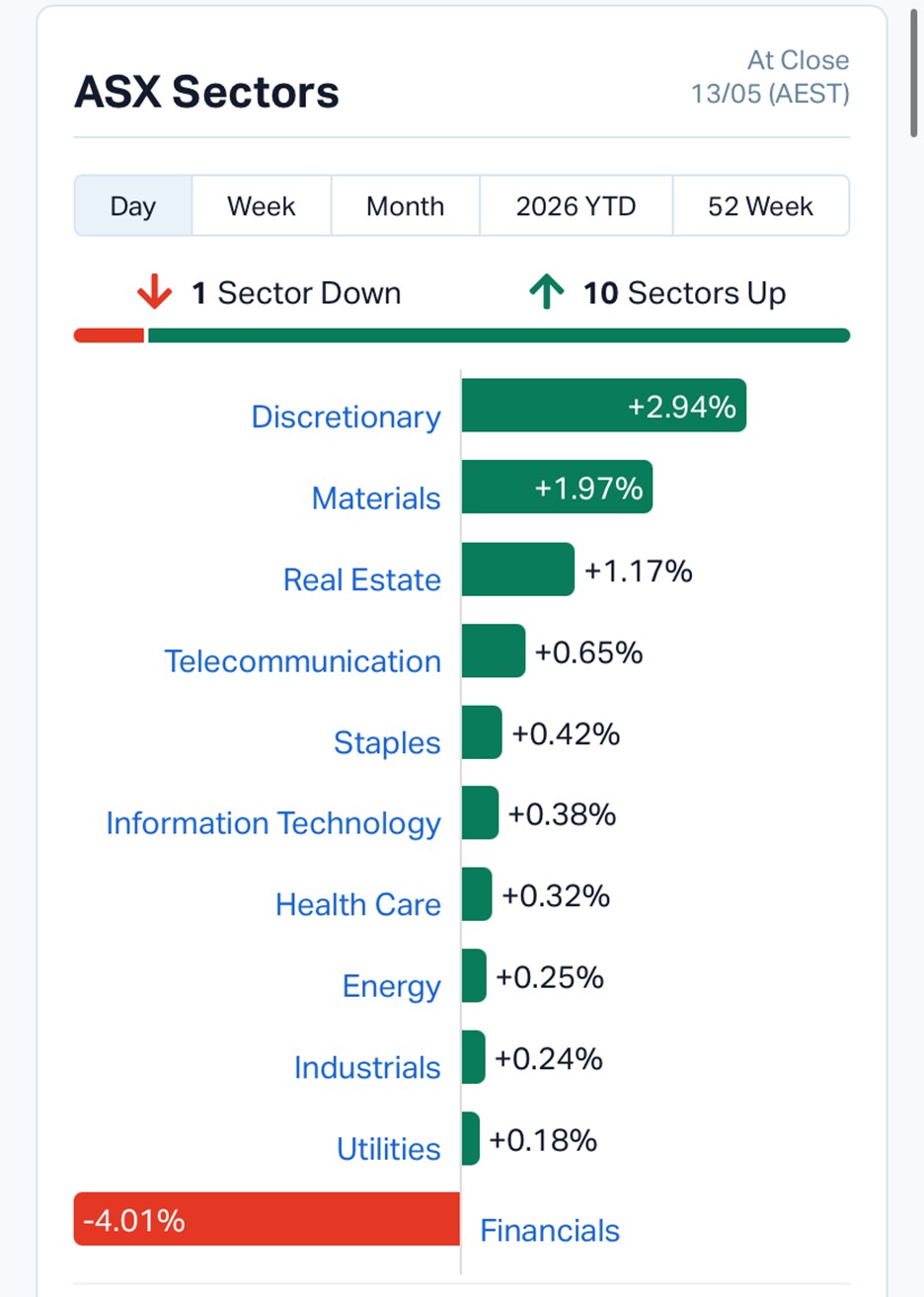
ASX Sector Snapshot | Source: MarketIndex
Markets quickly interpreted the reforms as a direct hit to investor demand across housing and lending.
The banking sector has spent decades tied closely to Australia’s property cycle. When investor activity slows, mortgage growth often follows.
CBA also announced an additional $200 million in provisions tied to supply chain disruption risks and macroeconomic uncertainty linked to tensions in the Middle East.
CBA chief executive Matt Comyn said global instability was creating a more uncertain operating environment.
“Conflict in the Middle East is disrupting critical supply chains and contributing to global uncertainty,” he said.
The reaction spread beyond the banks.
Property-linked sentiment weakened after fresh data from the Australian Bureau of Statistics showed new home loan commitments fell 6.2 per cent in the March quarter.
That decline points to a housing market beginning to feel the combined impact of higher interest rates and changing tax incentives.
JP Morgan economist Tom Ryan described the figures as a “partial reversal” from the stronger credit growth seen throughout 2025.
The Reserve Bank’s back-to-back rate hikes earlier this year are now beginning to feed through the system, particularly as household budgets remain under pressure.
Wages grew 3.3 per cent over the year to March, but inflation continues to run higher at 4.6 per cent.
That gap matters because it shapes consumer confidence.
Australians may still be earning more on paper, but rising living costs are eroding spending power across groceries, housing and utilities.
Citigroup analyst Thomas Strong said the policy shift arrives at a delicate moment for the economy.
“Changes to negative gearing and CGT, which will dampen investor activity, come as rates are rising, consumer sentiment has troughed and construction costs are rising,” he said.
The housing slowdown is already forcing economists to revisit property forecasts.
CBA chief economist Luke Yeaman said dwelling price growth expectations had been revised lower.
“Dwelling price growth is now forecast to be 3% over the year to December 2026, down from 5%, due to the effect of these policy changes on sentiment,” he said.
Still, the market was not entirely defensive.
Gaming giant Aristocrat Leisure jumped 13.13 per cent to $51.87 after delivering a strong half-year result and expanding its share buy-back program.
The rally stood out sharply against the broader weakness across financials and healthcare.
Critical minerals stocks also found support as traders rotated back into lithium and rare earth names tied to long-term energy security themes.
Ioneer climbed 15.52 per cent, while Arafura Rare Earths gained 10.61 per cent following continued momentum around US-aligned supply agreements.
Stay ahead of the market
The most important stories, delivered to your inbox. No noise, just what matters.
By subscribing, you agree to our Privacy Policy.
Elsewhere, Healius slumped 20.1 per cent after releasing a weak trading update tied to its strategic review.
Paladin Energy fell 11.18 per cent as uranium stocks retreated after weeks of strong gains, while Elevra Lithium lost 9.46 per cent as the market absorbed its large institutional placement.
Overseas, Wall Street delivered a mixed lead overnight.
The Dow Jones edged 0.11 per cent higher, but the Nasdaq fell 0.71 per cent as traders took profits from technology shares that had driven much of the recent rally.
In Asia, markets stabilised after early weakness.
The Shanghai Composite rose 0.1 per cent and Hong Kong’s Hang Seng gained 0.3 per cent as investors bought back into AI-related stocks following recent volatility.
Attention is also turning toward upcoming discussions between Donald Trump and Xi Jinping, with markets watching closely for signs of improving trade stability between the world’s two largest economies.
Despite the sharp reaction across banks, volatility indicators remained relatively calm.
The ASX VIX index closed at 13.2, a level generally associated with stable market conditions rather than widespread panic.
That suggests investors currently view the sell-off as sector-specific rather than the start of a broader financial shock.
But Wednesday’s session still carried an unmistakable message.
Australia’s market has spent years leaning on banks and housing for stability.
The budget may have just changed the shape of both.
What is your take on this story?
This is user sentiment & not financial advice.
Disclaimer - Skrill Network is designed solely for educational and informational use. The content on this website should not be considered as investment advice or a directive. Before making any investment choices, it is crucial to carry out your own research, taking into account your individual investment objectives and personal situation. If you're considering investment decisions influenced by the information on this website, you should either seek independent financial counsel from a qualified expert or independently verify and research the information.