


DroneShield Lands $21.7M Military Deal as Counter-Drone Demand Surges Worldwide

Team Skrill Network
Team Skrill Network comprises seasoned professionals from diverse fields including Finance, Mining, Technology, Investing, and Digital Strategy. They bring a deep knowledge and understanding of financial markets and behavioural patterns to every story, ensuring credibility and precision in every piece. Whether analysing emerging market trends or spotlighting small- and mid-cap growth companies across ASX, TSX, or NASDAQ, the team’s editorial approach blends data-driven insights with compelling storytelling. Their expertise enables them to process complex developments into content that resonates with both institutional investors and retail audiences. Backed by experience in content curation, SEO strategy, and investor-focused messaging, the team of writers at Skrill Network are committed to delivering stories that matter—authentic, relevant, and strategically aligned with the evolving landscape of global investing.
Read more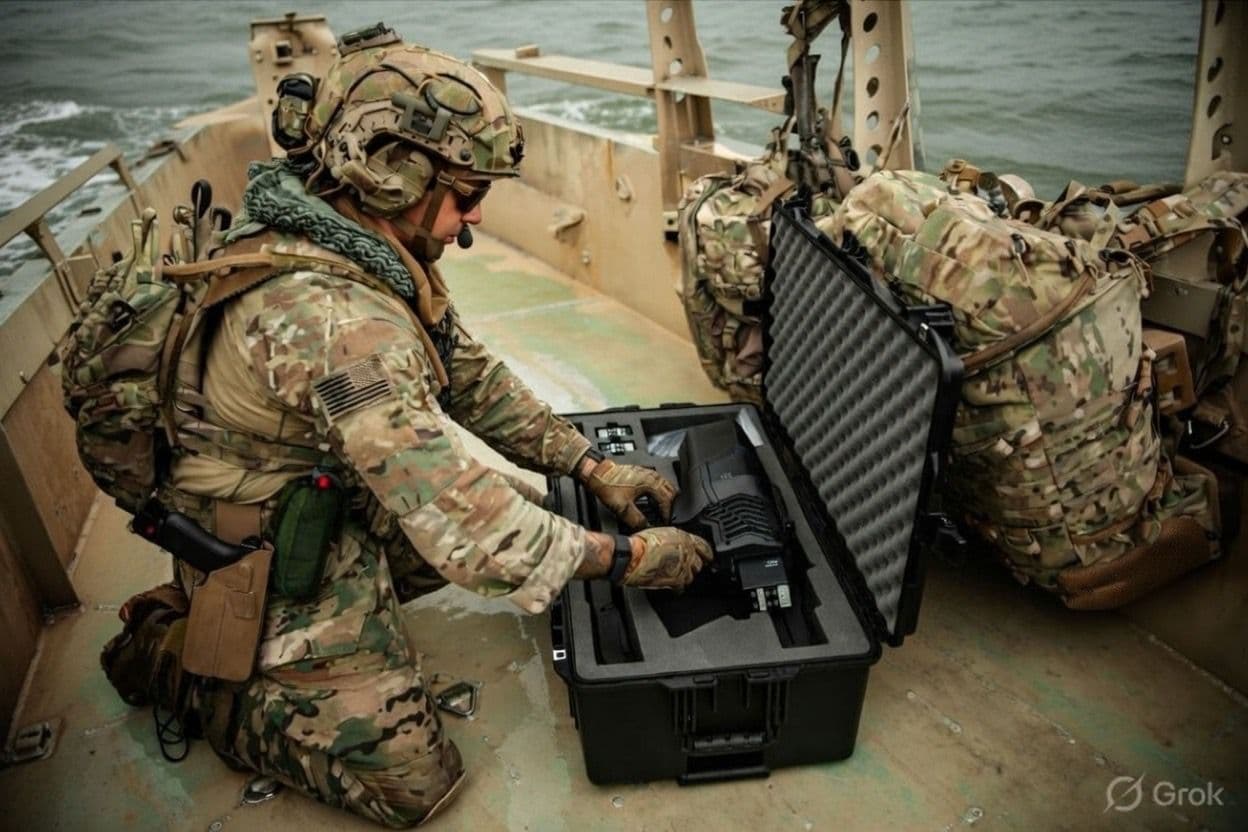
Key Highlights:
- DroneShield secures $21.7M contract for handheld counter-drone systems
- Order exceeds total sales to the reseller over the past seven years
- Delivery scheduled for Q1 2026, with revenue expected by June
- Software subscriptions add recurring income beyond hardware sales
- Shares rise 10.62% as global defense demand accelerates
The quiet revolution in modern warfare is not happening in fighter jets or submarines. It is happening in the sky, often with machines costing less than a family car. And for Australian defense technology company DroneShield Ltd, that shift is turning into real revenue.
DroneShield announced a $21.7 million contract package to supply handheld counter-drone systems to a global defense reseller, marking one of the largest deals in the company’s history. The order will ultimately support an unnamed Western military customer and represents a sharp escalation in adoption of counter-drone technology.
The significance lies not just in the dollar figure, but in the pace and scale. DroneShield has done $17.8 million in total business with this reseller over the past seven years. This single order surpasses that entire cumulative amount.
Market Snapshot
Even more unusually, delivery is immediate. The systems are already in stock and expected to ship during the current quarter, with revenue anticipated before June 2026, according to company information.
A Turning Point in Scale
For DroneShield, the deal marks a transition from experimental deployments to widespread military use.
Company chief executive Oleg Vornik said the contract reflects how rapidly defense priorities are evolving.
“This represents a total transformation of the scale at which DroneShield operates. We are no longer looking at trial phases. We are looking at mass-market military adoption,” he said.
The systems involved include portable counter-drone equipment designed to detect, track and disrupt hostile drones using radio frequency and artificial intelligence technologies.
These handheld units allow soldiers to neutralise drone threats without relying on expensive missile systems or large infrastructure.
Why Counter-Drone Technology Is Surging
The rise of inexpensive drones has reshaped modern battlefields. Conflicts in Ukraine and the Middle East have demonstrated how small unmanned aircraft can destroy armored vehicles, disrupt logistics and gather intelligence.
According to defense analysts and government procurement reports, global counter-drone spending is expanding rapidly as militaries scramble to defend against these low-cost threats.
DroneShield’s products are part of a new generation of portable defense systems designed to close that gap.
Unlike traditional weapons, counter-drone equipment often relies on software updates to remain effective against evolving threats. That creates an additional layer of recurring revenue beyond the initial hardware sale.
In DroneShield’s case, the contract includes software subscriptions that provide ongoing system upgrades.
This “software-enabled defense” model is increasingly valued because it generates longer-term income streams rather than one-off equipment sales.
Market Reaction Reflects Confidence
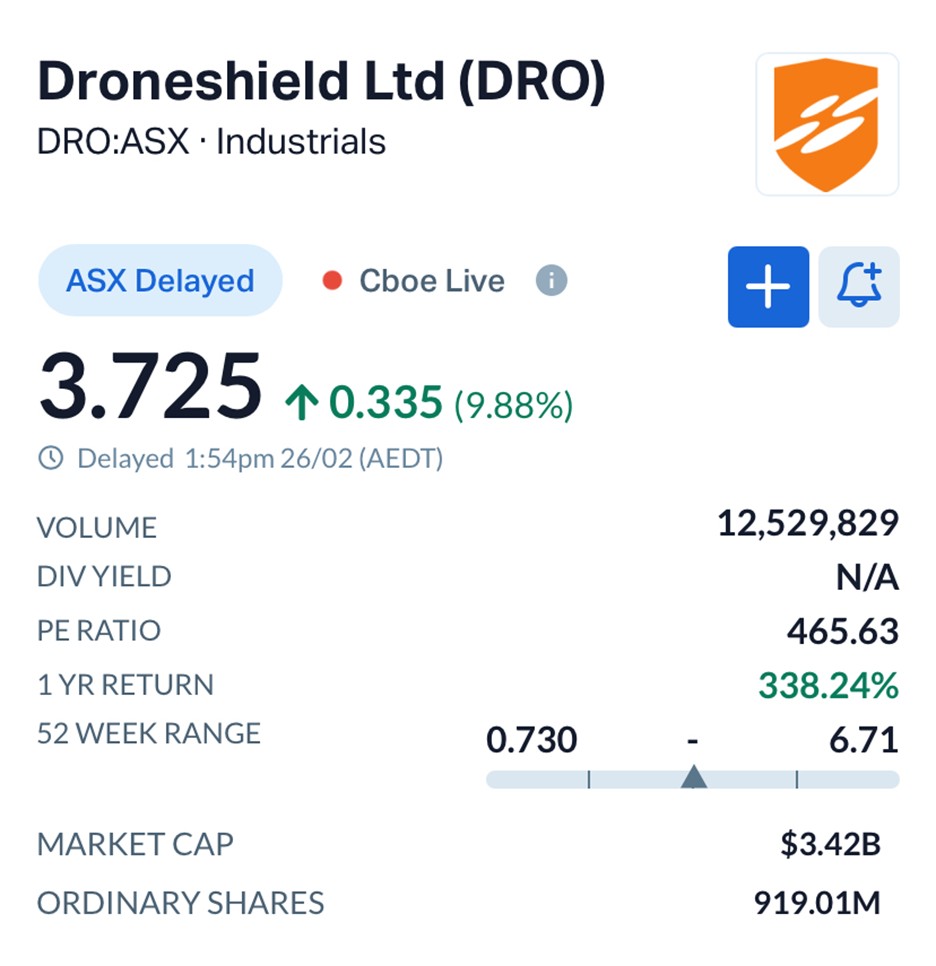
DroneShield shares rose 10.62 percent to $3.75 by early afternoon trading on Thursday. The company’s market value has now reached approximately $3.45 billion, reflecting growing confidence in its commercial and strategic position.
Over the past year, the stock has delivered a return of more than 340 percent, highlighting how rapidly sentiment around defense technology has shifted.
The company’s growth mirrors a broader global trend. Defense spending among NATO countries has increased significantly since 2022, with many governments prioritising electronic warfare and drone defense capabilities.
Source: MarketIndex
A Strategic Shift for an Australian Defense Firm
DroneShield’s expansion reflects a wider transformation within Australia’s defense technology sector.
Stay ahead of the market
The most important stories, delivered to your inbox. No noise, just what matters.
By subscribing, you agree to our Privacy Policy.
Historically, many local companies focused on niche engineering or subcontracting roles. Today, firms like DroneShield are exporting proprietary technologies directly to international military customers.
This shift aligns with Australia’s broader strategic partnerships, including the AUKUS security alliance with the United States and United Kingdom, which has accelerated investment in advanced defense capabilities.
The company’s expanding global reseller network is also helping scale its reach. By partnering with established defense distributors, DroneShield can access large military customers without maintaining a massive direct sales force.
The Road Ahead
The $21.7 million contract arrives at a time when DroneShield is scaling production capacity and expanding internationally.
The company has already reported strong financial growth in recent results, supported by rising demand for counter-drone systems across Europe, North America and Asia.
Still, defense procurement cycles can be unpredictable. Contracts often depend on government budgets and geopolitical developments.
What is clear, however, is that counter-drone technology is no longer a niche capability. It is becoming a standard part of modern military equipment.
For DroneShield, the latest deal signals that its technology has moved beyond the testing phase and into operational deployment at scale.
As global security priorities evolve, the company now finds itself at the center of one of the fastest-growing segments in defense technology.
What is your take on this story?
This is user sentiment & not financial advice.
Disclaimer - Skrill Network is designed solely for educational and informational use. The content on this website should not be considered as investment advice or a directive. Before making any investment choices, it is crucial to carry out your own research, taking into account your individual investment objectives and personal situation. If you're considering investment decisions influenced by the information on this website, you should either seek independent financial counsel from a qualified expert or independently verify and research the information.