

Energy Fuels (UUUU) Is a Stock to Watch: What’s Powering the Recent Market Buzz

Team Skrill Network
Team Skrill Network comprises seasoned professionals from diverse fields including Finance, Mining, Technology, Investing, and Digital Strategy. They bring a deep knowledge and understanding of financial markets and behavioural patterns to every story, ensuring credibility and precision in every piece. Whether analysing emerging market trends or spotlighting small- and mid-cap growth companies across ASX, TSX, or NASDAQ, the team’s editorial approach blends data-driven insights with compelling storytelling. Their expertise enables them to process complex developments into content that resonates with both institutional investors and retail audiences. Backed by experience in content curation, SEO strategy, and investor-focused messaging, the team of writers at Skrill Network are committed to delivering stories that matter—authentic, relevant, and strategically aligned with the evolving landscape of global investing.
Read more%252520Is%252520a%252520Stock%252520to%252520Watch%252520What%2525E2%252580%252599s%252520Powering%252520the%252520Recent%252520Market%252520Buzz.webp&w=3840&q=75)
Key Highlights
• Energy Fuels aims to become a fully integrated rare-earth supplier from mine to alloy
• White Mesa Mill Phase-2 expansion targets 6,000 tpa NdPr output
• Acquisition of Australian Strategic Materials to add metals and alloy production
• Project Vault policy expected to boost domestic demand for critical minerals
• Analysts and markets react positively as the company shifts from uranium-focused producer to diversified critical minerals platform
Uranium to Magnets: Energy Fuels’ Rare-Earth Push Gains Momentum as Project Vault Strengthens U.S. Critical Mineral Strategy
The global race to secure critical minerals is accelerating, and one company drawing growing attention is Energy Fuels, a U.S. producer long known for uranium but now repositioning itself at the center of the Western rare-earth supply chain.
Recent announcements, including a major rare-earth processing expansion and the proposed acquisition of Australian Strategic Materials, have placed the company firmly in the spotlight. At the same time, Washington’s newly launched $12 billion strategic mineral reserve, Project Vault, is expected to complement companies like Energy Fuels by strengthening demand visibility and supply-chain security for domestically produced critical minerals.
Market Snapshot
Together, these developments are reshaping how markets view the company, turning it from a traditional uranium producer into a vertically integrated supplier of materials essential for electric vehicles, renewable energy, robotics, and defence systems.
From uranium producer to rare-earth supply-chain builder
Energy Fuels has spent the past several years quietly building rare-earth processing capabilities at its White Mesa Mill in Utah, the only fully licensed conventional uranium processing facility operating in the United States. The facility is now becoming a cornerstone of the country’s rare-earth ambitions.
A recently released Bankable Feasibility Study outlines a Phase-2 processing expansion capable of producing roughly 6,000 tonnes per year of neodymium-praseodymium (NdPr) along with dysprosium and terbium oxides. The study estimates initial capital expenditure of approximately $410 million and positions the project among the lowest-cost NdPr producers globally.
Chief Executive Officer Mark S. Chalmers said the expansion could solve a long-standing bottleneck in the U.S. rare-earth supply chain.
“Energy Fuels is on the cusp of solving America’s rare earth processing bottleneck. Today's BFS shows that Energy Fuels is in the process of restoring a U.S. rare earth supply chain that is world-competitive,” he said.
The company also expects the Phase-2 expansion and related projects to generate substantial long-term cash flow, highlighting the economic case behind the shift toward rare earths.
The ASM acquisition: completing the mine-to-metal chain
In January 2026, Energy Fuels signed a Scheme Implementation Deed to acquire Australian Strategic Materials, a producer of rare-earth metals and alloys. The transaction, valued at roughly A$447 million, is designed to add downstream metallisation and alloy production capacity to Energy Fuels’ existing oxide production operations.
.png)
Rowena Smith, MD & CEO, ASM and Mark S. Chalmers, CEO, Energy Fuels (CNW Group/Energy Fuels Inc.)
The integration would combine ASM’s Korean Metals Plant and planned U.S. alloy facilities with Energy Fuels’ White Mesa processing infrastructure. The result would be what the company describes as a fully integrated “mine-to-metal and alloy” rare-earth supply chain outside China.
Chalmers emphasized the strategic value of the move, stating:
“Energy Fuels is executing our plan to create the largest fully integrated producer of REE materials outside of China, including REE oxides, metals and alloys, while supporting U.S. and allied critical mineral supply chains.”
For markets, the acquisition signals a shift toward margin capture across the value chain, allowing the company to sell products at multiple stages rather than relying solely on raw mineral output.
How Project Vault strengthens the investment case
Washington’s newly announced Project Vault, a civilian strategic mineral stockpile designed to secure supplies of rare earths and battery metals, is expected to reinforce the growth outlook for companies operating in domestic processing and refining.
The initiative creates government-backed demand stability for critical materials, particularly those produced within allied supply chains. For Energy Fuels and similar U.S. companies, this policy environment offers several potential advantages:
First, government stockpiling programs reduce supply-chain uncertainty, encouraging manufacturers to source materials domestically.
Second, strategic reserves can support long-term pricing stability, improving project financing conditions for mining and processing developments.
Third, policy support increases the likelihood of long-term contracts with defence, automotive, and technology manufacturers that require secure supply.
Industry observers note that as Western governments seek alternatives to Chinese processing dominance, vertically integrated companies capable of producing oxides, metals, and alloys domestically are likely to become increasingly valuable.
Strong uranium base still supports growth
While the rare-earth transformation is gaining attention, the company continues to maintain a strong uranium production base. Energy Fuels reported more than one million pounds of finished uranium production in 2025 and continues to hold its position as one of the largest U.S. uranium producers.
This diversified portfolio allows the company to participate in two major structural themes simultaneously: the global nuclear energy revival and the rapid growth of rare-earth demand driven by electrification and clean-energy technologies.
Market reaction and analyst sentiment
The market has responded quickly to the strategic shift. Trading volumes and share prices have risen following the company’s BFS announcement, the ASM acquisition plan, and rare-earth policy developments. Analysts have also begun revising coverage, with upgrades and higher price targets reflecting growing recognition of the company’s evolving role in the critical-minerals ecosystem.
However, analysts continue to highlight execution risk, noting that project timelines, permitting, commodity pricing, and integration of acquired assets will play a major role in determining long-term valuation.
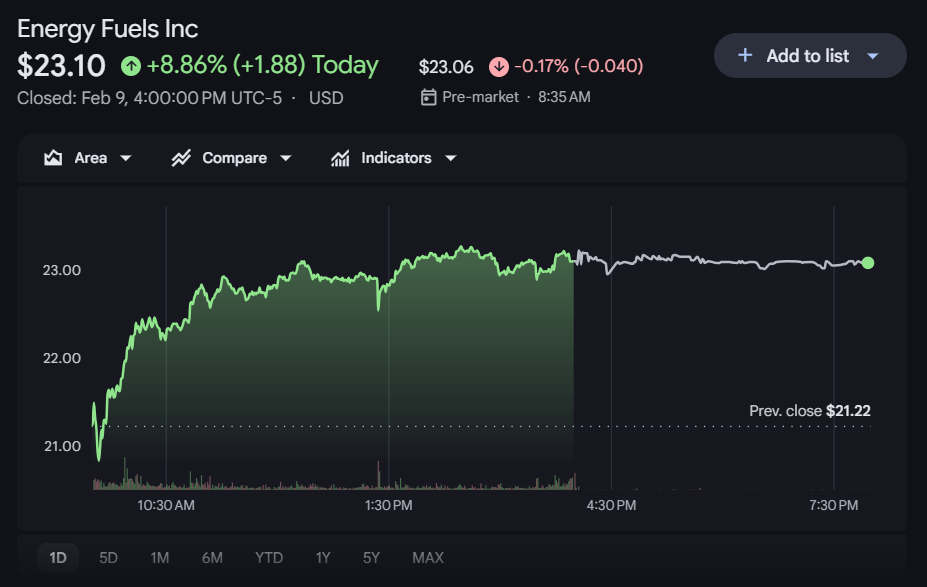
At yesterday's market close, UUUU shares were trading at $23.10, up by 8.86%.
Stay ahead of the market
The most important stories, delivered to your inbox. No noise, just what matters.
By subscribing, you agree to our Privacy Policy.
Source: Google
Key trends shaping the sector
Several broader trends explain why companies such as Energy Fuels are gaining attention:
• Governments are increasingly treating critical minerals as strategic assets similar to oil reserves
• Western economies are building independent supply chains from mine to magnet
• Vertical integration is becoming a competitive advantage in rare-earth markets
• Strategic stockpiles such as Project Vault are creating new demand anchors for domestic producers
• Diversified companies producing both energy fuels and critical minerals are attracting renewed market interest
Together, these forces are transforming the rare-earth industry from a niche mining segment into a central pillar of industrial policy and energy transition planning.
Revenue and Profit Snapshot
Energy Fuels’ recent financials reflect a company still investing heavily in expansion. Revenue fluctuated from $39.9 million in December 2024 to $17.7 million in September 2025, driven largely by timing of uranium sales and early-stage rare-earth operations. The company continues to report net losses, though these narrowed from $32.9 million to $16.7 million over the same period as operations stabilized.
The key takeaway is that current earnings pressure largely reflects upfront spending on rare-earth processing capacity and vertical integration projects. Markets are focused less on near-term profitability and more on whether upcoming production expansions can convert these investments into stronger long-term revenue growth.
Source: (Quarterly Income Statement, 2024–2025).
The bigger picture
Energy Fuels’ strategy reflects a broader shift underway across global resource markets. Companies that once focused on single commodities are repositioning themselves as integrated suppliers capable of supporting emerging technology sectors.
If the White Mesa expansion, ASM acquisition, and international project pipeline progress as planned, the company could emerge as a significant Western supplier of magnet-grade rare earth materials at a time when governments are actively encouraging domestic production.
For the broader market, the message is clear. The competition for rare-earth supply chains is intensifying, and companies that combine production scale, processing capacity, and policy alignment are increasingly at the center of the conversation.
Source: Energy Fuels Inc. company announcements and Skrill Network market research.
What is your take on this story?
This is user sentiment & not financial advice.
Disclaimer - Skrill Network is designed solely for educational and informational use. The content on this website should not be considered as investment advice or a directive. Before making any investment choices, it is crucial to carry out your own research, taking into account your individual investment objectives and personal situation. If you're considering investment decisions influenced by the information on this website, you should either seek independent financial counsel from a qualified expert or independently verify and research the information.