

Energy Gripped: How the Strait of Hormuz Standoff Is Reshaping Global Markets and Your Portfolio

Team Skrill Network
Team Skrill Network comprises seasoned professionals from diverse fields including Finance, Mining, Technology, Investing, and Digital Strategy. They bring a deep knowledge and understanding of financial markets and behavioural patterns to every story, ensuring credibility and precision in every piece. Whether analysing emerging market trends or spotlighting small- and mid-cap growth companies across ASX, TSX, or NASDAQ, the team’s editorial approach blends data-driven insights with compelling storytelling. Their expertise enables them to process complex developments into content that resonates with both institutional investors and retail audiences. Backed by experience in content curation, SEO strategy, and investor-focused messaging, the team of writers at Skrill Network are committed to delivering stories that matter—authentic, relevant, and strategically aligned with the evolving landscape of global investing.
Read more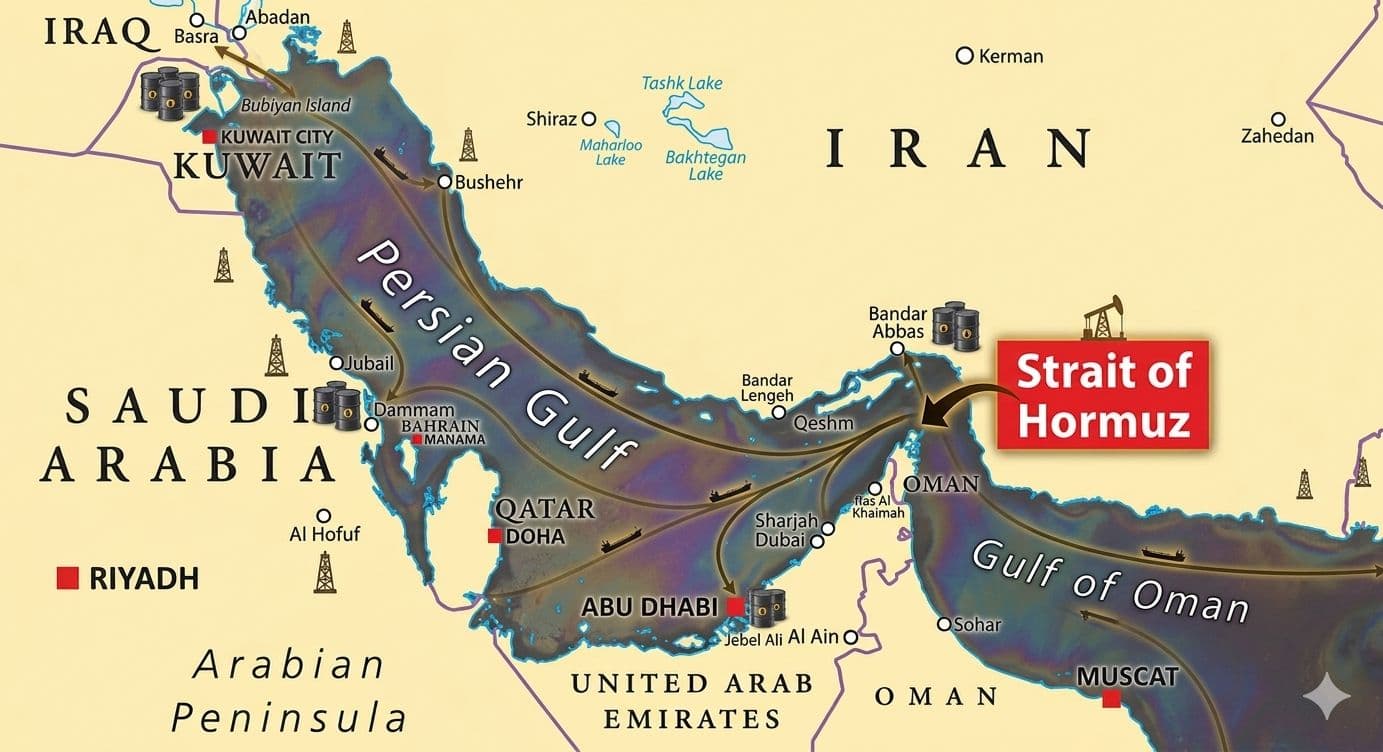
Key Highlights:
- Around 25% of global seaborne oil flows through the Strait of Hormuz
- Oil surges above $112 per barrel as supply disruptions intensify
- LNG flows disrupted with Qatar declaring force majeure
- ASX energy stocks hold firm while airlines, miners and small caps face pressure
- Analysts warn prolonged disruption could trigger a multi-month global inflation shock
A narrow waterway, a global ripple effect
It is only 33 kilometres wide at its narrowest point, yet the Strait of Hormuz has become the focal point of global financial anxiety.
While headlines have been dominated by political ultimatums and military rhetoric, the deeper story unfolding is economic. This is no longer a theoretical risk. It is a real-time disruption to the arteries that power the global economy.
According to the International Energy Agency, roughly 20 million barrels of oil per day pass through the Strait. That represents about one quarter of global seaborne oil trade. Add to that nearly 20% of global LNG supply, and the scale becomes clear.
Market Snapshot
This is not just an energy story. It is a growth, inflation, and supply chain story all at once.
From theory to reality: the supply shock unfolds
In recent weeks, what markets once treated as a low-probability geopolitical risk has shifted into a tangible supply shock.
Shipping activity through the Strait has dropped dramatically, with vessel traffic falling to a fraction of normal levels. At the same time, war-risk insurance premiums for tankers have surged, making transit commercially unviable for many operators.
The consequences are already visible.
Qatar, one of the world’s largest LNG exporters, has declared force majeure on key shipments. With no alternative pipeline routes, much of this supply is effectively stranded.
Across the region, oil producers including Saudi Arabia and the UAE are facing logistical constraints, forcing production slowdowns. Estimates suggest a potential 10 million barrels per day supply deficit has opened up globally.
The tension escalated sharply after former US President Donald Trump issued a 48-hour ultimatum demanding Iran reopen the Strait of Hormuz, warning that failure to comply would result in targeted strikes on Iran’s power infrastructure. The statement has effectively placed a countdown on global markets, turning what was once a geopolitical risk into a binary economic event with immediate consequences for oil supply and inflation.
The London School of Economics Business Review captures the broader impact:
“This is not just a regional oil story. It is a global inflation and growth story. The duration of this disruption is now the rough guide to the economically tolerable length of the war itself.”
Oil markets: calm on the surface, chaos underneath
At first glance, oil prices may not appear extreme.
Brent crude is trading around $112 per barrel, up sharply but not yet at crisis levels. However, this headline number masks deeper stress in physical markets.
Regional benchmarks tell a different story. In Asia, where dependence on Middle Eastern supply is highest, crude prices have surged far more aggressively. Freight costs have also jumped, adding an estimated $12 per barrel for shipments rerouted around Africa.
This divergence between “paper” and “physical” markets suggests that pricing pressure may still be building.
Historically, oil shocks take time to fully filter through. During the 1973 and 1979 crises, prices rose steadily over months, not days.
The ASX response: resilience with cracks
Australian markets are feeling the impact, though not uniformly.
The ASX 200 has shown relative resilience compared to global peers, but beneath the surface, sector divergence is widening.
Energy stocks are benefiting directly from higher oil prices. Companies with exposure outside the Middle East are attracting renewed interest, as they offer pricing upside without immediate geopolitical risk.
Utilities and healthcare stocks are also gaining traction as defensive plays.
Where pressure is building:
Airlines and transport companies are among the most exposed. Fuel typically accounts for up to 30% of operating costs, meaning sustained oil prices above $100 can significantly erode margins.
Materials stocks are also under pressure. Higher energy costs are expected to dampen global manufacturing demand, weighing on metals like copper.
Small-cap stocks are seeing the sharpest declines, reflecting a broader move away from risk.
The hidden layer: food and inflation risks
Beyond energy, the Strait of Hormuz disruption carries a less visible but equally important consequence.
The region plays a critical role in global fertiliser production. Around 35% of Asia’s urea supply originates from the Gulf.
Any prolonged disruption could push fertiliser prices higher, eventually feeding into global food inflation.
This is where the story becomes more personal.
Higher fuel costs impact transport. Higher fertiliser costs impact food. Together, they create a chain reaction that reaches households worldwide.
Expert view: a market adjusting to prolonged risk
Market strategists are increasingly warning that this may not be a short-lived disruption.
Jake Dollarhide, CEO of Longbow Asset Management, notes:
Stay ahead of the market
The most important stories, delivered to your inbox. No noise, just what matters.
By subscribing, you agree to our Privacy Policy.
“The market is finally settling into the idea that this may go on longer than initially expected, and I think that’s why markets are selling off. This conflict may go on not for just a few weeks, but maybe beyond several months.”
That shift in mindset is critical.
Markets are moving from pricing a temporary shock to preparing for a sustained period of elevated risk.
What this means for portfolios
In practical terms, the current environment is reshaping how capital is allocated.
Beneficiaries:
Energy producers outside the Middle East, as well as logistics and shipping companies, are seeing increased demand. Uranium and renewable energy sectors are also gaining attention as long-term alternatives.
Vulnerable sectors:
Airlines, transport operators, and energy-intensive industries face rising cost pressures. Consumer-facing sectors may also feel the impact as inflation filters through.
The next 48 hours
At the centre of the current uncertainty is a geopolitical deadline that markets are watching closely.
Any escalation could further disrupt supply chains and push oil prices significantly higher. Some analysts warn that in a worst-case scenario, prices could approach $150 per barrel.
For now, markets appear to be holding onto the hope of de-escalation.
But as history has shown, when it comes to energy shocks, the real impact often unfolds gradually, and then all at once.
Source:
International Energy Agency (IEA); LSE Business Review; Reuters; Market data March 23, 2026
What is your take on this story?
This is user sentiment & not financial advice.
Disclaimer - Skrill Network is designed solely for educational and informational use. The content on this website should not be considered as investment advice or a directive. Before making any investment choices, it is crucial to carry out your own research, taking into account your individual investment objectives and personal situation. If you're considering investment decisions influenced by the information on this website, you should either seek independent financial counsel from a qualified expert or independently verify and research the information.