

EOS Pushes Back Against Grizzly Report Allegations

Team Skrill Network
Team Skrill Network comprises seasoned professionals from diverse fields including Finance, Mining, Technology, Investing, and Digital Strategy. They bring a deep knowledge and understanding of financial markets and behavioural patterns to every story, ensuring credibility and precision in every piece. Whether analysing emerging market trends or spotlighting small- and mid-cap growth companies across ASX, TSX, or NASDAQ, the team’s editorial approach blends data-driven insights with compelling storytelling. Their expertise enables them to process complex developments into content that resonates with both institutional investors and retail audiences. Backed by experience in content curation, SEO strategy, and investor-focused messaging, the team of writers at Skrill Network are committed to delivering stories that matter—authentic, relevant, and strategically aligned with the evolving landscape of global investing.
Read more
Key Highlights:
- EOS formally rejects allegations made by Grizzly Research and considers legal options.
- Company clarifies Korean contract with Goldrone remains conditional and risk-managed
- Order book rises to A$459 million as defence demand strengthens globally.
- EOS emphasises improved balance sheet, zero debt, and expanding laser weapon production capacity.
EOS Responds to Grizzly Research as Defence Technology Debate Intensifies
Australian defence technology developer Electro Optic Systems Holdings Ltd (ASX: EOS) has issued a detailed response to the recent short-seller report published by Grizzly Research, firmly rejecting the allegations while reiterating confidence in its contract pipeline, strategic acquisitions, and long-term growth outlook.
The dispute highlights the growing scrutiny surrounding defence technology companies operating in rapidly evolving geopolitical markets, where high-value contracts, advanced weapon systems, and global supply chain partnerships often attract both investor attention and activist research campaigns.
What Grizzly Research Alleged
Grizzly Research released a report questioning the credibility of EOS’s announced US$80 million conditional high-energy laser contract with a Korean counterparty. The report claimed that the counterparty, identified by the firm as Goldrone Co., Ltd., lacked sufficient financial capacity to support a deal of that magnitude and suggested that certain company statements could be misleading.
Market Snapshot
The report also raised questions about EOS’s acquisition strategy, financial disclosures, and historical contract announcements, arguing that management may have overstated future growth prospects. Grizzly disclosed that it held a short position in EOS shares, meaning it could benefit financially if the stock declined.
Beyond the headline allegations about the Korean laser contract, the Grizzly Research report raises a broader set of concerns around execution, disclosures, and financial positioning. The short seller questions the economics of the recently announced MARSS acquisition, arguing that publicly available filings appear to show lower historical revenues than what management commentary implied, suggesting that investors should closely monitor whether projected growth materialises. The report also points to the company’s earlier disclosure-related regulatory penalties as a reason for heightened scrutiny of recent contract announcements and backlog claims.
Grizzly further argues that the company has faced increased pressure to demonstrate strong deal momentum following the sale of its previously profitable EM Solutions division in 2024, suggesting that several large contracts announced during 2025 may require careful verification regarding their funding status and revenue conversion timelines.
The report also highlights potential balance-sheet and financing considerations, noting that large defence programs typically demand significant working capital and execution certainty. As with most short-seller reports, these claims represent a critical viewpoint that markets will weigh against the company’s official responses and future operational performance.
Source: Grizly LLC
EOS Rejects Allegations and Signals Legal Review
In its official ASX response, EOS described the report’s conclusions as “misleading, manipulative and pejorative” and confirmed that legal advisers in Australia and Germany had been instructed to evaluate potential legal remedies.
The company also emphasised the disclosed short position held by Grizzly Research, noting that such a financial interest may influence the publication’s perspective. EOS stated that the timing and content of the report, combined with the short position disclosure, raised concerns about the motivations behind the allegations.
Clarification on the Korean Contract
A central point of contention involves the Korean laser weapons contract. EOS clarified that the agreement is conditional, requiring the customer to pay an initial US$18 million deposit and provide a letter of credit before becoming unconditional. The company stressed that this conditional structure was fully disclosed in earlier announcements and that the contract was not included in its secured order book figures.
EOS explained that staged contracts are common in the defence sector, particularly when local partners are used to access new markets. According to the company, the selected Korean partner was evaluated for its market access capabilities rather than its balance sheet strength alone, with funding expected to be sourced from investors or government customers as the project progresses.
Importantly, EOS noted that it has incurred minimal costs to date related to the project and will only proceed once commercial conditions are satisfied.
Strengthening Order Book and Contract Momentum
Beyond the disputed contract, EOS pointed to a strengthening operational outlook supported by several confirmed contract wins during 2025. The company reported that its unconditional order book increased to approximately A$459 million by December 2025, reflecting multiple defence system contracts across Europe, Australia, and North America.
Among these were contracts for counter-drone weapon systems, remote weapon platforms for armoured vehicles, and high-energy laser systems supplied to NATO-aligned defence customers. EOS stated that these secured contracts, rather than speculative agreements, have been a major driver of recent share price performance.
Financial Position and Balance Sheet Improvements
EOS also highlighted improvements in its financial structure following the divestment of its EM Solutions business in early 2025. The transaction allowed the company to repay all outstanding borrowings and strengthen liquidity, leaving the group with over A$100 million in cash at the end of 2025 and access to a committed A$100 million credit facility if required.
Management argues that this stronger balance sheet positions the company to pursue acquisitions such as the proposed MARSS transaction, which is aimed at expanding software and command-and-control capabilities for integrated counter-drone systems.
Defence Spending Tailwinds Support Sector Outlook
EOS also pointed to structural growth trends across the global defence industry. According to international defence expenditure data cited by the company, global military spending rose sharply in 2024, with NATO members committing to increased defence budgets over the coming decade.
For companies focused on counter-drone technologies, directed energy weapons, and integrated surveillance systems, this spending cycle is expected to create sustained demand, though the long procurement timelines typical of defence contracts mean revenue growth can occur gradually.
Market Reaction and Share Price Context
The controversy surrounding the report contributed to share price volatility, reflecting how sensitive defence technology stocks can be to research publications, short-seller campaigns, and contract developments. EOS shares have experienced strong gains over the past year amid rising defence spending expectations, although trading fluctuations have intensified following the publication of the Grizzly report.
Stay ahead of the market
The most important stories, delivered to your inbox. No noise, just what matters.
By subscribing, you agree to our Privacy Policy.
Management maintains that the share price performance over the past year reflects broader factors including global defence demand, technological developments, and contract wins rather than any single announcement.
The Bigger Picture: Transparency vs. Activist Research
The dispute between EOS and Grizzly Research reflects a broader trend in global equity markets where activist short-seller research is increasingly influencing trading dynamics. While such reports can expose legitimate governance or disclosure issues, they also often lead to intense public disagreements as companies defend their strategies and disclosures.
EOS concluded its statement by reiterating that it remains compliant with disclosure obligations and committed to transparency with shareholders, while acknowledging that investing in defence technology companies inherently involves operational and contract execution risks.
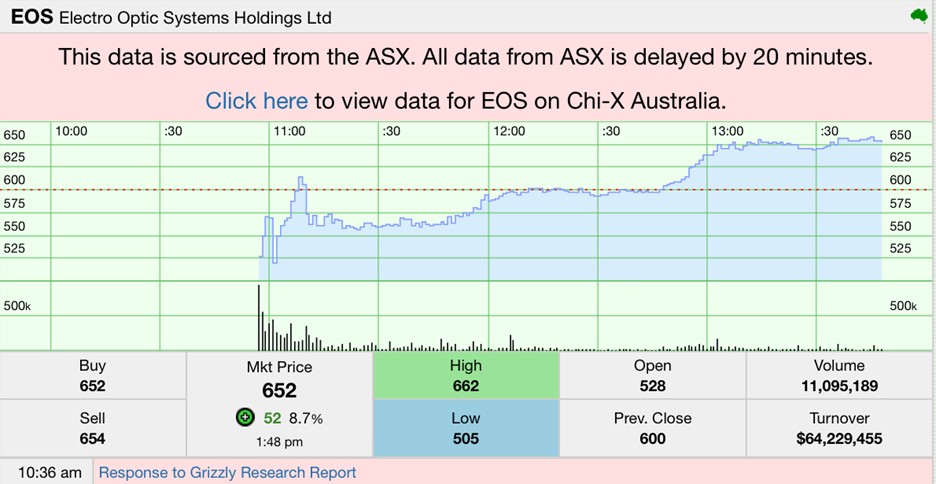
EOS (ASX: EOS) – Recent Stock Price Movement
Source: StocknessMonster
As of 10 February 2026 (1:30 pm AEDT):
- Last price: A$6.45
- Daily change: +A$0.45 (+7.50%)
- 52-week range: A$0.995 – A$11.20
- 1-year return: +388.64%
Market capitalisation: ~A$1.24 billion
What is your take on this story?
This is user sentiment & not financial advice.
Disclaimer - Skrill Network is designed solely for educational and informational use. The content on this website should not be considered as investment advice or a directive. Before making any investment choices, it is crucial to carry out your own research, taking into account your individual investment objectives and personal situation. If you're considering investment decisions influenced by the information on this website, you should either seek independent financial counsel from a qualified expert or independently verify and research the information.