


FortifAI (ASX: FTI) AI Breakthrough Challenges Google RE2 with 200,000x Speed Advantage


Key Highlights:
- FortifAI Limited claims up to 200,000x performance advantage over Google’s RE2 engine
- Nol8 technology delivers consistent 1,500 MB/s throughput even under extreme AI workloads
- Shares surged 20% intraday to $0.48, capping a 1,700% one-year return
- Global data volumes expected to grow from 334 ZB in 2025 to 19,267 ZB by 2035
- Enterprise-ready benchmarking engine targeted for June 2026
The Australian tech sector is rarely short on ambition, but every so often a claim emerges that forces the market to pause and reassess the rules entirely.
That appears to be the case with FortifAI Limited, which says it has achieved a breakthrough in how data is processed for artificial intelligence systems, benchmarking its Nol8 engine against Google’s widely used RE2 software.
The result is striking. Under high-complexity AI workloads, FortifAI reports a throughput of 1,500 megabytes per second, while RE2 drops to just 0.007 MB/s under extreme conditions.
That is the difference between a highway flowing freely and one completely gridlocked.
A Market That Is Starting to Pay Attention
Shares in FortifAI rose 25% to $0.50 by early afternoon trade, extending a remarkable 12-month gain of more than 1,700%.
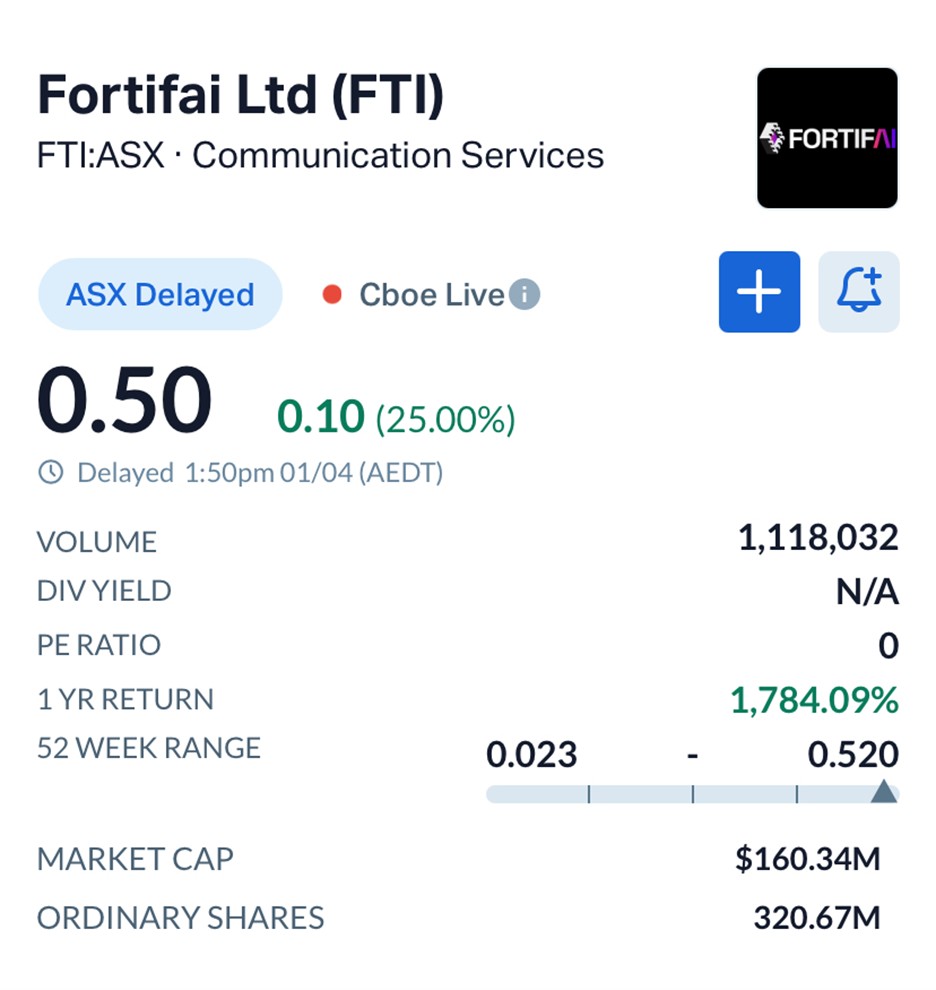
FTI Stock Index | Source: MarketIndex
The company’s market capitalisation now sits at approximately $154 million, still modest by global tech standards, but the scale of the claim is anything but.
For context, RE2 is not just another piece of software. It is considered the global benchmark for safe and efficient data pattern matching, used across modern infrastructure systems.
That is precisely why FortifAI chose it.
As Nol8 co-founder and CTO Alon Rashelbach explained, “The purpose of this benchmark was simple: to put our technology against the best available software standard and let the results speak for themselves.”
Breaking the Software Ceiling
At the heart of the announcement is a shift in architecture.
Traditional data systems rely on CPUs, which process tasks sequentially. As workloads grow more complex, performance slows.
FortifAI’s Nol8 engine instead uses FPGA hardware, allowing it to process multiple streams of data simultaneously.
The result is consistent speed, regardless of how demanding the task becomes.
Rashelbach said, “The scalability ceiling that has constrained AI data infrastructure is not a software problem. It is an architectural one. Nol8 solves it at the hardware level.”
This distinction matters more than it might first appear.
AI systems are no longer batch-processing tools. They operate continuously, making decisions in real time. A slowdown is not just inconvenient, it can break the system entirely.
Why “P99” Is the Real Test
Much of the benchmarking focuses on what engineers call “P99” performance.
This refers to the most extreme 1% of operating conditions, similar to a Black Friday surge in online traffic.
In these scenarios, RE2’s throughput collapses. Nol8’s does not.
It remains flat at 1,500 MB/s across all complexity tiers, from simple filtering tasks to advanced AI data classification involving more than 6,000 rules.
This consistency is what separates a theoretical improvement from an enterprise-ready solution.
As Rashelbach put it, “What we are seeing in these results is the practical consequence of a genuine architectural breakthrough.”
The Bigger Opportunity: The AI Data Explosion
Behind the technical detail sits a much larger trend.
Global data volumes are expected to surge from 334 zettabytes in 2025 to more than 19,000 zettabytes by 2035, according to company data.
Crucially, around 90% of that data will be unstructured.
This is the hardest type of data to process, requiring filtering, classification, and routing before it even reaches an AI model.
That gap is what FortifAI calls the “AI Data Plane.”
It is effectively the infrastructure layer between raw data and AI decision-making.
While much of the industry’s attention has focused on models like large language systems, the underlying data pipelines have quietly become a bottleneck.
FortifAI’s pitch is that it has solved that bottleneck.
A Cost and Energy Story, Not Just Speed
There is also an economic angle that extends beyond performance metrics.
Today, many enterprises handle complex workloads by scaling horizontally, adding more CPUs to share the load.
Stay ahead of the market
The most important stories, delivered to your inbox. No noise, just what matters.
By subscribing, you agree to our Privacy Policy.
This approach is expensive and energy-intensive.
If FortifAI’s claims hold, a single FPGA-based system could replace thousands of traditional processors.
That would reduce not only hardware costs but also power consumption and cooling requirements, a growing concern for data centres globally.
In that sense, the story shifts from speed to efficiency.
What Comes Next
For now, the results remain company-led benchmarks, and the next milestone will be external validation.
FortifAI is targeting the release of an enterprise-ready benchmarking engine by June 2026, which will allow customers and partners to test the technology independently.
Further testing is also underway to quantify how these performance gains translate into real-world infrastructure savings.
The company has made it clear that the current results represent only a portion of Nol8’s full capability.
A David vs Goliath Moment
The narrative is hard to ignore.
A small ASX-listed firm is claiming to outperform one of the world’s most established technology standards by a margin that, if proven, could redefine how AI systems are built.
Whether Nol8 ultimately delivers at scale remains to be seen.
But the broader signal is already clear.
As AI systems grow more autonomous and data-intensive, the infrastructure behind them is becoming just as important as the models themselves.
And in that race, FortifAI is positioning itself not just as a participant, but as a disruptor.
What is your take on this story?
Disclaimer - Skrill Network is designed solely for educational and informational use. The content on this website should not be considered as investment advice or a directive. Before making any investment choices, it is crucial to carry out your own research, taking into account your individual investment objectives and personal situation. If you're considering investment decisions influenced by the information on this website, you should either seek independent financial counsel from a qualified expert or independently verify and research the information.