


FortifAI’s (ASX: FTI) 60,000 CPU Breakthrough Drives Institutional Rush as AI Infrastructure Shifts

Team Skrill Network
Team Skrill Network comprises seasoned professionals from diverse fields including Finance, Mining, Technology, Investing, and Digital Strategy. They bring a deep knowledge and understanding of financial markets and behavioural patterns to every story, ensuring credibility and precision in every piece. Whether analysing emerging market trends or spotlighting small- and mid-cap growth companies across ASX, TSX, or NASDAQ, the team’s editorial approach blends data-driven insights with compelling storytelling. Their expertise enables them to process complex developments into content that resonates with both institutional investors and retail audiences. Backed by experience in content curation, SEO strategy, and investor-focused messaging, the team of writers at Skrill Network are committed to delivering stories that matter—authentic, relevant, and strategically aligned with the evolving landscape of global investing.
Read more
Key Highlights:
- FortifAI replaces up to 60,000 CPUs with a single FPGA appliance in benchmark tests
- $15M capital raise completed at nil discount, signalling strong institutional conviction
- AI infrastructure costs potentially slashed from millions to under $50,000 annually
- Shares surge over 32% as market reacts to breakthrough validation
- Positioned as a key enabler of next-generation “Agentic AI” systems
FortifAI Limited has delivered one of the more striking announcements in Australia’s technology sector this year, not just for what it built, but for what it potentially replaces.
In a market increasingly focused on artificial intelligence, the conversation is shifting. It is no longer just about smarter algorithms or larger models. It is about whether the underlying infrastructure can keep up.
FortifAI’s latest update suggests that question may have a radically different answer.
Market Snapshot
A breakthrough that reframes the problem
The company revealed benchmark results showing that a single Nol8 FPGA appliance can replace more than 60,000 CPUs under high-complexity AI workloads.
To put that into perspective, large-scale AI systems today rely heavily on vast CPU clusters to process data before it even reaches GPUs. These CPUs act as the “traffic controllers” of data.
FortifAI is effectively proposing to remove that layer.
Co-founder and CTO Dr Alon Rashelbach explained:
“The question is no longer around how many CPUs do we need? It is about why are we still using CPUs at all for this class of workload. A single FPGA appliance replacing 60,000 CPUs is a structural shift in the economics of data infrastructure.”
That is not incremental improvement. It is a redesign.
The economics are difficult to ignore
The cost comparison highlights why institutions are paying attention.
A traditional 10,000 CPU array can cost around A$4.5 million per year in cloud compute alone. When operating costs are included, total expenditure rises to A$6 million to A$7.5 million annually.
FortifAI’s Nol8 system delivers comparable capacity for less than A$50,000 per year.
That is not a marginal saving. It is an order-of-magnitude reduction.
In an environment where AI adoption is accelerating but costs remain a barrier, this kind of efficiency could reshape infrastructure decisions across industries.
Why this matters now
The timing of the announcement is not accidental.
The AI industry is entering what many describe as the “Agentic AI” phase, where systems act autonomously, process real-time data, and operate continuously.
These systems generate massive volumes of unstructured data, expected to account for up to 90% of future data flows.
Traditional CPU-based architectures are struggling to handle this load efficiently.
This has created what analysts often refer to as an “infrastructure wall,” where computing demand grows faster than the ability to process it economically.
FortifAI’s solution is designed specifically for this bottleneck.
Rather than scaling horizontally with more CPUs, it processes complex rules directly within the data stream, reducing latency and cost simultaneously.
Institutional conviction shows up in pricing
Alongside the technical update, FortifAI completed a $15 million capital raise.
What stands out is not just the size, but the structure.
The placement was executed at $0.715 per share, with no discount to the prevailing market price.
In small-cap capital markets, that is rare.
Discounts are typically used to incentivise participation. Removing the discount suggests strong demand and high conviction among institutional investors.
Non-Executive Chair Shannon Robinson framed it clearly.
“The demand achieved, and the at-market pricing secured, are a strong validation of the market’s recognition of Nol8’s world-first technology and the scale of the opportunity ahead.”
Market reaction: from validation to repricing
The market response has been immediate.
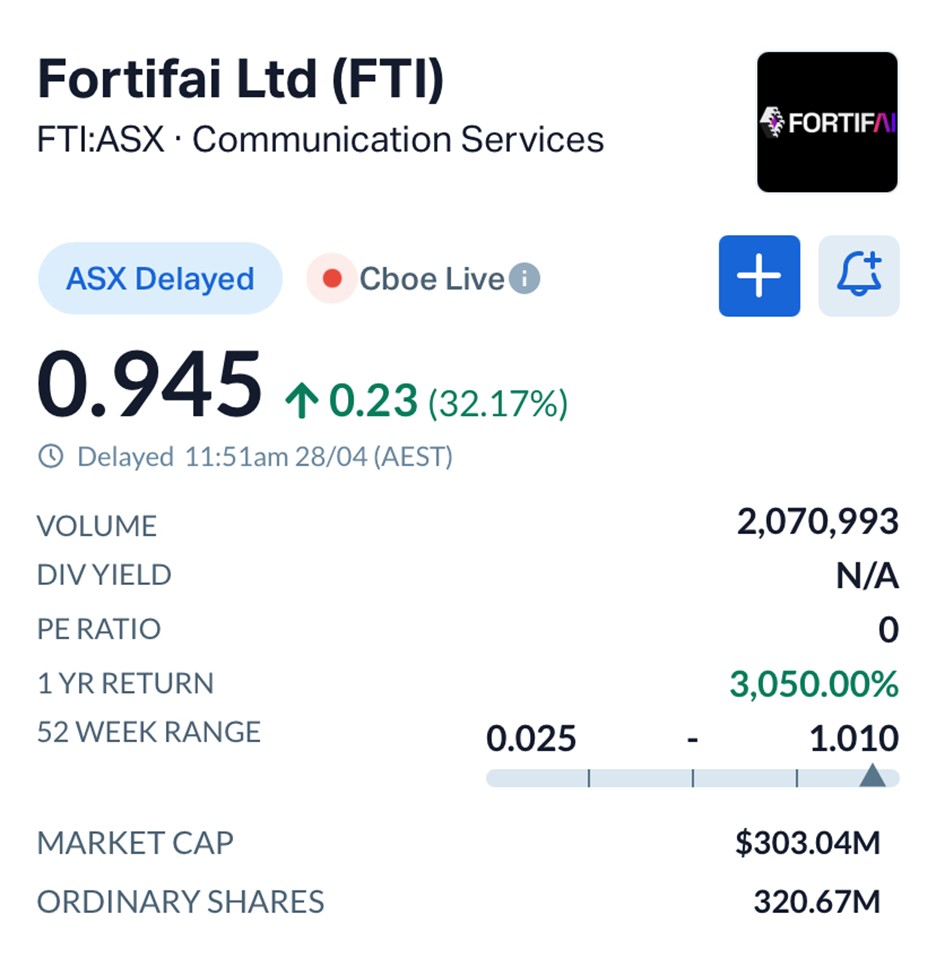
FortifAI shares surged 32.17% to $0.945, with trading volumes exceeding 2 million shares by late morning.
Source: MarketIndex
Over the past year, the stock has delivered a return of more than 3,000%, reflecting a rapid re-rating as the company transitions from a niche player to a potential infrastructure disruptor.
Stay ahead of the market
The most important stories, delivered to your inbox. No noise, just what matters.
By subscribing, you agree to our Privacy Policy.
The current market capitalisation sits around $303 million, placing it firmly in the small-cap category, but with growing attention from institutional capital.
From software race to infrastructure war
The broader AI narrative has largely been dominated by software players and large language models.
But beneath that layer, a quieter shift is taking place.
The focus is moving toward the “picks and shovels” of AI, the infrastructure that enables these systems to function at scale.
FortifAI is positioning itself within this layer.
Its Nol8 architecture is not competing with AI models. It is enabling them to run more efficiently, at lower cost, and with less reliance on traditional hardware stacks.
Infrastructure providers often capture long-term value because they sit beneath multiple applications and industries.
What comes next
The capital raise provides FortifAI with a war chest to engage with global enterprise partners.
The next phase will likely focus on:
- Converting benchmark validation into commercial deployments
- Securing design wins with large-scale enterprise clients
- Scaling production and distribution of Nol8 systems
Execution will be key.
Technology breakthroughs can attract attention, but sustained value depends on adoption.
The Bigger Picture
FortifAI’s latest announcement signals more than a strong quarter. It points to a potential architectural shift in how AI infrastructure is built and scaled. By demonstrating that one system can replace tens of thousands of CPUs while dramatically reducing costs, the company is challenging long-held assumptions about computing economics.
The strong institutional backing and immediate share price reaction suggest the market is beginning to recognise this shift. If FortifAI can translate technical validation into widespread adoption, it may not just participate in the AI boom but help define the infrastructure that powers it.
What is your take on this story?
This is user sentiment & not financial advice.
Disclaimer - Skrill Network is designed solely for educational and informational use. The content on this website should not be considered as investment advice or a directive. Before making any investment choices, it is crucial to carry out your own research, taking into account your individual investment objectives and personal situation. If you're considering investment decisions influenced by the information on this website, you should either seek independent financial counsel from a qualified expert or independently verify and research the information.