

From Speculation to Super-Profit DroneShield’s $216M Breakout Year Marks a New Era

Team Skrill Network
Team Skrill Network comprises seasoned professionals from diverse fields including Finance, Mining, Technology, Investing, and Digital Strategy. They bring a deep knowledge and understanding of financial markets and behavioural patterns to every story, ensuring credibility and precision in every piece. Whether analysing emerging market trends or spotlighting small- and mid-cap growth companies across ASX, TSX, or NASDAQ, the team’s editorial approach blends data-driven insights with compelling storytelling. Their expertise enables them to process complex developments into content that resonates with both institutional investors and retail audiences. Backed by experience in content curation, SEO strategy, and investor-focused messaging, the team of writers at Skrill Network are committed to delivering stories that matter—authentic, relevant, and strategically aligned with the evolving landscape of global investing.
Read more
Key Highlights
- Revenue surges 276% to $216.5 million in FY2025
- Underlying profit before tax jumps 1,686% to $33.3 million
- $210 million cash balance, zero debt
- $2.3 billion global sales pipeline
- SaaS revenue up 312% as software pivot accelerates
For months, it was labelled speculative.
On Wednesday, the numbers told a different story.
DroneShield Ltd delivered a 2025 result that signals its shift from a niche counter-drone technology player to a scaled, profitable defence manufacturer. The company reported revenue of $216.5 million, up 276 percent from $57.5 million the previous year.
Market Snapshot
Statutory profit after tax came in at $3.5 million, a dramatic turnaround from a $1.3 million loss in FY2024. Strip out non-cash items such as share-based payments and the transformation looks even sharper. Underlying profit before tax surged 1,686 percent to $33.3 million.
The market responded decisively. Shares climbed 10.96 percent to $3.34 by early afternoon trade, extending a 12-month gain of more than 320 percent. The company now carries a market capitalisation above $3 billion.
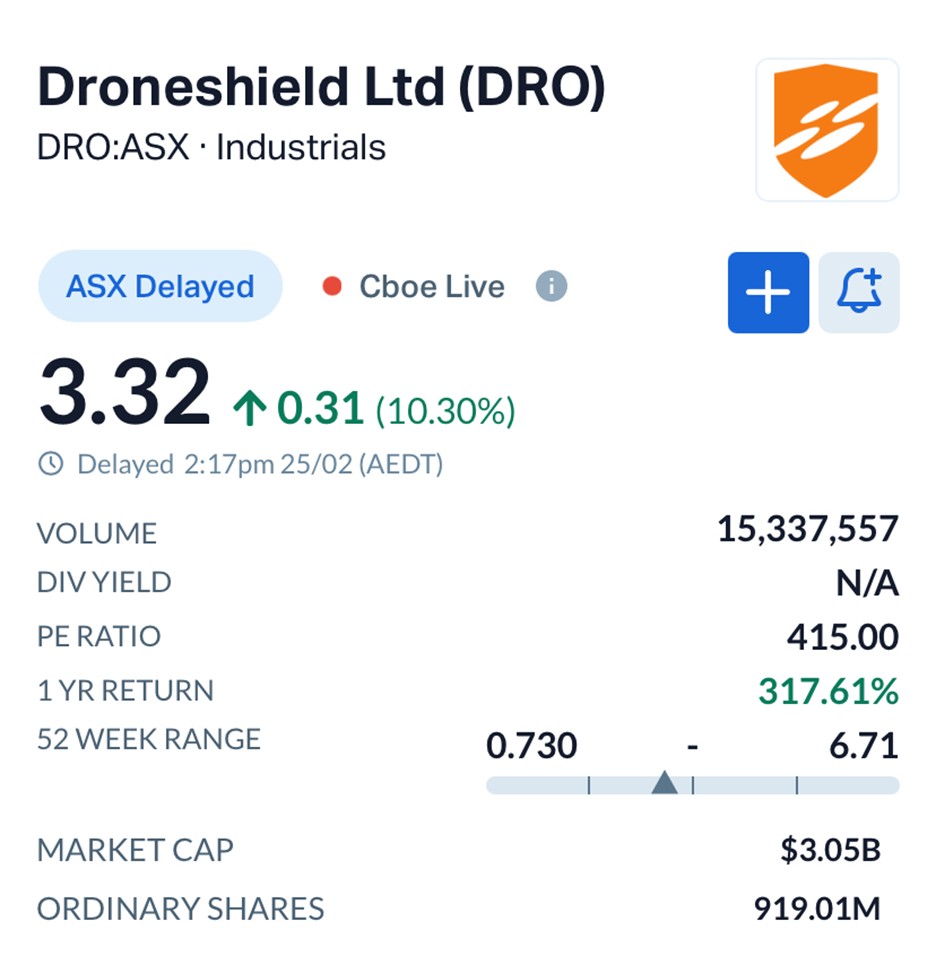
Source: MarketIndex
The Inflection Point
DroneShield’s annual report reads like a coming-of-age document.
The company ended the year with $210 million in cash and no debt. That war chest gives it strategic flexibility at a time when global defence spending remains elevated. According to data from SIPRI, global military expenditure has increased for nine consecutive years, reaching record levels in 2024. The war in Ukraine and broader geopolitical tensions have accelerated procurement cycles for counter-drone systems.
DroneShield is positioning itself squarely in that demand wave.
Its sales pipeline stands at $2.3 billion, spanning nearly 300 opportunities across Australia, the United States, Europe and the Middle East. Management also flagged plans to scale production capacity sixfold, from roughly $500 million annually to $2.4 billion by the end of 2026.
That is no longer startup ambition. It is industrial scale.
Not Just Hardware
One of the more significant shifts is happening beneath the surface.
Software-as-a-Service revenue grew 312 percent to $11.6 million. More than 3,000 AI-enabled devices are now connected under subscription models. Management has set a target for software to account for 30 percent of total revenue within five years.
Recurring software income typically attracts higher valuation multiples than one-off hardware sales. In simple terms, investors prefer predictable subscription streams over lumpy contract wins.
This pivot places DroneShield closer to defence tech platforms rather than traditional arms manufacturers.
The Fine Print
The results were not without caveats.
The company recorded a $10.3 million non-cash inventory impairment, largely tied to older DroneGun Mk3 units as customers rapidly migrated to newer Mk4 models. In fast-moving technology markets, obsolescence risk is real.
There was also $23.5 million in share-based payment expenses linked to executive incentives. While performance targets were met, governance-focused observers will note the size of that compensation relative to statutory profit.
These details matter. They temper the narrative of flawless execution.
The Defence Megatrend
The broader backdrop helps explain the momentum.
Counter-drone systems have shifted from experimental to essential. Small unmanned aerial vehicles have altered battlefield dynamics, particularly in Ukraine. Governments worldwide are investing in detection and neutralisation capabilities to protect infrastructure, military assets and civilian events.
Industry estimates place the total addressable market for counter-drone technologies above $60 billion globally over the coming decade.
DroneShield is positioning itself as a pure-play operator in that niche. Its inclusion in the S&P/ASX 200 has further boosted institutional visibility.
Stay ahead of the market
The most important stories, delivered to your inbox. No noise, just what matters.
By subscribing, you agree to our Privacy Policy.
The Valuation Question
At a trailing price to earnings ratio above 400, the stock is priced for growth. That valuation reflects expectations that a meaningful portion of the $2.3 billion pipeline converts into signed contracts.
Bulls argue that operating leverage is only just beginning. Revenue has surged while operating costs have grown at a slower rate. With $210 million in cash, the company can invest in research, acquisitions and capacity without relying on fresh equity.
Skeptics point to concentration risks and the possibility that defence spending growth moderates if geopolitical tensions ease. Pipeline opportunities are not guaranteed revenue.
The next 12 months will be critical in determining which side of the debate gains ground.
A New Identity
For much of its early life, DroneShield was viewed as an emerging technology play with uncertain earnings.
The FY2025 numbers challenge that perception.
Revenue of $216.5 million, positive statutory profit, strong cash reserves and expanding recurring software income mark a shift in maturity. Whether that momentum sustains will depend on contract conversion and disciplined execution.
For now, the company has delivered the kind of result that forces a reassessment.
Speculation has given way to super-profit.
What is your take on this story?
This is user sentiment & not financial advice.
Disclaimer - Skrill Network is designed solely for educational and informational use. The content on this website should not be considered as investment advice or a directive. Before making any investment choices, it is crucial to carry out your own research, taking into account your individual investment objectives and personal situation. If you're considering investment decisions influenced by the information on this website, you should either seek independent financial counsel from a qualified expert or independently verify and research the information.