

Humm Group Takeover Fight Escalates as Regulator Flags ‘Unacceptable’ Conduct

Team Skrill Network
Team Skrill Network comprises seasoned professionals from diverse fields including Finance, Mining, Technology, Investing, and Digital Strategy. They bring a deep knowledge and understanding of financial markets and behavioural patterns to every story, ensuring credibility and precision in every piece. Whether analysing emerging market trends or spotlighting small- and mid-cap growth companies across ASX, TSX, or NASDAQ, the team’s editorial approach blends data-driven insights with compelling storytelling. Their expertise enables them to process complex developments into content that resonates with both institutional investors and retail audiences. Backed by experience in content curation, SEO strategy, and investor-focused messaging, the team of writers at Skrill Network are committed to delivering stories that matter—authentic, relevant, and strategically aligned with the evolving landscape of global investing.
Read more
Key Highlights
- Takeovers Panel declares “unacceptable circumstances” in Humm saga
- Founder Andrew Abercrombie challenges ruling amid governance concerns
- Credit Corp bid of $0.77 per share remains central to dispute
- Shareholding lifted from 26.19% to 29.19% during contested period
- Extraordinary meeting set to decide board’s future in May
A corporate battle spilling into the open
What began as a routine takeover approach has evolved into one of the most closely watched boardroom conflicts on the ASX this year.
At the centre of it is Humm Group, a consumer finance company now caught between a premium takeover offer, internal power struggles, and a rare regulatory intervention.
This week, the Takeovers Panel stepped in with a decisive ruling. It declared that circumstances surrounding the company’s handling of a takeover proposal were “unacceptable,” effectively questioning whether the market had been properly informed.
Market Snapshot
The bid that triggered the storm
The dispute traces back to November 2025, when Credit Corp Group put forward an offer to acquire Humm at $0.77 per share under a scheme, or $0.72 via a takeover route.
The proposal represented a significant premium compared to earlier interest in the company, including a $0.58 per share bid linked to Humm’s own founder, Andrew Abercrombie.
On paper, it appeared straightforward. A higher offer had emerged, and the market was waiting for the board’s response.
What followed instead has become the subject of scrutiny.
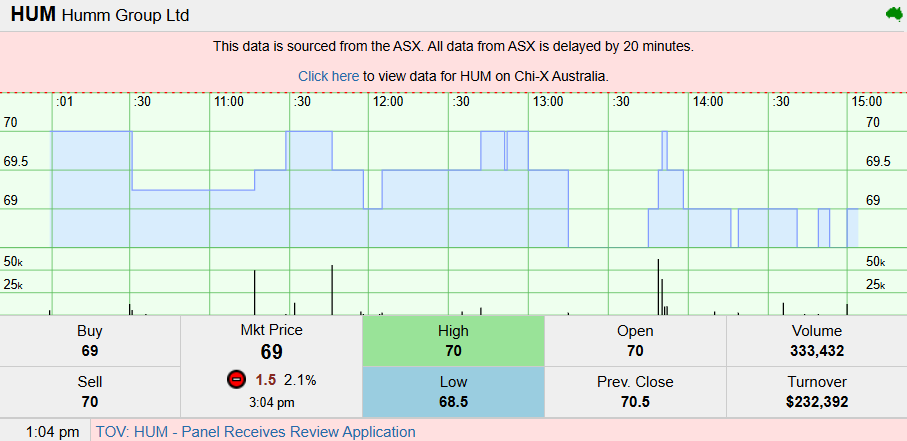
HUMM Group Stock Price DATA: 20th March 2026 | StocknessMonster
The disconnect between words and actions
According to the Takeovers Panel, Humm’s public messaging did not align with internal decisions.
On December 17, 2025, the company told the ASX it was “carefully evaluating” the Credit Corp proposal and was willing to engage.
However, evidence presented to the Panel showed that weeks earlier, on November 27, Mr. Abercrombie had already instructed advisers to treat the proposal as a “non-starter.”
In parallel, the company indicated that an Independent Board Committee would assess the offer.
The Panel found that no such committee was ever intended to be formed.
For a market that relies on transparency, this gap between communication and reality became the central issue.
The share purchase that raised eyebrows
The situation escalated further when Mr. Abercrombie increased his stake in the company.
Between December 17 and 19, immediately following the market announcement, his voting power rose from 26.19% to 29.19%.
This 3% increase may appear modest, but in takeover terms it is significant.
It strengthened his influence at a critical moment, potentially making it more difficult for Credit Corp to achieve the 50.1% acceptance threshold required under a takeover structure.
The Panel concluded that these purchases occurred in a market that had not been properly informed, raising concerns about fairness.
A rare regulatory rebuke
Declarations of “unacceptable circumstances” are not issued lightly.
They signal that the principles underpinning Australia’s takeover regime, including an efficient, competitive, and informed market, may have been compromised.
In this case, the Panel pointed to three key concerns.
First, the market may have been misled about the company’s willingness to engage with the offer.
Second, governance processes such as the Independent Board Committee were not accurately represented.
Third, the timing of share acquisitions created a potential imbalance in control.
Together, these findings elevate the situation from a commercial disagreement to a governance issue.
The founder fights back
Mr. Abercrombie has since filed a review application, challenging the Panel’s decision.
This introduces a new phase in the saga, one that could extend beyond the boardroom into a more formal legal process.
At the same time, attention is turning to the company’s leadership.
An Extraordinary General Meeting, now scheduled for May 1, 2026, will give shareholders the opportunity to vote on potential board changes.
Stay ahead of the market
The most important stories, delivered to your inbox. No noise, just what matters.
By subscribing, you agree to our Privacy Policy.
This adds another layer to an already complex situation, effectively turning the takeover into a referendum on governance.
A broader lesson in market trust
While the numbers and timelines are specific to Humm, the underlying themes resonate more widely.
Takeover battles are not new to the ASX. Similar conflicts have emerged in sectors ranging from mining to technology, often highlighting tensions between founders and shareholders.
What makes this case notable is the regulatory intervention.
It underscores the importance of clear communication during corporate transactions, particularly when control of a company is at stake.
What happens next
The immediate path forward hinges on two developments.
The outcome of Mr. Abercrombie’s review application will determine whether the Panel’s findings stand or are reconsidered.
At the same time, the May shareholder meeting will shape the company’s governance structure.
For Credit Corp, the situation remains fluid. The attractiveness of its offer is clear, but the pathway to execution has become more complicated.
Humm Group now finds itself in a position few companies anticipate.It is navigating a takeover proposal, a regulatory challenge, and an internal leadership contest all at once.
The coming weeks will be critical.
Whether the company moves toward a transaction, a board reshuffle, or a prolonged standoff will depend on how these parallel processes unfold.
What is your take on this story?
This is user sentiment & not financial advice.
Disclaimer - Skrill Network is designed solely for educational and informational use. The content on this website should not be considered as investment advice or a directive. Before making any investment choices, it is crucial to carry out your own research, taking into account your individual investment objectives and personal situation. If you're considering investment decisions influenced by the information on this website, you should either seek independent financial counsel from a qualified expert or independently verify and research the information.