

Ioneer (ASX INR) Slides Nearly 18% as Equity Raise Triggers Dilution Fears Despite US$50m Funding Win

Team Skrill Network
Team Skrill Network comprises seasoned professionals from diverse fields including Finance, Mining, Technology, Investing, and Digital Strategy. They bring a deep knowledge and understanding of financial markets and behavioural patterns to every story, ensuring credibility and precision in every piece. Whether analysing emerging market trends or spotlighting small- and mid-cap growth companies across ASX, TSX, or NASDAQ, the team’s editorial approach blends data-driven insights with compelling storytelling. Their expertise enables them to process complex developments into content that resonates with both institutional investors and retail audiences. Backed by experience in content curation, SEO strategy, and investor-focused messaging, the team of writers at Skrill Network are committed to delivering stories that matter—authentic, relevant, and strategically aligned with the evolving landscape of global investing.
Read more
Key Highlights
- Ioneer shares fall almost 18% after announcing a US$50 million equity raise
- Market reaction driven by dilution concerns, not project fundamentals
- Funds support the Rhyolite Ridge lithium-boron project in Nevada
- Heavy trading volume signals short-term selling pressure
- Lithium sector sentiment remains fragile amid volatile pricing
Shares in Ioneer Ltd (ASX: INR) were sharply lower on Friday, tumbling nearly 18% in late morning trade, as the market reacted to the company’s latest equity raising despite the headline securing of fresh U.S. funding.
At around midday, Ioneer was trading near A$0.17, placing it close to the lower end of its 52-week range of A$0.092 to A$0.285, with more than 17.6 million shares changing hands. The scale of the sell-off suggests investors were more focused on short-term dilution and funding structure than the longer-term strategic importance of the capital raised.
The company confirmed it had secured US$50 million (around A$72 million) through a single-tranche institutional placement, issuing approximately 400 million new shares at A$0.18 each, a 14.3% discount to the previous close.
Market Snapshot
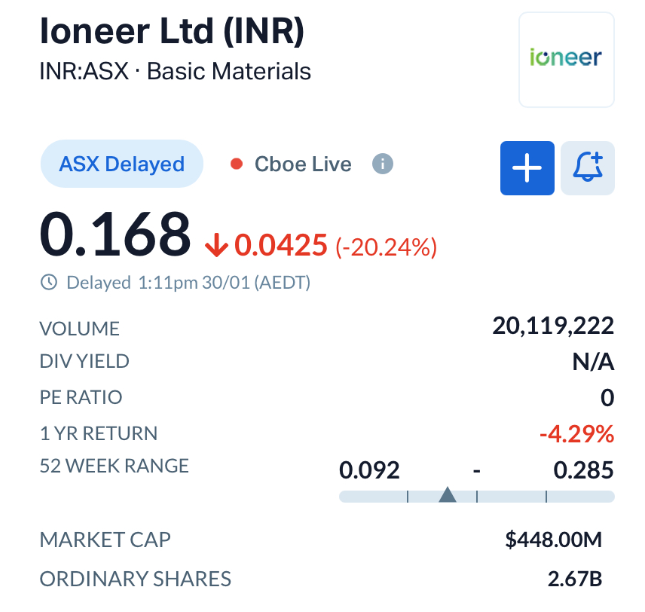
Source: MarketIndex
Why the Market Reacted So Sharply
On the surface, the announcement looked constructive. The capital raise strengthens Ioneer’s balance sheet and supports its ambition to become a U.S.-based supplier of critical minerals at a time when Washington is pushing to reduce reliance on China.
Yet markets are often unforgiving when it comes to equity dilution, especially in sectors already under pressure.
By issuing such a large block of new shares, Ioneer has materially expanded its share count, immediately reducing the ownership percentage of existing shareholders. For many short-term holders, that dilution outweighed the strategic benefits of the funding, prompting selling pressure soon after trading resumed.
The discount pricing also mattered. Placements below market price frequently act as a near-term anchor on share prices, as traders reassess valuation levels in light of the new issue price.
Lithium Sentiment Is Doing No Favours
Ioneer’s sell-off did not happen in isolation. The broader lithium sector has been grappling with volatile pricing, cautious capital markets, and delayed project timelines.
After the explosive rally seen between 2021 and 2023, sentiment toward lithium developers has cooled markedly. Investors have become more selective, favouring near-term cash flow and proven producers over capital-intensive developers still working toward construction.
That backdrop meant Ioneer’s announcement landed in a market already primed to scrutinise funding risk, execution timelines and balance-sheet strength.
What the Funding Is Actually For
According to the company, the proceeds will be used to accelerate development at its Rhyolite Ridge lithium-boron project in Nevada, one of the few permitted, shovel-ready lithium projects in the United States.
The funds are earmarked for:
- Long-lead items and early construction works
- Advancing project readiness
- Environmental commitments and permitting obligations
- Working capital and corporate purposes
Importantly, Rhyolite Ridge already holds key federal permits and is positioned within the U.S. government’s broader push to onshore critical minerals supply chains.
Management Pushes Back on Market Anxiety
Company leaders framed the placement as a vote of confidence rather than a setback.
Executive Chair James Calaway said the raise was a strong endorsement of Ioneer’s strategy and the strategic value of Rhyolite Ridge.
“The result of this offering is a strong endorsement of Ioneer’s strategy and the market’s understanding of the unique value and importance of Rhyolite Ridge to help onshore U.S. critical minerals production,” Calaway said.
“This funding milestone allows us to aggressively move towards commencing construction and advancing discussions with potential strategic partners.”
Managing Director Bernard Rowe echoed that view, highlighting the project’s readiness and national importance.
“This capital raise demonstrates clear market confidence in Ioneer and the Rhyolite Ridge Lithium-Boron Project,” Rowe said.
“With permitting complete, these funds enable us to strengthen our position as a key U.S. domestic supplier of two critical minerals and efficiently move toward construction.”
Heavy Volume Signals Short-Term Exit, Not Structural Damage
Friday’s trading volume was well above Ioneer’s recent average, suggesting short-term repositioning rather than a collapse in conviction.
Large equity raisings often trigger this pattern. Some investors step aside temporarily, waiting for the market to digest the new share supply before reassessing value. Others rotate capital into sectors with clearer near-term catalysts.
Stay ahead of the market
The most important stories, delivered to your inbox. No noise, just what matters.
By subscribing, you agree to our Privacy Policy.
From a technical perspective, the share price move reflects re-pricing, not new project risk.
Zooming Out: What Has Not Changed
Despite the sharp fall:
- Rhyolite Ridge remains fully permitted
- Ioneer still holds a U.S. Department of Energy loan facility secured in 2025
- Offtake agreements with major global partners remain intact
- The project sits at the centre of U.S. critical minerals policy
In other words, Friday’s reaction was driven more by capital structure mechanics than a deterioration in fundamentals.
The Bigger Picture for Lithium Developers
Ioneer’s experience highlights a broader reality for lithium juniors in 2026. Capital is still available, particularly for strategically important projects, but markets are demanding discipline, clarity and minimal dilution.
Securing funding is no longer enough. How that funding is structured, priced and timed now matters just as much.
As Reuters has previously reported, investors have grown wary of projects that rely heavily on equity markets in a weaker commodity cycle, even when geopolitical support is strong.
Bottom Line
Ioneer’s near-18% share price drop on Friday reflects short-term dilution fears and cautious lithium sentiment, not a rejection of its U.S. onshoring strategy.
The US$50 million raise strengthens the company’s ability to move toward construction at Rhyolite Ridge, but the market has made it clear that execution and capital discipline will be closely watched from here.
For now, the sell-off appears to be a market adjustment, not a verdict on the project itself.
What is your take on this story?
This is user sentiment & not financial advice.
Disclaimer - Skrill Network is designed solely for educational and informational use. The content on this website should not be considered as investment advice or a directive. Before making any investment choices, it is crucial to carry out your own research, taking into account your individual investment objectives and personal situation. If you're considering investment decisions influenced by the information on this website, you should either seek independent financial counsel from a qualified expert or independently verify and research the information.