

Ionic Rare Earths (ASX: IXR) Breakthrough UK Project Completes with Ford Success

Key Highlights
- Ionic Rare Earths completes UK-backed rare earth recycling project with Ford
- Recycled magnets matched performance of virgin production magnets in Ford motor testing
- Ionic Technologies produced high-purity rare earth oxides above 99.5% grade
- Project demonstrates a Western-based rare earth recycling supply chain
- Belfast commercial recycling plant development gains momentum with £11 million backing
The race for rare earth independence has quietly become one of the defining industrial battles of the decade.
Governments want secure supply chains. Automakers want reliable access to electric vehicle materials. Western economies want alternatives to China’s dominance in critical minerals.
On Monday, Ionic Rare Earths (ASX: IXR) moved one step closer to proving that recycling may become part of the answer.
The company announced the successful completion of the UK government-backed CLIMATES project, a collaboration involving Ford UK, Less Common Metals, GKN, and Ionic Technologies, the company’s wholly owned subsidiary focused on rare earth recycling.
The project achieved something that has long been discussed but rarely demonstrated at commercial relevance in the West: manufacturing electric motor magnets from recycled rare earth materials that perform just as well as newly mined products.
Shares in Ionic Rare Earths rose 1.72% to 29.5 cents during Monday afternoon trade, valuing the company at about $66.7 million.
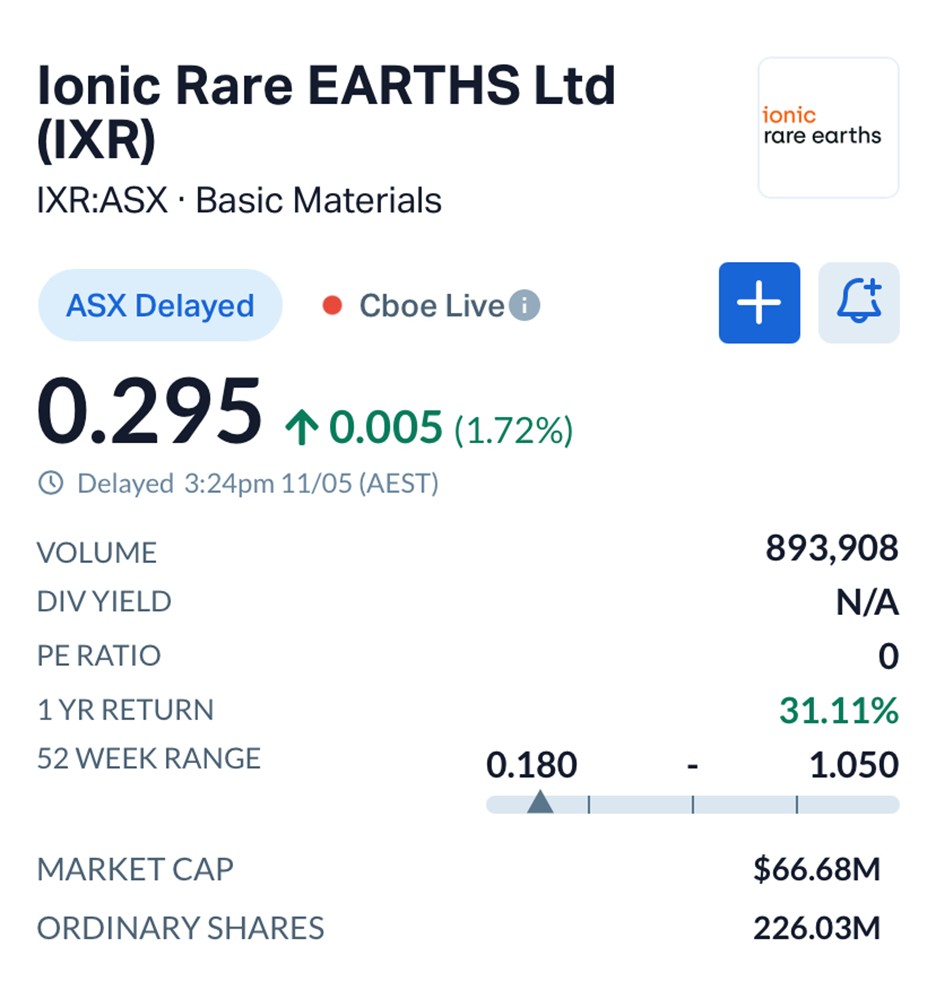
Source: MarketIndex
From discarded magnets to Ford-tested motors
At the centre of the announcement is what the company describes as a “long-loop” recycling process.
Ionic Technologies successfully extracted and refined high-purity neodymium, dysprosium, and terbium oxides from spent magnets and secondary feedstock materials, achieving purity levels above 99.5%.
Those materials were then converted back into permanent magnets and tested inside a Ford electric motor rotor.
The outcome matters because the recycled magnets passed durability testing with performance equivalent to traditional “virgin” magnets produced from newly mined rare earth materials.
That removes one of the biggest concerns surrounding recycled magnet supply chains.
Automotive manufacturers have historically worried recycled materials may not deliver the same consistency, heat resistance, or long-term reliability required for electric drivetrains.
Ford’s successful testing effectively provides industrial-scale validation.
The project was supported by InnovateUK and forms part of a broader UK government strategy aimed at rebuilding sovereign critical mineral capability.
Why rare earths matter so much
Rare earth magnets sit at the centre of modern electrification.
They are used in electric vehicle motors, wind turbines, defence systems, robotics, smartphones, and advanced industrial machinery.
Yet despite their importance, the global supply chain remains heavily concentrated.
China currently controls most of the world’s rare earth processing and magnet manufacturing capacity, giving Beijing enormous influence over pricing, exports, and downstream manufacturing access.
That concentration has increasingly become a geopolitical issue.
The United States, Europe, Australia, Japan, and the United Kingdom have all accelerated investment into alternative supply chains following years of trade tensions and growing concern over resource security.
Most of the conversation has focused on mining new deposits.
Ionic Rare Earths is taking a different path.
Rather than competing to dig new material from the ground, the company is targeting what many analysts now call the “urban mine” — discarded electronics, industrial scrap, and spent magnets already circulating inside the economy.
Recycling moves from theory to industrial reality
For years, recycling rare earth magnets was viewed as technically difficult and commercially uncertain.
The metals are complex to separate, expensive to refine, and often embedded in sophisticated manufacturing systems.
The CLIMATES project appears to show those barriers are beginning to break down.
The company described the achievement as a significant advance toward creating a “sovereign, secure and sustainable UK rare earth permanent magnet supply chain” for advanced manufacturing, defence, and renewable energy.
Supply chain resilience is now being treated almost as seriously as energy security.
The timing also aligns with growing pressure on automakers to improve environmental performance across their full manufacturing process.
Stay ahead of the market
The most important stories, delivered to your inbox. No noise, just what matters.
By subscribing, you agree to our Privacy Policy.
Recycled rare earth materials carry a significantly lower environmental footprint compared to traditional mining and refining operations.
As ESG requirements tighten globally, “green magnets” could eventually command premium pricing.
Belfast becomes the next focus
Attention now shifts toward commercial scale-up.
Ionic Technologies is advancing plans for a Belfast-based commercial rare earth recycling facility supported by the £11 million CirculaREEconomy partnership.
The project aims to establish one of the first large-scale Western recycling hubs capable of processing end-of-life rare earth magnets back into usable industrial feedstock.
For the UK, the project fits within a broader push to rebuild domestic industrial capability tied to electric vehicles and clean energy manufacturing.
Success in Belfast could position the company as one of the few listed rare earth players offering exposure to the recycling side of the supply chain rather than conventional mining alone.
That distinction is increasingly important as governments seek lower-carbon and geopolitically secure sources of critical minerals.
A changing rare earth narrative
The rare earth sector has traditionally been dominated by stories about exploration, deposits, and processing bottlenecks.
The company’s success with Ford suggests recycled materials are no longer being treated as inferior substitutes.
Instead, they are beginning to emerge as a commercially viable supply source for global manufacturers.
For a market increasingly focused on energy transition, supply chain resilience, and industrial independence, that may prove to be one of the more important developments happening quietly beneath the surface of the EV boom.
What is your take on this story?
Disclaimer - Skrill Network is designed solely for educational and informational use. The content on this website should not be considered as investment advice or a directive. Before making any investment choices, it is crucial to carry out your own research, taking into account your individual investment objectives and personal situation. If you're considering investment decisions influenced by the information on this website, you should either seek independent financial counsel from a qualified expert or independently verify and research the information.