

IperionX (NASDAQ: IPX, ASX: IPX) wins Rheinmetall prototype order as U.S. titanium reshoring shifts from funding to field tests

Team Skrill Network
Team Skrill Network comprises seasoned professionals from diverse fields including Finance, Mining, Technology, Investing, and Digital Strategy. They bring a deep knowledge and understanding of financial markets and behavioural patterns to every story, ensuring credibility and precision in every piece. Whether analysing emerging market trends or spotlighting small- and mid-cap growth companies across ASX, TSX, or NASDAQ, the team’s editorial approach blends data-driven insights with compelling storytelling. Their expertise enables them to process complex developments into content that resonates with both institutional investors and retail audiences. Backed by experience in content curation, SEO strategy, and investor-focused messaging, the team of writers at Skrill Network are committed to delivering stories that matter—authentic, relevant, and strategically aligned with the evolving landscape of global investing.
Read more%252520wins%252520Rheinmetall%252520prototype%252520order%252520as%252520U.S.%252520titanium%252520reshoring%252520shifts%252520from%252520funding%252520to%252520field%252520tests.webp&w=3840&q=75)
Key Highlights
- IperionX lands a US$0.3m prototype order from American Rheinmetall to supply 700 titanium track pins for U.S. Army heavy ground combat systems, with delivery targeted within 8 to 9 months.
- The parts will be produced in the U.S. using 100% recycled titanium feedstock, via IperionX’s HAMR and HSPT processes.
- A week earlier, IperionX confirmed it had received the final US$4.6m tranche of its US$47.1m U.S. Department of War IBAS award, supporting scale-up planning toward 1,400 tonnes per annum at its Virginia campus.
- The U.S. Government also transferred about 290 metric tons of Ti64 titanium scrap at no cost, which IperionX says equates to about 1.5 years of feedstock at its current 200 tpa full operating capacity.
IperionX (NASDAQ: IPX, ASX: IPX) has spent the past year talking about building a domestic titanium supply chain that is cheaper, cleaner, and less exposed to geopolitics. This week brought a practical proof point.
The company says it has received a US$0.3 million prototype purchase order from American Rheinmetall to produce 700 lightweight titanium components (track pins) for U.S. Army heavy ground combat systems, with delivery expected within 8 to 9 months.
It is not a large revenue number in isolation. But as a signal, it matters. Prototype orders are the early gates that tell you whether an industrial story is staying in the “grant and pilot” lane or moving into the “use it on real platforms” lane. IperionX’s announcement frames this as the latter, calling the order an initial scope that could expand if the delivery is successful.
Market Snapshot
What the order is, and why it is a meaningful test
The core of the purchase order is straightforward: 700 titanium track pins, worth about US$300,000, for heavy ground combat vehicles. Track pins are not glamorous. They are, however, high-wear components that sit in a system designed to endure heat, impact, grit, and long duty cycles. If you want to stress-test a “new” production pathway, a part like this is a decent place to start.
IperionX says the parts will be made in the United States using 100% recycled titanium feedstock and produced through its patented Hydrogen Assisted Metallothermic Reduction (HAMR) and Hydrogen Sintering and Phase Transformation (HSPT) technologies.
The company’s claim is not just that it can make titanium domestically, but that it can do so at materially lower cost than conventional routes. In the defense context, cost matters, but so does reliability of supply, repeatability of quality, and the ability to scale without hitting a logistics wall.
The “lightweighting” angle
Heavy military vehicles have a recurring design problem: every new capability tends to add mass. Better armour adds weight. Counter-drone and counter-UAS systems add weight. Survivability upgrades add weight. That can reduce mobility, range, and flexibility.
IperionX’s release leans into a simple proposition: replace steel components with titanium to reduce weight while maintaining strength. It says the swap can deliver a 40% to 45% weight reduction per component, which could translate into several hundred kilograms less per vehicle, depending on the final configuration.
That weight reduction has downstream benefits the company lists in practical terms: faster acceleration and better agility, increased operational range and survivability, and reduced ground pressure which can improve traction in softer terrain. The math of this is intuitive: lighter platforms generally require less energy to move and can be more manoeuvrable, especially over mixed ground.
IperionX CEO Taso Arima said:
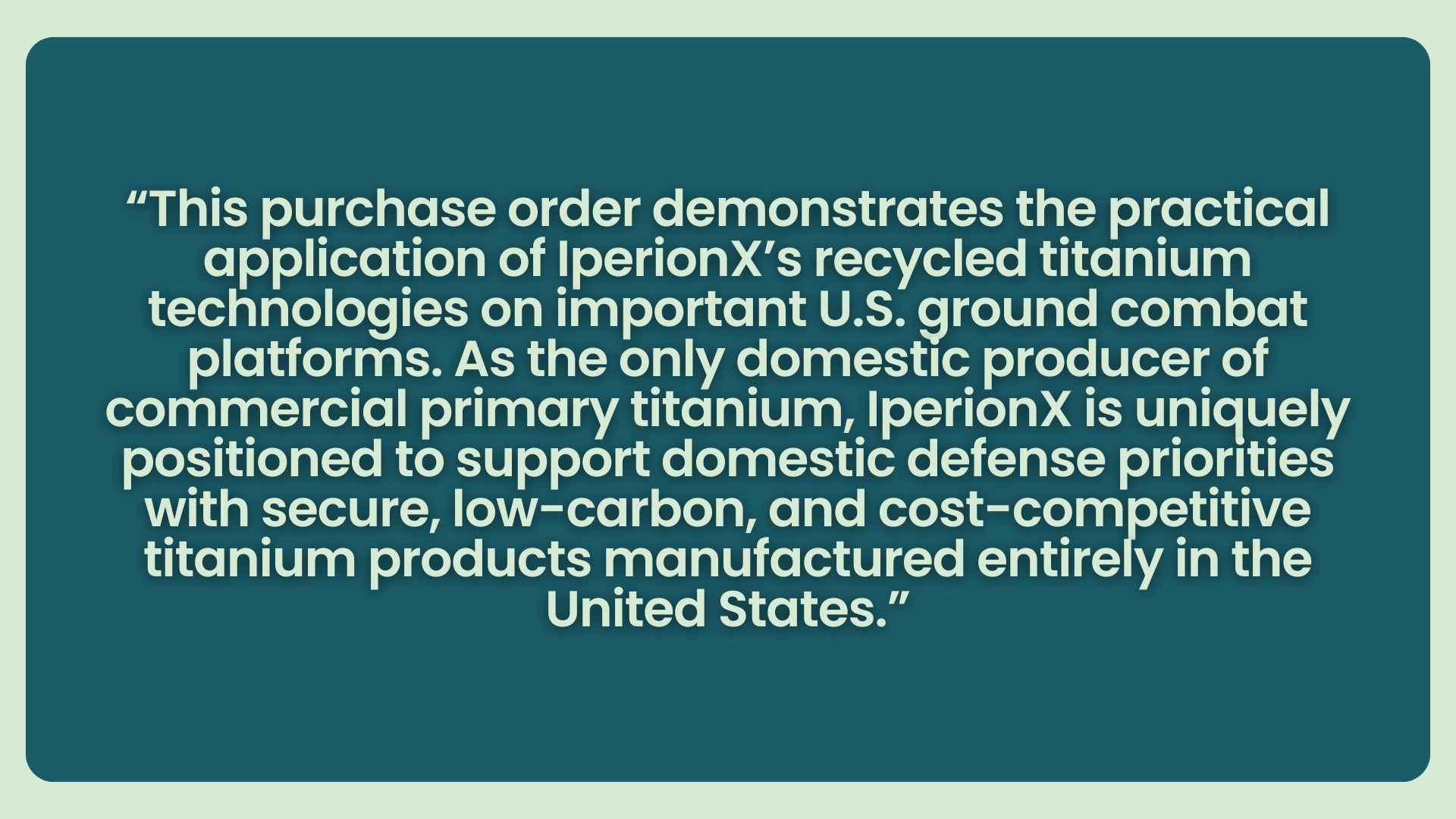
Source: IperionX ASX Announcement
The framing is notable for what it emphasises: not just performance, but security of supply, a lower-carbon pathway, and cost competitiveness. Those are the attributes that tend to decide whether a prototype becomes a program.
The bigger context: a week of “supply chain” milestones
The prototype order did not arrive in a vacuum. On January 16, IperionX announced it had received the final US$4.6 million obligation under a previously awarded US$47.1 million U.S. Department of War program (IBAS).
The company said the funding will be applied to scale-up work at its Titanium Manufacturing Campus in Virginia, targeting output of up to 1,400 metric tons per year. It also noted that planning, design, and long-lead activities were underway.
Alongside the funding, the U.S. Government transferred about 290 metric tons (320 short tons) of Ti64 titanium scrap at no cost. IperionX said that volume equates to roughly 1.5 years of titanium feedstock at the company’s current 200 metric tons per year full operating capacity, and that it already held around 90 metric tons of scrap inventory (excluding the government transfer).
Taken together, the two updates show a sequence that is easy for readers to follow:
First, a government-backed package that improves funding certainty and feedstock availability.
Then, a defense-adjacent prototype order that tests whether the production pathway translates into real components for real platforms.
Stock Price Snapshot:
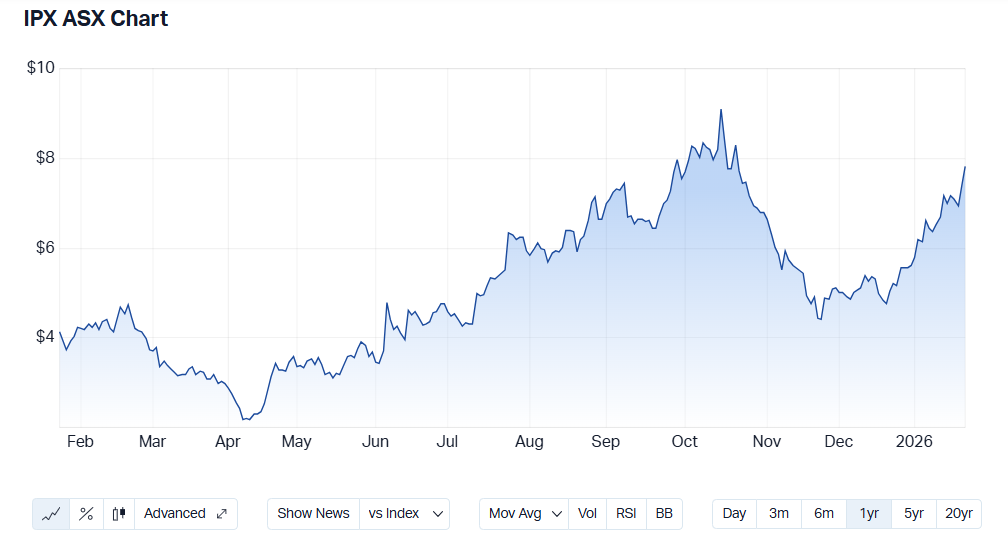
IperionX shares were last at $7.82, up $0.43 (5.82%), after trading between $7.48 and $7.90. Turnover was about $4.32 million on 560,816 shares, with VWAP at $7.705 and the prior close at $7.39 (last trade 2:32pm AEDT). The stock is up 9.22% over a week, 55.47% over a month, 39.64% year-to-date, and 88.43% over one year, outperforming the ASX 200 by 83.52% on a one-year basis.
Stay ahead of the market
The most important stories, delivered to your inbox. No noise, just what matters.
By subscribing, you agree to our Privacy Policy.
What to watch next
A prototype purchase order is still a prototype purchase order. It is a validation step, not a guarantee of scale.
So the next checkpoints are fairly concrete:
Delivery execution: the company says delivery is targeted within 8 to 9 months. Meeting that window matters because defense supply chains are as much about schedule discipline as they are about metallurgy.
Repeatability: one run can prove a concept; repeated runs prove manufacturability.
Scale-up progress in Virginia: the company has pointed to 1,400 tpa as its expansion target, and it has now confirmed all US$47.1 million of IBAS obligations have been received.
If those pieces land cleanly, the narrative becomes less about “can it work” and more about “how fast can it scale”.
Why titanium sits in the “strategic materials” bucket
IperionX describes itself as the only domestic U.S. producer of commercial-scale primary titanium metal, and notes that titanium is designated as strategic and critical by the U.S. Government, with the U.S. historically reliant on foreign titanium sponge and upstream processing.
The practical takeaway is simple: the more a material is tied to defense and aerospace, the more governments tend to care about domestic capacity, redundancy, and secure inputs. The funding and scrap transfer announced on January 16 explicitly framed IBAS as a program designed to reinforce defense supply chains and reduce reliance on imports.
What is your take on this story?
This is user sentiment & not financial advice.
Disclaimer - Skrill Network is designed solely for educational and informational use. The content on this website should not be considered as investment advice or a directive. Before making any investment choices, it is crucial to carry out your own research, taking into account your individual investment objectives and personal situation. If you're considering investment decisions influenced by the information on this website, you should either seek independent financial counsel from a qualified expert or independently verify and research the information.