

Lindian Resources (ASX LIN) Rockets on ‘Defining’ Kazakhstan Deal

Team Skrill Network
Team Skrill Network comprises seasoned professionals from diverse fields including Finance, Mining, Technology, Investing, and Digital Strategy. They bring a deep knowledge and understanding of financial markets and behavioural patterns to every story, ensuring credibility and precision in every piece. Whether analysing emerging market trends or spotlighting small- and mid-cap growth companies across ASX, TSX, or NASDAQ, the team’s editorial approach blends data-driven insights with compelling storytelling. Their expertise enables them to process complex developments into content that resonates with both institutional investors and retail audiences. Backed by experience in content curation, SEO strategy, and investor-focused messaging, the team of writers at Skrill Network are committed to delivering stories that matter—authentic, relevant, and strategically aligned with the evolving landscape of global investing.
Read more
Key Highlights:
- LIN surges 23.6% to $0.655, near 52-week high
- Acquires operational Kazakhstan MREC plant for US$15m
- Comparable greenfield cost estimated above $500m
- Downstream MREC production targeted for Q4 2026
- 92% TREO and ~97% NdPr recovery confirmed by ANSTO
Shares in Lindian Resources Ltd jumped sharply on Tuesday after the company unveiled what Executive Chairman Robert Martin called a “defining step” in its evolution from miner to integrated rare earths producer.
Lindian was trading at $0.655, up 23.59%, with more than 44 million shares changing hands. The stock is now up nearly 590% over the past year, lifting its market capitalisation to about $1.1 billion.
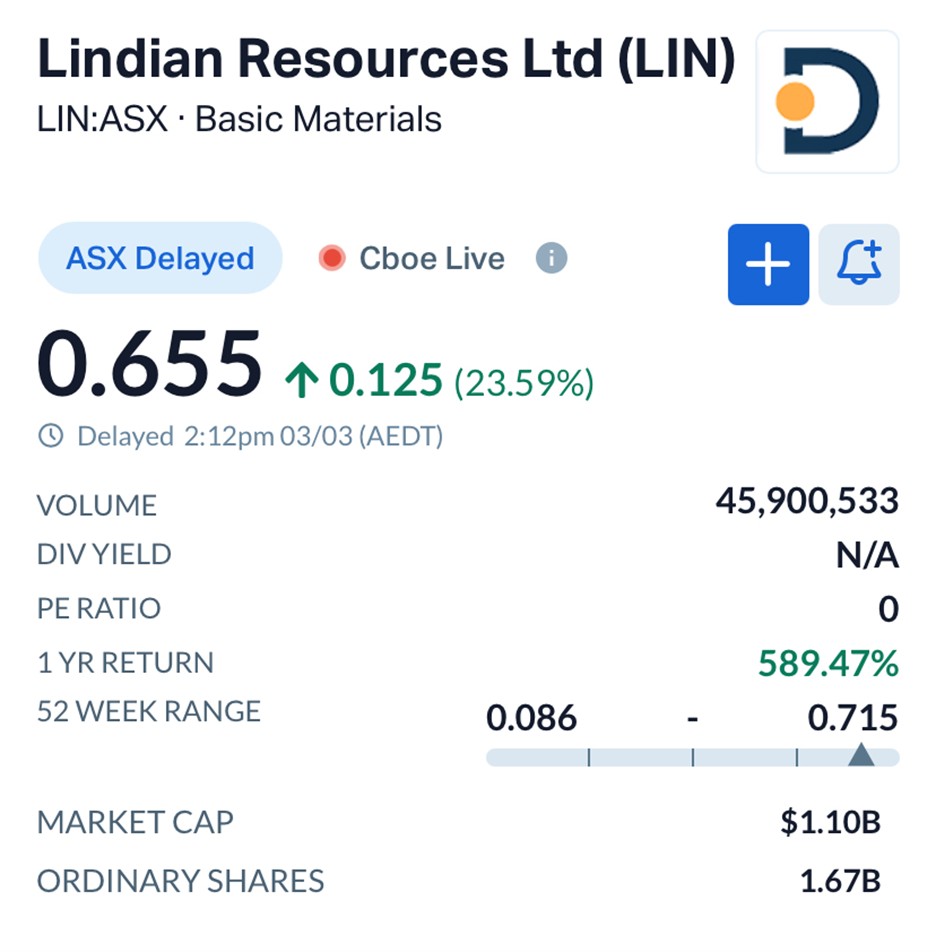
Market Snapshot
Source: MarketIndex
The catalyst is a binding term sheet to acquire 100% of the SARECO hydrometallurgical plant in Stepnogorsk, Kazakhstan, through a 51:49 incorporated joint venture with local partner RA Group.
The price tag is US$15 million.
In mining terms, that number stands out.
Lindian is building a new cracking and leaching plant of similar scale can cost between $555 million and $800 million, based on recent disclosures from peers such as Arafura Rare Earths and Lynas. By buying an existing operational facility, Lindian has effectively skipped years of permitting and hundreds of millions in capital expenditure.
“This transaction positions Lindian to be one of the very few non-Chinese companies globally producing both rare earth concentrate and MREC,” Mr Martin said.
“What makes this transaction particularly compelling is the capital efficiency. Securing a fully constructed, operational cracking facility for US$15 million, compared to over half a billion dollars typically required for greenfield downstream development, allows Lindian to avoid years of development, construction, permitting and balance sheet risk whilst maintaining our first to market approach.”
From concentrate to higher-value product
Until now, Lindian’s strategy centred on producing monazite concentrate from its Kangankunde project in Malawi.
The SARECO acquisition changes that.
Instead of selling concentrate alone, the company will now produce Mixed Rare Earth Carbonate, known as MREC. This is a chemically upgraded intermediate product that commands higher payabilities because it sits further along the processing chain and can be fed directly into separation plants.
Stage 1 production is expected to supply about 12,500 tonnes per annum of monazite concentrate to the Kazakhstan plant, with both mine and downstream facility targeted to be operational by Q4 2026.
In mining timelines, that is considered near term.
Independent testwork by the Australian Nuclear Science and Technology Organisation confirmed strong metallurgical performance. Results showed 91 to 94% total rare earth extraction and up to 97% recovery for neodymium and praseodymium, the key magnet metals used in electric vehicles and wind turbines. Uranium and thorium levels were below detection limits in the final product, simplifying logistics and customer acceptance.
Mr Martin said the downstream capability “materially enhances margins, commercial flexibility and long term strategic value.”
A geopolitical tailwind
The timing of the acquisition is also notable.
In November 2025, the United States and Kazakhstan signed a Memorandum of Understanding to strengthen cooperation in critical minerals supply chains. The agreement builds on the C5+1 Critical Minerals Dialogue and reflects Western efforts to diversify away from Chinese-dominated processing networks.
Kazakhstan is already the world’s largest uranium producer and is positioning itself as a strategic partner for rare earth processing.
Kazakh Minister of Industry and Construction Yersaiyn Nagaspayev said the project “places our Central Asian country in unique position in the global supply chain of Rare Earths combining upstream Kangankunde feedstock from Malawi and midstream processing capability in Stepnogorsk.”
He added that the project would receive necessary support given its strategic importance.
For Lindian, this alignment means its downstream plant sits within an increasingly Western-backed critical minerals corridor, with access to European OEMs and magnet manufacturers under the European Critical Raw Materials Act framework.
Stay ahead of the market
The most important stories, delivered to your inbox. No noise, just what matters.
By subscribing, you agree to our Privacy Policy.
Additional upside
The SARECO plant also produces a phosphate-based byproduct that can be sold as trisodium phosphate or processed into granular NP(S) fertiliser. Market pricing for these products typically ranges between US$300 and US$700 per tonne, depending on specification and region.
While not central to the investment case, the fertiliser stream could provide incremental revenue and improve overall project economics.
Market reaction
The strong share price move reflects how materially the deal reshapes Lindian’s risk profile.
Instead of facing multi-year construction and funding uncertainty for a greenfield plant, the company is acquiring established infrastructure with existing permits, utilities and workforce in place.
Completion remains subject to due diligence, definitive agreements and regulatory approvals. The majority of the purchase price is deferred until three months after commercial production, which reduces upfront balance sheet strain.
For a company previously seen as an upstream developer, the move into integrated production marks a structural shift.
If delivered on schedule, Lindian would join a small group of non-Chinese producers capable of supplying both concentrate and MREC by 2026.
In a market increasingly defined by supply chain security, that positioning may prove as valuable as the rare earths themselves.
Source: Lindian ASX announcement dated 3 March 2026 and market data.
What is your take on this story?
This is user sentiment & not financial advice.
Disclaimer - Skrill Network is designed solely for educational and informational use. The content on this website should not be considered as investment advice or a directive. Before making any investment choices, it is crucial to carry out your own research, taking into account your individual investment objectives and personal situation. If you're considering investment decisions influenced by the information on this website, you should either seek independent financial counsel from a qualified expert or independently verify and research the information.