


MARKETS LIVE: ASX Pushes Higher as Oil Rebounds on Geopolitical Jitters; GYG Surges on US Exit

Team Skrill Network
Team Skrill Network comprises seasoned professionals from diverse fields including Finance, Mining, Technology, Investing, and Digital Strategy. They bring a deep knowledge and understanding of financial markets and behavioural patterns to every story, ensuring credibility and precision in every piece. Whether analysing emerging market trends or spotlighting small- and mid-cap growth companies across ASX, TSX, or NASDAQ, the team’s editorial approach blends data-driven insights with compelling storytelling. Their expertise enables them to process complex developments into content that resonates with both institutional investors and retail audiences. Backed by experience in content curation, SEO strategy, and investor-focused messaging, the team of writers at Skrill Network are committed to delivering stories that matter—authentic, relevant, and strategically aligned with the evolving landscape of global investing.
Read more
Key Highlights
- ASX 200 trades higher as weaker jobs data cools fears of more RBA tightening
- Guzman y Gomez jumps 14% after shutting down its underperforming US operations
- Brent crude rebounds above US$104 a barrel amid renewed Middle East uncertainty
- Australian unemployment rises to 4.5%, with 18,600 jobs lost during the month
- Materials and tech stocks lead gains while utilities and energy lag
Australian shares edged higher on Friday as traders balanced slowing domestic economic data against easing interest rate fears, while oil prices swung sharply on renewed geopolitical unease in the Middle East.
The benchmark S&P/ASX 200 hovered between 8,651 and 8,666 points through the session, tracking modest gains across Wall Street overnight after the Dow Jones closed at another record high.
The broader All Ordinaries index climbed 0.54% to 8,888.6 points, while the ASX All Technology Index was largely flat as investors rotated selectively into software and AI-linked names.
Market Snapshot
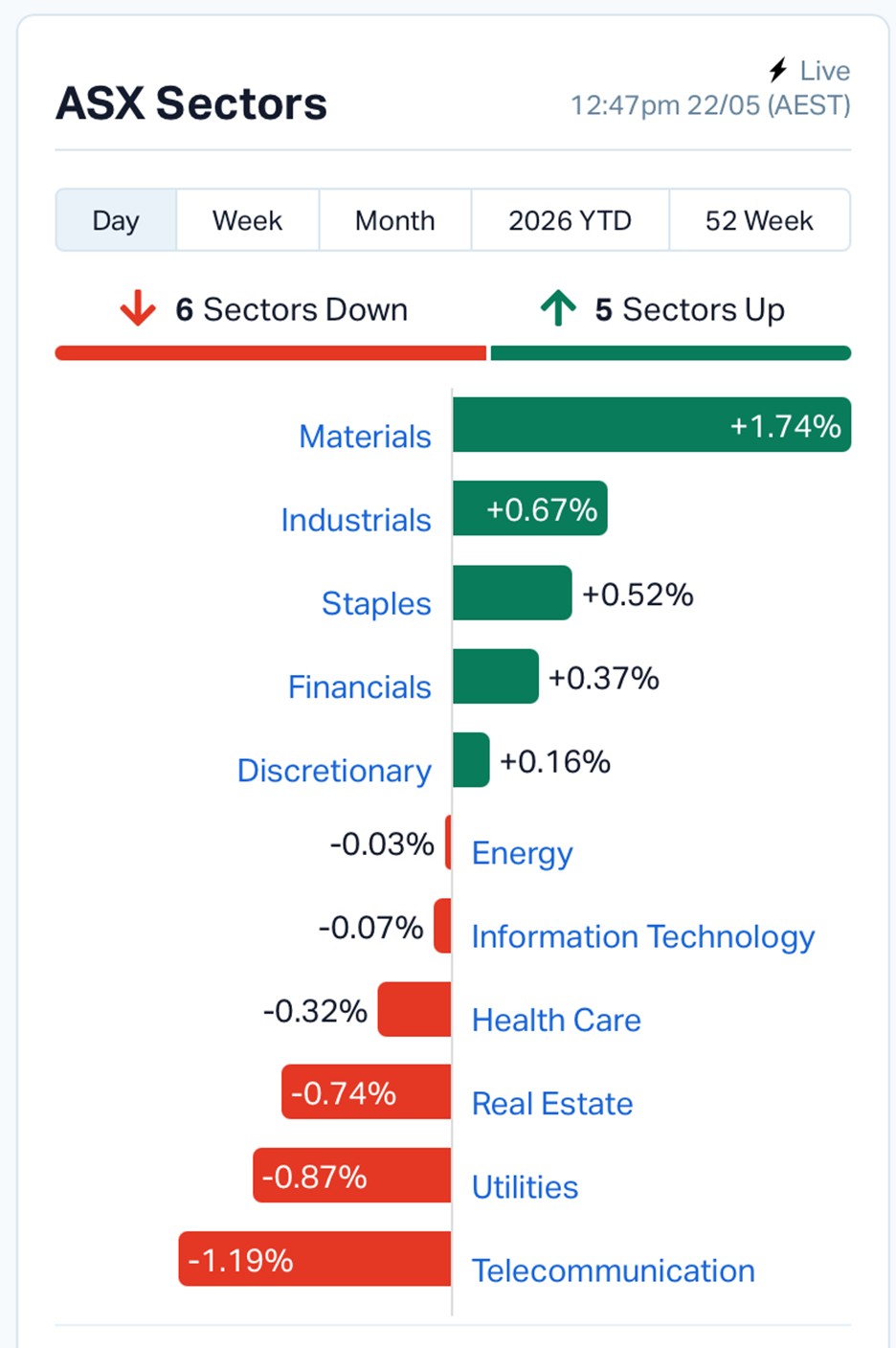
ASX Sector Snapshot | Source: MarketIndex
The tone across the market reflected a familiar dynamic beginning to emerge in 2026: softer economic data is increasingly being interpreted as positive for equities because it reduces the likelihood of further aggressive interest rate hikes from the Reserve Bank of Australia.
Australia’s unemployment rate unexpectedly climbed from 4.3% to 4.5%, while the economy shed 18,600 jobs over the month. The weaker labour data arrived alongside soft business confidence readings and subdued consumer activity, reinforcing expectations that the RBA may soon pause its tightening cycle.
HSBC Chief Economist Paul Bloxham said the labour market deterioration was beginning to align with broader economic softness.
“When combined with weaker business confidence and consumer sentiment, the jump in unemployment suggests the economy may be heading into a sharper downturn,” he said.
The Australian dollar remained subdued at around 71.44 US cents as bond markets adjusted to a softer domestic growth outlook.
Oil markets, meanwhile, reversed course overnight.
Brent crude rose almost 2% to US$104.60 a barrel after fresh geopolitical concerns resurfaced around the Middle East. Traders continue to react to every headline tied to negotiations involving Iran and broader regional security risks, with volatility remaining elevated across global energy markets.
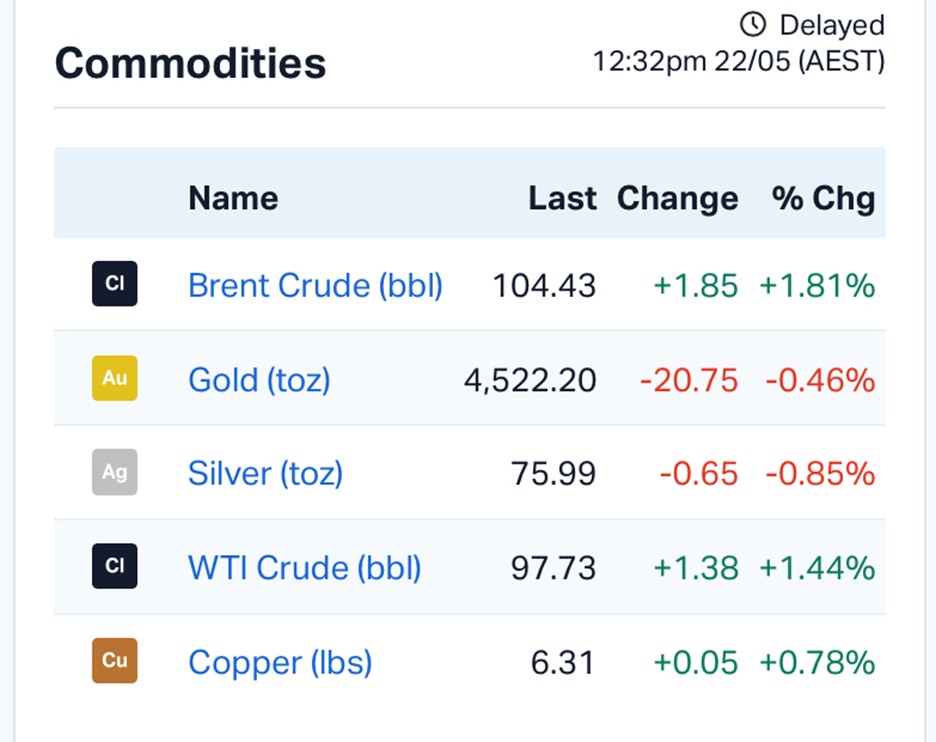
Commodities Index | Source: MarketIndex
That rebound in oil prices did little to help local energy stocks, however, with the ASX energy sector slipping 0.89% as broader caution lingered around global growth and commodity demand.
Materials stocks led the market higher, gaining 1.75%, helped by strength across selective mining and battery-linked names. Financials and industrials also pushed modestly into positive territory.
The standout corporate story of the day came from Guzman y Gomez, which surged more than 14% after announcing the closure of its struggling US operations in Chicago.
The burrito chain’s decision to exit the United States was interpreted by the market as a disciplined retreat designed to protect margins and refocus capital on its highly profitable Australian business.
Founder and co-chief executive Steven Marks said the company had concluded the American rollout would require far more time and capital than initially expected.
“I realized this was going to take significantly more time and capital than we had expected,” Marks said.
“The business is unlikely to deliver the performance that would justify continued investment of shareholder capital. Concentrating our capital behind Australia is the most effective way to compound value.”
The market appeared to welcome the decisiveness.
Analysts at RBC Capital Markets described the withdrawal as a positive development, arguing the underperforming US division had been dragging on group earnings and distracting from the company’s core domestic growth engine.
RBC said exiting early could improve FY27 profit forecasts by roughly 20% once one-off shutdown costs are stripped out.
Stay ahead of the market
The most important stories, delivered to your inbox. No noise, just what matters.
By subscribing, you agree to our Privacy Policy.
The reaction underlined a broader trend now shaping equity markets globally: investors are rewarding companies willing to prioritise profitability and disciplined capital allocation over aggressive expansion.
Elsewhere, AI and defence-linked stocks continued to attract strong speculative interest.
Electro Optic Systems jumped 11.35%, while Appen rallied 10.71% as traders rotated back into beaten-down technology names.
Weebit Nano also gained 7.66% amid ongoing enthusiasm surrounding semiconductor and memory technologies tied to artificial intelligence infrastructure demand.
On the downside, Energy Resources of Australia tumbled 16.67%, while lithium producer Core Lithium lost nearly 5% as commodity price weakness continued to pressure battery material names.
Outside equities, spot gold eased 0.33% to US$4,528 an ounce, while iron ore slipped 1.2% to US$105.90 a tonne.
Bitcoin traded slightly lower around US$77,391 as crypto markets remained relatively subdued despite ongoing macro volatility.
Another emerging tension point for local markets is Victoria’s proposed workplace legislation designed to strengthen working-from-home protections. Business groups argue the rules risk increasing compliance burdens while further weakening CBD office occupancy rates.
At the same time, rising fuel costs and supply chain pressures continue to weigh heavily on Australia’s construction sector, with analysts warning that escalating project costs could reduce future housing supply over the next several years.
For now, though, Friday’s session reflected a market increasingly focused on one thing: the possibility that economic weakness may finally start easing pressure on interest rates.
What is your take on this story?
This is user sentiment & not financial advice.
Disclaimer - Skrill Network is designed solely for educational and informational use. The content on this website should not be considered as investment advice or a directive. Before making any investment choices, it is crucial to carry out your own research, taking into account your individual investment objectives and personal situation. If you're considering investment decisions influenced by the information on this website, you should either seek independent financial counsel from a qualified expert or independently verify and research the information.


%2520Up%2520676%2525%2520in%252012%2520Months%2520Forrest%2520Stake%2520Trade%2520Sparks%252065M%2520Share%2520Buying%2520Frenzy.png&w=3840&q=75)