


Mesoblast (ASX MSB) Reaches Key Milestone as Phase 3 Back Pain Trial Fully Enrolled

Team Skrill Network
Team Skrill Network comprises seasoned professionals from diverse fields including Finance, Mining, Technology, Investing, and Digital Strategy. They bring a deep knowledge and understanding of financial markets and behavioural patterns to every story, ensuring credibility and precision in every piece. Whether analysing emerging market trends or spotlighting small- and mid-cap growth companies across ASX, TSX, or NASDAQ, the team’s editorial approach blends data-driven insights with compelling storytelling. Their expertise enables them to process complex developments into content that resonates with both institutional investors and retail audiences. Backed by experience in content curation, SEO strategy, and investor-focused messaging, the team of writers at Skrill Network are committed to delivering stories that matter—authentic, relevant, and strategically aligned with the evolving landscape of global investing.
Read more
Key Highlights:
- Mesoblast completes enrollment of 300-patient Phase 3 back pain trial
- Targets chronic low back pain linked to degenerative disc disease
- Top-line results expected by mid-2027
- Therapy aims to reduce pain and opioid dependence
- Shares rise 3.7% as milestone de-risks clinical pathway
Mesoblast Limited has taken a significant step forward in its clinical pipeline, confirming it has reached full patient enrollment in its pivotal Phase 3 trial targeting chronic low back pain.
The update marks a turning point for one of the ASX’s most closely followed biotechnology companies, shifting focus from execution risk to data delivery over the next 12 months.
A milestone that starts the clinical clock
The company confirmed that at least 300 patients have now been enrolled and randomized in its Phase 3 trial (MSB-DR004), evaluating its cell therapy rexlemestrocel-L.
Market Snapshot
The treatment involves a single injection into the spinal disc, designed to reduce inflammation and address the underlying cause of pain rather than simply masking symptoms.
The ongoing study will track patients over 12 months, with top-line results expected in mid-2027.
This could be a crucial transition point for MSB. Once enrollment is complete, timelines become more predictable. The next major catalyst is now clearly defined.
Targeting a massive and underserved market
Chronic low back pain is one of the most common and debilitating conditions globally.
In the United States alone, more than 7 million people suffer from the condition linked to degenerative disc disease, making it a significant healthcare burden.
More importantly, it sits at the centre of the opioid crisis.
Back pain accounts for roughly 50% of prescription opioid use in the US, highlighting the urgent need for alternative treatments.
Mesoblast’s therapy is positioned as a potential non-opioid, disease-modifying solution, a distinction that could carry both clinical and commercial significance.
Building on earlier success
The Phase 3 study is designed to confirm results from an earlier trial, where rexlemestrocel-L demonstrated meaningful reductions in pain and opioid use lasting up to three years.
The primary goal of the current trial is straightforward. It aims to show a statistically significant reduction in pain at 12 months compared to a placebo.
Secondary measures include improvements in mobility, quality of life, and the ability to stop pain medications.
If replicated, these outcomes could position the therapy as a first-line option for patients who currently face limited choices beyond surgery or long-term medication.
Regulatory pathway begins to take shape
The therapy already holds Regenerative Medicine Advanced Therapy (RMAT) designation from the US Food and Drug Administration.
This status provides benefits similar to breakthrough therapy pathways, including faster review timelines and closer regulatory engagement.
Mesoblast expects that a positive trial outcome would support a regulatory filing in the third quarter of 2027, bringing the product closer to commercialisation.
Chief Executive Dr Silviu Itescu described the milestone as a major step toward delivering a new treatment option.
“This is a major milestone toward delivering on our corporate goal of bringing to market a non-opioid, disease-modifying therapy for patients suffering from chronic low back pain, a condition with significant unmet medical need.”
Market reaction signals cautious optimism
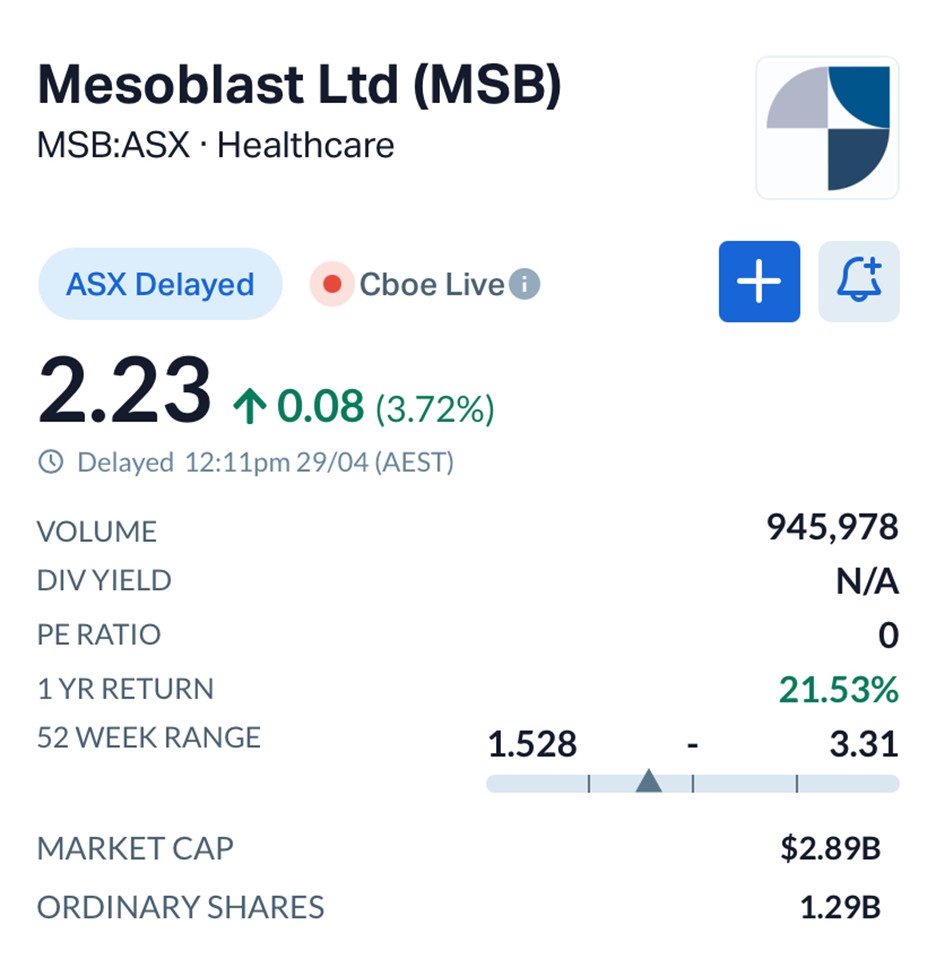
Shares in Mesoblast rose 3.72% to $2.23 by midday, reflecting a measured but positive response from the market.
The stock has gained over 21% over the past year, although it remains below its 52-week high of $3.31, indicating that investors are still weighing execution risks across its broader pipeline.
Source: MarketIndex
With a market capitalisation of approximately $2.9 billion, Mesoblast sits in a unique position among ASX biotech companies, combining late-stage assets with commercial ambitions.
A different kind of biotech story
Unlike many early-stage biotech firms, Mesoblast is not solely dependent on future trial outcomes.
The company already has an FDA-approved product, Ryoncil, and a broad pipeline targeting inflammatory diseases, including heart failure and immune-related conditions.
However, rexlemestrocel-L remains one of its most commercially significant opportunities.
Stay ahead of the market
The most important stories, delivered to your inbox. No noise, just what matters.
By subscribing, you agree to our Privacy Policy.
The company estimates the back pain indication alone could generate peak annual revenues exceeding US$10 billion, even with relatively modest market penetration.
Industry context: the shift away from opioids
The broader healthcare landscape is increasingly focused on reducing reliance on opioid-based treatments.
Regulators, insurers, and healthcare providers are all seeking alternatives that address underlying conditions rather than symptoms.
In this context, therapies like rexlemestrocel-L represent a potential shift in how chronic pain is treated.
If successful, it would not just be a new drug. It would be part of a broader move toward regenerative and cell-based therapies.
The waiting game begins
For now, the story enters a quieter phase.
With enrollment complete, there are fewer operational milestones in the near term. Instead, attention shifts to patient follow-up and eventual data release.
This period can often test market patience, particularly in biotech, where timelines are long and outcomes uncertain.
However, it also provides clarity.
The next major catalyst is no longer theoretical. It is scheduled.
The Bigger Picture
Mesoblast’s completion of patient enrollment marks a transition from execution to validation. The company has built the framework for what could become a major non-opioid treatment in a multi-billion dollar market. The focus now turns to data, where success could unlock significant commercial potential and reshape treatment options for chronic back pain.
While risks remain, particularly around clinical outcomes, the pathway is now clearly defined. In a sector driven by milestones, this update represents one of the most important steps toward potential approval and long-term value creation.
What is your take on this story?
This is user sentiment & not financial advice.
Disclaimer - Skrill Network is designed solely for educational and informational use. The content on this website should not be considered as investment advice or a directive. Before making any investment choices, it is crucial to carry out your own research, taking into account your individual investment objectives and personal situation. If you're considering investment decisions influenced by the information on this website, you should either seek independent financial counsel from a qualified expert or independently verify and research the information.