

Mineral Resources (ASX: MIN) Completes US$1.3B Bond Deal, Clears Debt Runway to 2030

Team Skrill Network
Team Skrill Network comprises seasoned professionals from diverse fields including Finance, Mining, Technology, Investing, and Digital Strategy. They bring a deep knowledge and understanding of financial markets and behavioural patterns to every story, ensuring credibility and precision in every piece. Whether analysing emerging market trends or spotlighting small- and mid-cap growth companies across ASX, TSX, or NASDAQ, the team’s editorial approach blends data-driven insights with compelling storytelling. Their expertise enables them to process complex developments into content that resonates with both institutional investors and retail audiences. Backed by experience in content curation, SEO strategy, and investor-focused messaging, the team of writers at Skrill Network are committed to delivering stories that matter—authentic, relevant, and strategically aligned with the evolving landscape of global investing.
Read more
Key Highlights:
- US$1.3 billion raised across two long-dated bond tranches
- High-cost debt refinanced, including 2027 and 2028 notes
- Iron ore prepayment facility fully repaid, restoring sales flexibility
- No major debt maturities until 2030 following restructuring
A sharp re-rating in Mineral Resources Ltd is gathering pace after the company completed a US$1.3 billion senior unsecured notes offering, a move that reshapes its balance sheet and removes one of the market’s key concerns.
The deal, executed in the US debt market, is structured across two tranches, US$650 million due 2032 at 6.000% and US$650 million due 2034 at 6.250%, locking in long-term funding at fixed rates.
More importantly, it marks a decisive shift in how the company is positioning itself through the current commodity cycle, moving from defensive refinancing toward capital flexibility and operational leverage.
Market Snapshot
A debt restructure, not just a capital raise
The proceeds from the bond offering are being deployed with precision.
Mineral Resources will refinance US$625 million of notes due in 2027, fully repay a US$300 million iron ore prepayment facility, and redeem US$350 million of higher-cost 2028 notes carrying a 9.250% coupon.
This sequence effectively removes near-term refinancing risk while targeting the most expensive layers of debt.
The iron ore prepayment repayment is particularly significant. It removes a direct linkage between production volumes and debt obligations, restoring full commercial control over sales and pricing decisions across its iron ore operations.
The broader outcome is a cleaner capital structure with fewer operational constraints.
Extending the runway
Following the transaction, Mineral Resources will have no material debt maturities until May 2030, a shift that materially alters its risk profile.
For a company operating across lithium, iron ore and mining services, this extended runway provides the flexibility to navigate commodity price volatility without immediate refinancing pressure.
It also positions the business to align capital allocation decisions with market cycles rather than debt timelines.
Management noted that, once proceeds from the POSCO lithium partnership are received, the remaining balance of 2028 notes is expected to be addressed, further strengthening the balance sheet.
Lower cost of capital, stronger cash flow
The refinancing exercise is expected to reduce the company’s annual finance costs by approximately $150 million, a meaningful improvement in underlying earnings capacity.
This effectively converts previously committed interest payments into available capital, which can be redeployed across operations, growth projects or balance sheet strengthening.
The weighted average cost of debt has also been lowered, with pricing achieved in the US market described as the most competitive the company has secured to date.
This signals improving institutional confidence in Mineral Resources’ diversified earnings base, which spans iron ore production, lithium exposure and mining services.
Market reaction reflects shifting sentiment
The market response has been immediate.
Shares in Mineral Resources are trading at $65.69, up 6.16%, after earlier touching a 52-week high of $67.80. The stock has now delivered a 219% return over the past year, reflecting a significant turnaround in sentiment.
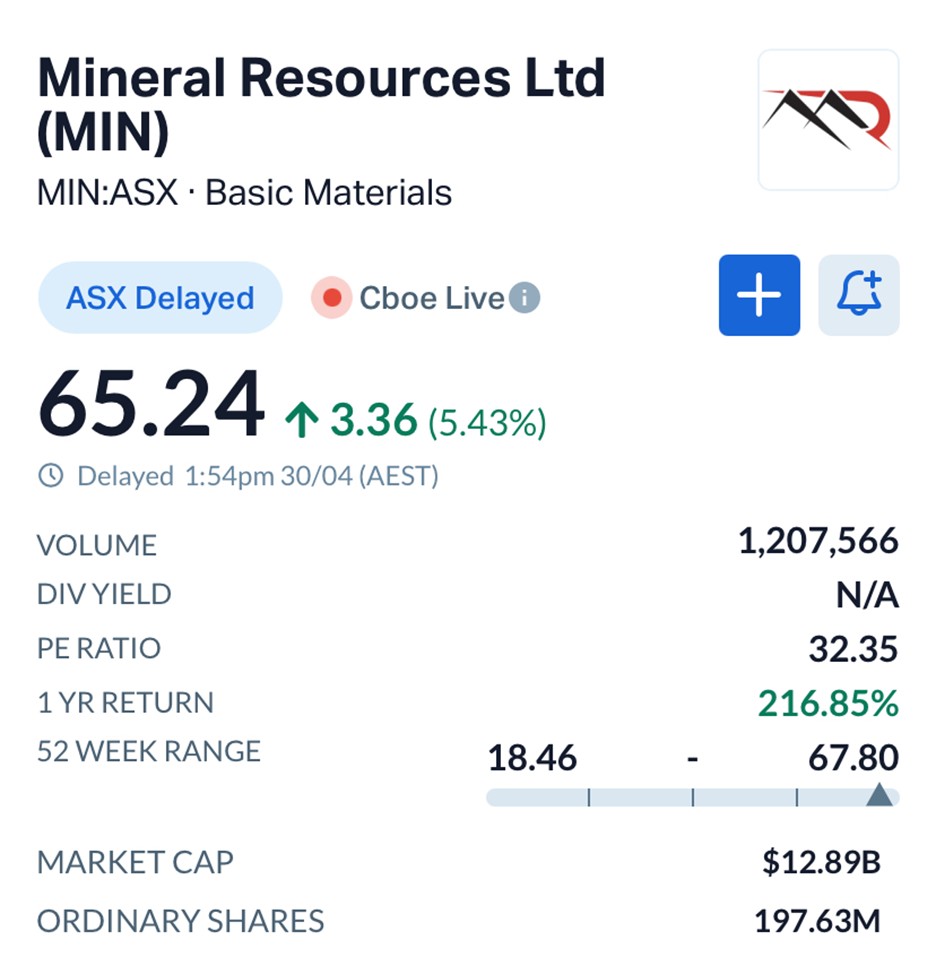
Source: MarketIndex
The rally follows a period where concerns around debt levels and refinancing risk formed the core of the bearish thesis.
With that overhang now largely removed, the narrative has shifted toward operational performance and capital efficiency.
Context: From balance sheet pressure to operational leverage
The timing of the transaction aligns with improving operational momentum.
The company’s Onslow Iron project is now operating at full capacity, providing a steady cash flow base to support the new debt structure.
Stay ahead of the market
The most important stories, delivered to your inbox. No noise, just what matters.
By subscribing, you agree to our Privacy Policy.
At the same time, lithium markets remain volatile, but the extended debt horizon allows Mineral Resources to wait for improved pricing conditions before committing to further large-scale capital deployment.
The refinancing acts as a bridge between cyclical lows and the next phase of commodity recovery.
A broader shift in strategy
The transaction also reflects a more disciplined approach to capital management.
Rather than pursuing expansion under tight financial constraints, Mineral Resources has effectively reset its funding profile, prioritising cost efficiency and balance sheet strength.
The removal of near-term maturities reduces the likelihood of equity dilution or asset sales, both of which had been key risks highlighted by the market over the past year.
This positions the company to focus on execution across its core operations rather than financing requirements.
Mineral Resources has completed more than a refinancing exercise.
By extending its debt maturity profile, lowering financing costs and removing structural constraints, the company has repositioned itself for the next phase of the cycle.
The balance sheet reset provides a clear runway through to 2030, allowing management to align growth decisions with market conditions rather than funding deadlines.
In a sector where capital discipline is increasingly being rewarded, the move signals a shift from balance sheet pressure to operational leverage.
What is your take on this story?
This is user sentiment & not financial advice.
Disclaimer - Skrill Network is designed solely for educational and informational use. The content on this website should not be considered as investment advice or a directive. Before making any investment choices, it is crucial to carry out your own research, taking into account your individual investment objectives and personal situation. If you're considering investment decisions influenced by the information on this website, you should either seek independent financial counsel from a qualified expert or independently verify and research the information.
%2520Up%2520676%2525%2520in%252012%2520Months%2520Forrest%2520Stake%2520Trade%2520Sparks%252065M%2520Share%2520Buying%2520Frenzy.png&w=3840&q=75)