

Mount Ridley Unveils 122Mt Rare Earth Resource, Stakes Claim in Global Critical Minerals Race

Team Skrill Network
Team Skrill Network comprises seasoned professionals from diverse fields including Finance, Mining, Technology, Investing, and Digital Strategy. They bring a deep knowledge and understanding of financial markets and behavioural patterns to every story, ensuring credibility and precision in every piece. Whether analysing emerging market trends or spotlighting small- and mid-cap growth companies across ASX, TSX, or NASDAQ, the team’s editorial approach blends data-driven insights with compelling storytelling. Their expertise enables them to process complex developments into content that resonates with both institutional investors and retail audiences. Backed by experience in content curation, SEO strategy, and investor-focused messaging, the team of writers at Skrill Network are committed to delivering stories that matter—authentic, relevant, and strategically aligned with the evolving landscape of global investing.
Read more
Key Highlights
- Mount Ridley (ASX: MRD) delivers 122.56Mt JORC resource at 889 ppm TREO
- High-value 41% heavy rare earth ratio with Dysprosium and Terbium
- Shares surge 33.33% as market re-rates growth potential
- Multi-commodity advantage with scandium and gallium in same system
- Over 80% of project area remains unexplored, offering strong upside
Mount Ridley Unveils Monster 122Mt Rare Earth Resource
In a market increasingly defined by geopolitics and supply chain security, Mount Ridley Mines has delivered the kind of announcement that can reshape a company’s trajectory overnight.
The Western Australia-based explorer revealed a 122.56 million tonne inferred rare earth resource, instantly elevating it from a small-cap name to a serious contender in the global critical minerals landscape.
The market responded swiftly. Shares in Mount Ridley climbed 33.33% to $0.032, with strong trading volumes signaling renewed confidence in the company’s long-term potential.
Market Snapshot
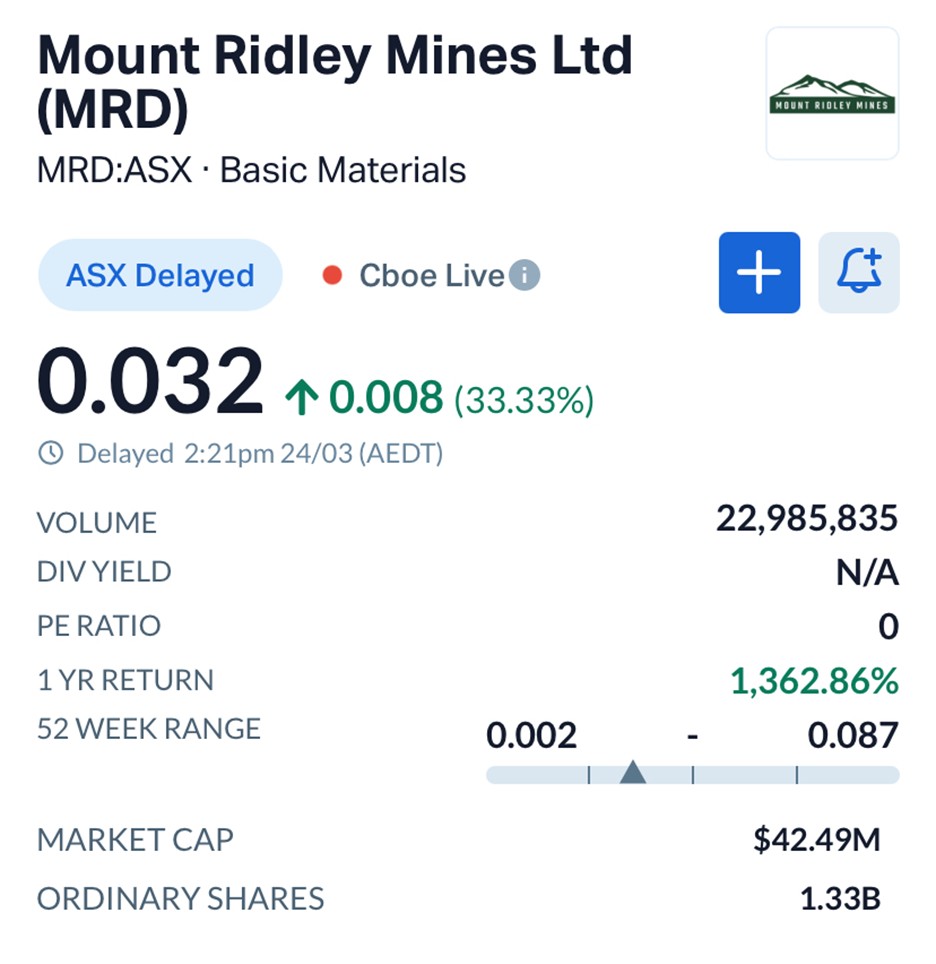
Source: MarketIndex
A resource that changes the narrative
At the heart of the announcement is scale. The company reported 889 ppm TREO, translating into more than 108,000 tonnes of contained rare earth oxides, including 44,610 tonnes of heavy rare earths.
In mining terms, size matters. But what makes this discovery particularly compelling is not just its scale, but its composition.
Mount Ridley’s deposit carries a 41% heavy rare earth ratio, a figure that stands out in an industry typically dominated by lower-value light rare earths.
Heavy rare earths such as dysprosium and terbium are essential for high-performance magnets used in electric vehicles, wind turbines, and advanced defence systems. According to the International Energy Agency, these elements sit at the core of the global energy transition, yet supply remains heavily concentrated in China.
That imbalance is what gives projects like Mount Ridley strategic weight.
Why heavy rare earths matter now
To understand the significance, it helps to look at history.
During past commodity cycles, markets focused on bulk materials like iron ore or coal. Today, the focus has shifted toward “critical minerals” that underpin clean energy and advanced technologies.
Heavy rare earths are among the most constrained. Global supply chains rely heavily on Chinese processing, with limited alternative sources emerging.
That is why Mount Ridley’s numbers are attracting attention.
The project contains 4,272 tonnes of dysprosium and 719 tonnes of terbium, placing it firmly in the premium end of the rare earth spectrum. These elements command higher prices due to their scarcity and their role in high-temperature and high-efficiency magnet applications.
A three-in-one project advantage
Beyond the headline numbers, there is another layer to this story.
Mount Ridley is not just a rare earth project. The mineralisation sits within the same regolith system as the company’s existing scandium and gallium resources.
This creates a rare “multi-commodity” advantage.
In practical terms, it means the company could potentially extract multiple high-value elements from the same mining operation. That improves project economics and reduces operational risk.
Managing Director Allister Caird highlighted this point, stating:
“The result confirms a large-scale, shallow, multi-element critical mineral system with excellent geological continuity and clear scope for expansion.”
He further added:
“Importantly, HREE mineralisation sits within the same regolith profile as our gallium and scandium resources, underpinning a highly attractive theoretical basket price and reinforcing Mount Ridley as a genuinely multi-element critical minerals project.”
Shallow, scalable and expandable
Another key detail is the geometry of the deposit.
The mineralisation is described as shallow, laterally extensive and consistent, characteristics that are typically associated with lower-cost open-pit mining.
This is not a deep, technically complex system. It is a broad, near-surface deposit that could be amenable to bulk mining methods if further studies confirm viability.
And perhaps more importantly, this may just be the beginning.
The current resource covers only a fraction of the company’s tenure. With over 80% of the project area still untested, the potential for expansion remains significant.
Caird noted:
Stay ahead of the market
The most important stories, delivered to your inbox. No noise, just what matters.
By subscribing, you agree to our Privacy Policy.
“There is clear potential to expand and upgrade the existing resource base through re-assaying of our extensive sample library and targeted drilling, with more than 80% of the tenure remaining untested.”
The bigger picture: supply chains and geopolitics
This announcement comes at a time when governments are actively seeking to diversify supply chains away from concentrated sources.
Australia has been positioning itself as a key supplier of critical minerals, backed by initiatives such as the A$1.2 billion Critical Minerals Strategic Reserve.
Globally, demand for rare earths is expected to accelerate as electrification trends gather pace. The International Energy Agency has repeatedly highlighted that demand for key minerals could grow multiple times over by 2040 under clean energy scenarios.
In that context, projects like Mount Ridley are not just mining assets. They are strategic assets.
Market perspective: early stage, but meaningful shift
Despite the strong share price reaction, Mount Ridley remains a relatively small company with a market cap of around $42 million.
That highlights both the opportunity and the risk.
The project is still at an inferred resource stage, meaning further drilling, metallurgical work, and feasibility studies will be required before any production decisions are made.
However, the latest update marks a clear transition.
The company is no longer simply exploring. It is now defining a resource that has the scale and composition to attract broader market attention.
The next phase will be critical. Resource upgrades, metallurgical results, and feasibility milestones will determine whether this early promise can translate into a viable mining operation.
For now, the message from the market is clear. Scale, strategy, and timing have aligned, and Mount Ridley has firmly placed itself on the radar.
What is your take on this story?
This is user sentiment & not financial advice.
Disclaimer - Skrill Network is designed solely for educational and informational use. The content on this website should not be considered as investment advice or a directive. Before making any investment choices, it is crucial to carry out your own research, taking into account your individual investment objectives and personal situation. If you're considering investment decisions influenced by the information on this website, you should either seek independent financial counsel from a qualified expert or independently verify and research the information.