


Nanoveu’s (ASX: NVU) Strategic Leap into the $98B Defense Market

Team Skrill Network
Team Skrill Network comprises seasoned professionals from diverse fields including Finance, Mining, Technology, Investing, and Digital Strategy. They bring a deep knowledge and understanding of financial markets and behavioural patterns to every story, ensuring credibility and precision in every piece. Whether analysing emerging market trends or spotlighting small- and mid-cap growth companies across ASX, TSX, or NASDAQ, the team’s editorial approach blends data-driven insights with compelling storytelling. Their expertise enables them to process complex developments into content that resonates with both institutional investors and retail audiences. Backed by experience in content curation, SEO strategy, and investor-focused messaging, the team of writers at Skrill Network are committed to delivering stories that matter—authentic, relevant, and strategically aligned with the evolving landscape of global investing.
Read more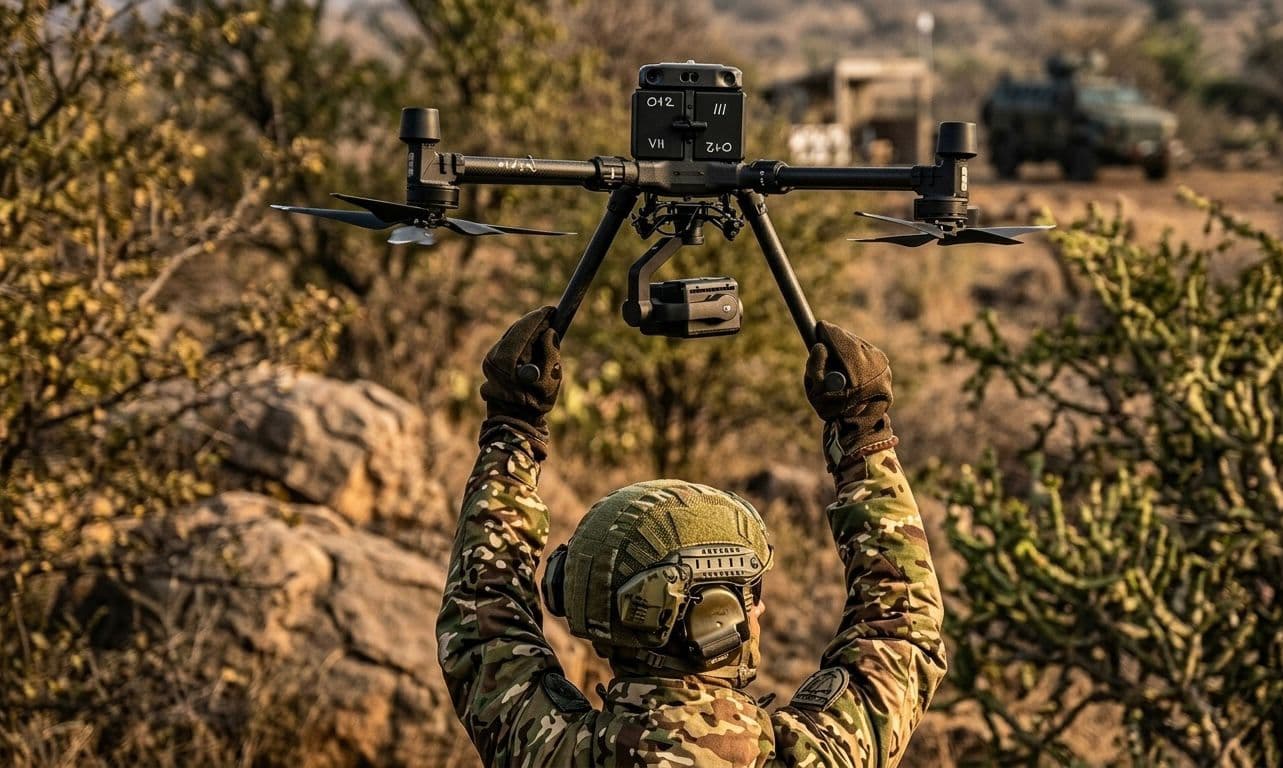
Key Highlights
- Nanoveu acquires Singapore-based Spinoff Robotics
- Deal expands company into full-stack drone and defense systems
- ALICE drone platform designed to operate without GPS or RF reliance
- Global military drone market projected to approach US$98 billion by 2033
- Shares rise as market weighs defense and sovereign technology potential
Small drones have become one of the defining technologies of modern conflict.
From Ukraine to the Red Sea, low-cost aerial systems are reshaping surveillance, targeting and battlefield logistics. At the same time, electronic warfare has exposed a growing vulnerability across the drone industry: many systems fail once GPS signals disappear or communications are jammed.
That pressure is reshaping defense procurement globally, and Australian-listed Nanoveu appears determined to position itself inside that shift.
Market Snapshot
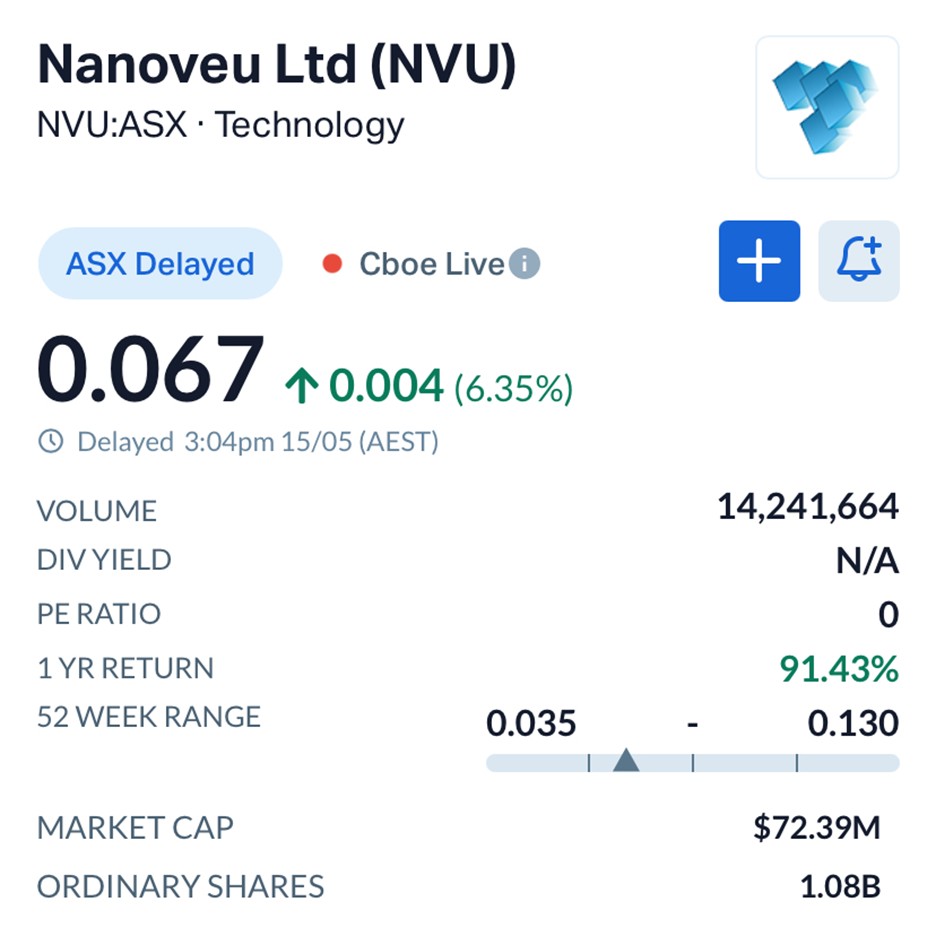
Shares in Nanoveu climbed on Friday after the company announced the acquisition of Singapore-based Spinoff Robotics, a move that transforms the group from a semiconductor-focused technology company into a vertically integrated drone and autonomy developer.
Source: MarketIndex
The stock traded at 6.7 cents in afternoon trade, up 6.35 per cent, with volumes remaining elevated throughout the session.
The acquisition brings aerial robotics, fluid dynamics engineering and proprietary drone manufacturing capability under the same roof as Nanoveu’s existing AI semiconductor business.
At the centre of the strategy sits ECS-DoT, the company’s low-latency AI chip platform designed for edge computing and autonomous processing. Until now, the technology largely existed as a component play.
Nanoveu will now control both the “brain” and the physical drone platform itself, allowing the company to integrate AI processing directly into aircraft architecture rather than treating chips as add-on payloads.
The timing reflects broader changes unfolding across the global defense market.
Research groups including Fortune Business Insights and MarketsandMarkets estimate the military drone sector could approach US$98 billion by the early 2030s as governments accelerate spending on autonomous surveillance, reconnaissance and counter-drone systems.
Within that race, resilience has become just as important as capability.
One of the more closely watched technologies inside the Nanoveu acquisition is ALICE, a tethered drone platform designed to operate without dependence on GPS or radio frequency communications. Instead, the platform uses a physical tether for power and data transmission, reducing exposure to signal jamming and spoofing attacks.
That vulnerability has become increasingly visible across recent conflicts, where electronic warfare systems have been able to disable or redirect conventional drones with relative ease.
Defense agencies across AUKUS and Five Eyes nations are now placing greater emphasis on sovereign supply chains and trusted technologies where chips, software, communications and manufacturing remain under tighter domestic control.
Nanoveu’s push into vertically integrated systems aligns neatly with that direction.
The acquisition also includes METRON, a compact camera-based sensing platform capable of sub-millimetre 3D measurement and mapping. The technology has applications extending beyond defense into industrial inspection, infrastructure monitoring and advanced manufacturing environments.
Management described the deal as creating a structural advantage difficult for standalone software or hardware competitors to replicate.
Stay ahead of the market
The most important stories, delivered to your inbox. No noise, just what matters.
By subscribing, you agree to our Privacy Policy.
The company said integrating silicon, autonomy software and airframe engineering together enables optimisation across the entire drone stack, particularly in applications where low latency, reduced power consumption and autonomous navigation are critical.
Defense markets have historically rewarded companies supplying complete operational systems rather than individual components, particularly where procurement cycles favour long-term platform partnerships.
The acquisition also reduces some of the commercial uncertainty typically attached to emerging defense technology plays. Nanoveu said the acquired drone platforms are already in active commercial deployment, providing existing operational use cases rather than purely conceptual development pathways.
The company’s market capitalisation now sits near $72 million, modest relative to larger listed defense technology peers, though Friday’s move suggests the market is beginning to reassess the company’s strategic direction.
For years, many smaller ASX technology firms struggled to bridge the gap between prototype development and scalable commercial adoption.
Defense demand is beginning to alter that equation.
Governments are spending heavily on autonomous systems, secure communications and electronic warfare resilience. Companies capable of offering sovereign, integrated technologies are increasingly moving from speculative interest to strategic relevance.
What is your take on this story?
This is user sentiment & not financial advice.
Disclaimer - Skrill Network is designed solely for educational and informational use. The content on this website should not be considered as investment advice or a directive. Before making any investment choices, it is crucial to carry out your own research, taking into account your individual investment objectives and personal situation. If you're considering investment decisions influenced by the information on this website, you should either seek independent financial counsel from a qualified expert or independently verify and research the information.