
🇺🇸 USA






The uranium market has spent the last two years searching for one thing above all else: certainty.
On Friday, NexGen Energy (ASX: NXG) delivered another reminder of why the market increasingly sees Saskatchewan’s Athabasca Basin as the centre of the global nuclear fuel story.
The company unveiled fresh assay results from its Patterson Corridor East, or PCE, discovery zone, confirming a new high-grade mineralised area just 3.5 kilometres from its flagship Arrow deposit in Canada.
While the uranium sector is no stranger to impressive drill numbers, the latest intercepts from PCE are forcing analysts and investors alike to ask a bigger question.
Is NexGen quietly building a second Arrow deposit?
The answer may still take years to fully emerge, but the latest results suggest the geological system continues to expand in both scale and continuity.
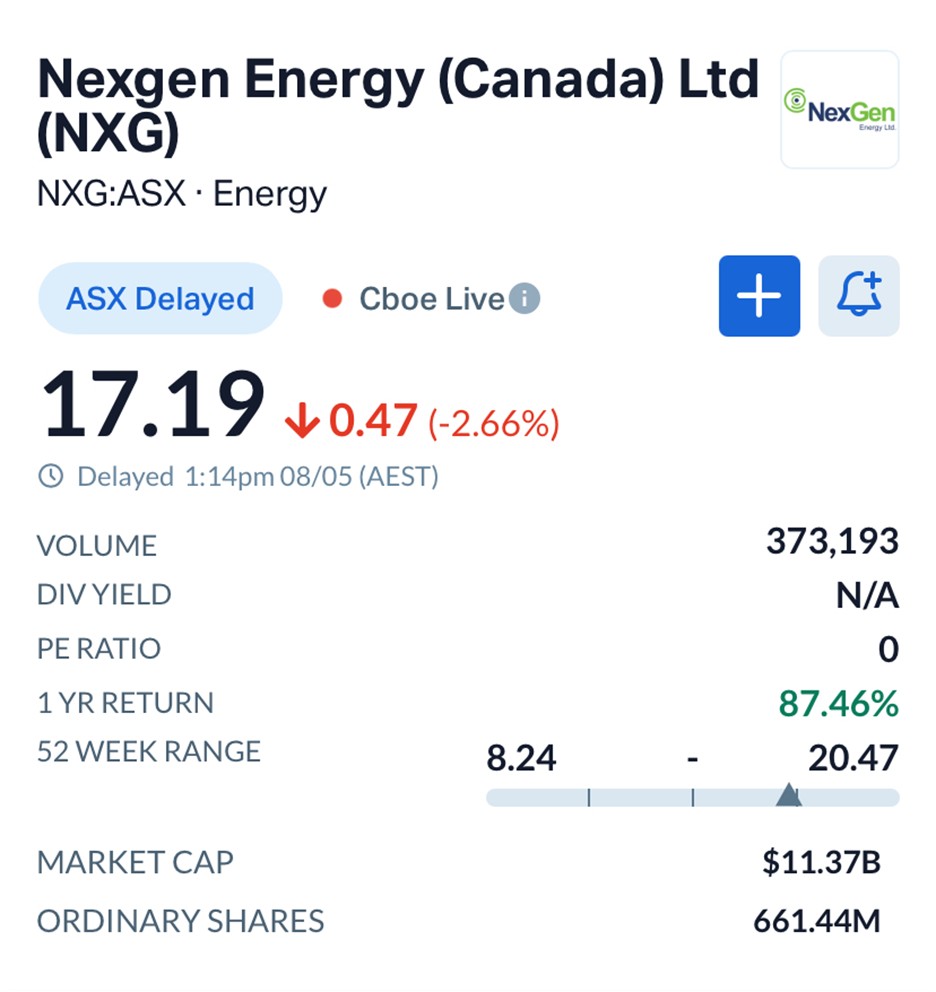
Shares in NexGen Energy (ASX: NXG) were trading at $17.19 on Friday afternoon, giving the company a market capitalisation of $11.37 billion. The stock remains up 87.46% over the past 12 months despite a softer session across broader uranium names.
Source: MarketIndex
The headline numbers were difficult for the market to ignore.
Hole RK-25-239 returned 13 metres grading 5.2% U₃O₈, including a spectacular half-metre interval grading 30.2% U₃O₈.
Another drill hole, RK-25-240, delivered 10 metres at 3.95% U₃O₈, including 0.5 metres at 33.3% U₃O₈.
Meanwhile, RK-25-230 returned 7.5 metres at 5.3% U₃O₈, including an extraordinary 0.5 metres at 35.9% U₃O₈.
To put those numbers into perspective, many conventional uranium mines globally operate at grades below 0.2% U₃O₈.
Anything above 1% is generally considered high grade in the uranium sector.
NexGen is reporting intervals more than 30 times higher than many global operations.
The company also confirmed a brand-new secondary high-grade subdomain approximately 850 metres below surface.
Hole RK-25-257 intersected 4.5 metres grading 4.8% U₃O₈, including 0.5 metres at 33.3% U₃O₈.
Importantly, the mineralised system now stretches across 292 metres of dip extent and remains open in multiple directions.
What makes the discovery particularly significant is not simply the grade.
It is the location.
Patterson Corridor East sits only a short distance from NexGen’s flagship Arrow deposit, which is already regarded as one of the world’s premier undeveloped uranium assets.
That proximity creates a powerful infrastructure advantage.
Rather than requiring an entirely separate processing plant or mining hub, any future development at PCE could potentially leverage the same infrastructure currently planned for the Rook I Project.
That dramatically lowers the future capital burden while accelerating the path from discovery to potential production.
Chief executive Leigh Curyer openly drew comparisons between PCE and the Arrow system itself.
“The combination of high-grades, continuity, scale and geotechnical characteristics continue to highlight the similarities between PCE and the mighty Arrow Deposit,” Curyer said.
He also linked the discovery directly to broader global energy security concerns.
“With a widening structural supply deficit caused by a generation of underinvestment in uranium production, NexGen is uniquely positioned to supply current and future generations seeking clean, secure energy,” he said.
The timing of the discovery is notable.
Governments across Europe, North America and Asia are rapidly revisiting nuclear energy as they attempt to balance decarbonisation targets with energy reliability.
Small Modular Reactor programs continue expanding globally, while several countries have extended the life of aging nuclear fleets amid ongoing instability in fossil fuel supply chains.
The uranium market itself has entered a period many analysts describe as structurally undersupplied.
Years of low uranium prices during the 2010s discouraged new mine development, while secondary supplies from government inventories and recycled nuclear material have steadily declined.
That has placed enormous strategic value on high-grade deposits located in politically stable jurisdictions such as Canada’s Athabasca Basin.
The region has increasingly become known as the “Saudi Arabia of uranium” due to its exceptionally rich ore grades and established mining infrastructure.
Beyond exploration success, NexGen is also moving toward a major operational milestone.
The company confirmed that construction at the Rook I Project is expected to commence in summer 2026, marking its transition from developer toward future producer status.
That shift is critical for the company’s long-term valuation.
Historically, mining companies often face significant re-rating events as they move from exploration into actual project development and production.
At the same time, the growing success at Patterson Corridor East suggests NexGen may be evolving beyond a single-asset uranium story.
Drilling is set to recommence in late May as part of a massive 42,000-metre exploration campaign, with more than 29,000 metres still planned for 2026.
For the market, that means the discovery story may still be in its early chapters.
The deeper significance behind NexGen’s latest discovery lies in the changing global energy landscape.
Countries searching for stable, low-carbon baseload power are now competing for secure uranium supply chains.
In that environment, large-scale, high-grade discoveries located in stable jurisdictions are becoming increasingly rare and strategically valuable.
Friday’s assay results reinforce the idea that NexGen may not simply be building one world-class uranium mine.
It may be uncovering an entire uranium district capable of supplying nuclear fuel for decades.
Disclaimer - Skrill Network is designed solely for educational and informational use. The content on this website should not be considered as investment advice or a directive. Before making any investment choices, it is crucial to carry out your own research, taking into account your individual investment objectives and personal situation. If you're considering investment decisions influenced by the information on this website, you should either seek independent financial counsel from a qualified expert or independently verify and research the information.
Tags:
RECENT POSTS
TAGS
Subscribe to the Skrill Network Newsletter today and stay informed
Recommended Articles
