

NexGen Energy Receives Final Federal Green Light: Construction Begins on World’s Largest Uranium Mine

Team Skrill Network
Team Skrill Network comprises seasoned professionals from diverse fields including Finance, Mining, Technology, Investing, and Digital Strategy. They bring a deep knowledge and understanding of financial markets and behavioural patterns to every story, ensuring credibility and precision in every piece. Whether analysing emerging market trends or spotlighting small- and mid-cap growth companies across ASX, TSX, or NASDAQ, the team’s editorial approach blends data-driven insights with compelling storytelling. Their expertise enables them to process complex developments into content that resonates with both institutional investors and retail audiences. Backed by experience in content curation, SEO strategy, and investor-focused messaging, the team of writers at Skrill Network are committed to delivering stories that matter—authentic, relevant, and strategically aligned with the evolving landscape of global investing.
Read more
Key Highlights:
- NexGen Energy receives final federal approval for the Rook I Uranium Project in Canada
- Project expected to produce 30 million pounds of uranium annually
- Construction scheduled to begin summer 2026 with a four year build timeline
- Shares trading near $17.65 on the ASX on March 6
- Approval marks the end of a 12 year regulatory process
A decade long regulatory journey has reached its final milestone for NexGen Energy Ltd (TSX: NXE) (NYSE: NXE) (ASX: NXG), clearing the way for construction of what is expected to become the largest uranium mine in the world.
The company confirmed that the Canadian Nuclear Safety Commission has granted the final federal approval for its Rook I Project in Saskatchewan’s renowned Athabasca Basin.
With the licence to prepare the site and begin construction now secured, NexGen says the project has passed the final regulatory checkpoint needed to move into full development.
Market Snapshot
At the time of writing, NexGen shares on the ASX were trading around $17.66, giving the company a market capitalisation of roughly $11.65 billion.
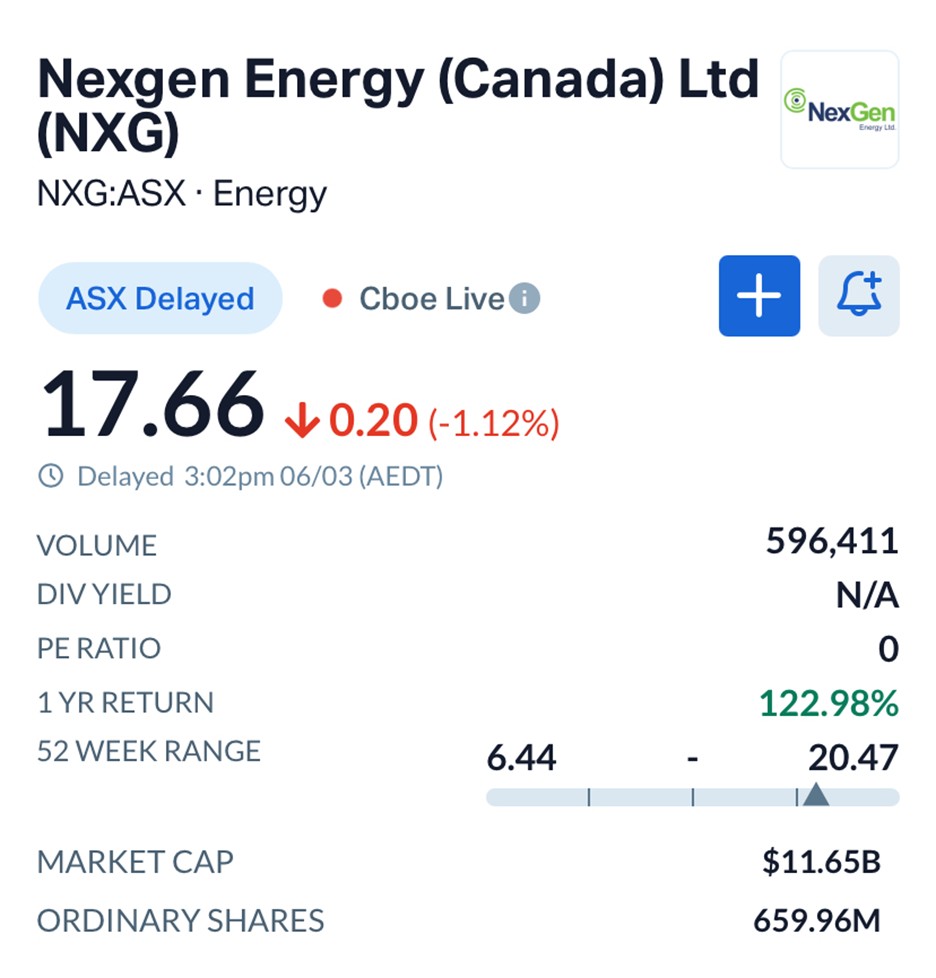
Source: MarketIndex
The end of a 12 year regulatory journey
Major mining projects often spend years navigating environmental reviews, community consultations and regulatory approvals. In the case of Rook I, the process has taken more than a decade.
Provincial environmental approval from the Government of Saskatchewan was received in 2023. The final federal sign off from the Canadian Nuclear Safety Commission now completes the regulatory framework required for construction.
Founder and Chief Executive Officer Leigh Curyer described the approval as a defining moment for the company.
“Today’s approval represents one of the most rigorous and comprehensive regulatory processes undertaken for a resource project globally. This milestone is the result of the NexGen team’s steadfast and unrelenting focus over 12 years understanding and delivering our objectives honestly and incorporating a culture of excellence,” Curyer said.
“I am incredibly proud of our team, their resilience, accountability and dedication to advancing Rook I optimally across all aspects.”
A mine with global scale
Once operational, the Rook I project is expected to become one of the most significant uranium mines ever built.
According to company estimates, the mine will produce up to 30 million pounds of uranium per year, equivalent to about 14 million kilograms annually.
To put that into context, that level of production could represent more than 20 percent of the current global uranium fuel supply and over half of the Western world’s supply, making it a major pillar in future nuclear energy supply chains.
Construction is scheduled to begin in summer 2026, with the development phase expected to take about four years.
The project has already reached a Final Investment Decision, meaning financing, engineering and contractor arrangements are already in place before construction begins.
Nuclear power back in focus
The timing of the project is closely aligned with a renewed global interest in nuclear energy.
Countries seeking reliable and low carbon electricity are increasingly revisiting nuclear power as a stable energy source. Unlike solar or wind, nuclear reactors provide continuous baseload electricity, which many policymakers see as essential for supporting electrification and energy intensive technologies such as artificial intelligence data centres.
Uranium prices have also strengthened in recent years as supply struggles to keep pace with demand from new reactor builds.
Curyer believes the shift is structural rather than temporary.
“The world is changing fast, and NexGen’s Rook I is now ready to be a significant contributor to global requirements for nuclear energy and Canada’s role as an energy superpower,” he said.
Stay ahead of the market
The most important stories, delivered to your inbox. No noise, just what matters.
By subscribing, you agree to our Privacy Policy.
“As global demand for reliable, clean, baseload nuclear energy continues to accelerate at an unprecedented pace, uranium is the critical fuel for powering industrial electrification and the digital infrastructure of tomorrow.”
A strategic region for uranium
The Athabasca Basin in northern Saskatchewan has long been considered the world’s premier uranium district, hosting some of the highest grade deposits ever discovered.
Major mines in the region have historically been operated by companies such as Cameco Corporation, which runs the nearby Cigar Lake Mine, one of the world’s highest grade uranium operations.
By comparison, NexGen’s Rook I project aims to deliver both scale and efficiency, positioning itself as a new cornerstone of Western uranium supply.
The project is also expected to generate significant economic benefits, including employment opportunities and long term infrastructure development across Saskatchewan.
A turning point for the company
For NexGen, the approval marks a transition from exploration and permitting into project execution.
With construction scheduled to begin later this year, the company now faces the next challenge of delivering the project on time and on budget.
But after more than a decade of regulatory preparation, the final green light has transformed Rook I from a promising deposit into a mine that could reshape the global uranium supply landscape.
What is your take on this story?
This is user sentiment & not financial advice.
Disclaimer - Skrill Network is designed solely for educational and informational use. The content on this website should not be considered as investment advice or a directive. Before making any investment choices, it is crucial to carry out your own research, taking into account your individual investment objectives and personal situation. If you're considering investment decisions influenced by the information on this website, you should either seek independent financial counsel from a qualified expert or independently verify and research the information.