

Nine Entertainment (ASX: NEC) accelerates digital shift with QMS deal as radio exits spotlight

Team Skrill Network
Team Skrill Network comprises seasoned professionals from diverse fields including Finance, Mining, Technology, Investing, and Digital Strategy. They bring a deep knowledge and understanding of financial markets and behavioural patterns to every story, ensuring credibility and precision in every piece. Whether analysing emerging market trends or spotlighting small- and mid-cap growth companies across ASX, TSX, or NASDAQ, the team’s editorial approach blends data-driven insights with compelling storytelling. Their expertise enables them to process complex developments into content that resonates with both institutional investors and retail audiences. Backed by experience in content curation, SEO strategy, and investor-focused messaging, the team of writers at Skrill Network are committed to delivering stories that matter—authentic, relevant, and strategically aligned with the evolving landscape of global investing.
Read more
Key highlights
- Nine to acquire digital outdoor media group QMS for A$850 million, reshaping its media portfolio
- Broadcast radio assets sold to the Laundy Family Office, while regional TV arm NBN shifts to an affiliate model
- Digital growth businesses expected to contribute more than 60 percent of revenue by FY27
- Shares up 4.6 percent as the market weighs long term strategic clarity against near term balance sheet impact
Australian media heavyweight Nine Entertainment Co. Holdings Ltd (ASX: NEC) has kicked off 2026 with one of its most decisive strategic resets in years, announcing a sweeping portfolio overhaul aimed at accelerating its transition into a digital first media business.
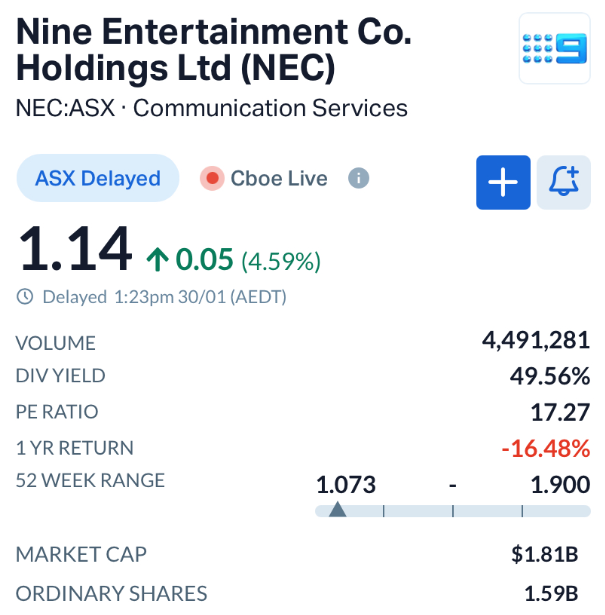
The market response was measured but positive. Nine shares rose about 4.6 percent to A$1.14 in early afternoon trade, lifting the company’s market capitalisation to around A$1.8 billion. Trading volumes were elevated as investors and analysts digested the scale of the changes unveiled in today’s ASX announcement.
At the centre of the reshuffle is Nine’s agreement to acquire digital outdoor advertising group QMS Media for A$850 million on a cash and debt free basis, funded through existing debt facilities and cash reserves. At the same time, Nine will exit traditional broadcast radio entirely and restructure its regional television footprint in northern New South Wales.
Market Snapshot
Why Nine is betting on outdoor and digital
Nine’s strategy is built around a simple but ambitious premise: future growth lies in digital scale, diversified revenue streams and advertising formats that are less exposed to global tech platforms.
QMS fits that thesis neatly. The outdoor advertising group operates a network of digital billboards and street furniture across Australia and New Zealand, with around 95 percent of its Australian revenue now generated from digital formats. Outdoor advertising has been one of the fastest growing segments of the local ad market over the past decade, expanding its share from about 10 percent in 2014 to roughly 18 percent today, according to industry data referenced by Nine.
QMS is expected to deliver EBITDA of about A$105 million in calendar year 2026, with operating margins of roughly 26 percent on a pre lease accounting basis. Nine says the acquisition equates to an effective EBITDA multiple of around 6.5 times once tax benefits and cost synergies are factored in.
Nine Group chief executive Matt Stanton described the transaction as a turning point for the company.
“Today’s announcements mark a critical milestone in our Nine2028 transformation,” Stanton said. “These transactions will create a more efficient, higher growth, and digitally powered Nine Group for our consumers, advertisers, shareholders and people. This positions Nine well for the future, enabling the Group to withstand industry disruption and deliver long term sustainable value.”
In plain terms, Nine is aiming to link its television, streaming, publishing and now outdoor assets into a single advertising ecosystem, offering what it calls a “sofa to street” proposition. Advertisers could place campaigns that follow audiences from the living room screen to city streets, supported by Nine’s first party data and targeting tools.
Radio sold, regional TV reworked
Balancing the QMS acquisition is Nine’s exit from legacy broadcast radio. The company has agreed to sell its radio stations, including 2GB, 3AW and 6PR, to the Laundy Family Office for A$56 million. The sale is expected to complete before the end of June, subject to regulatory approvals.
Nine argues that while radio still generates cash, it no longer aligns with its focus on scalable digital growth. Importantly, the group is not abandoning audio altogether. Podcasts, vodcasts and digital audio distributed across platforms like 9Now, Stan and Nine’s publishing mastheads will remain a core part of the business.
Meanwhile, Nine’s regional television station NBN in northern New South Wales will be converted from a wholly owned operation into an affiliate run by WIN Network. Nine will retain its broadcast presence in the region under a long term affiliation agreement but removes the operational burden from its balance sheet.
Together, the radio sale and NBN restructure are expected to deliver around A$217 million in cash proceeds and tax benefits, partially offsetting the cost of the QMS deal.
Financial impact and balance sheet considerations
On a pro forma basis, Nine estimates a net cash outlay of about A$601 million once tax losses are taken into account. Net leverage is expected to rise temporarily to around 1.8 times EBITDA in FY26 before easing back into the group’s target range of 1.0 to 1.5 times by FY27 as earnings and synergies flow through.
Management says the combined transactions should be low double digit earnings per share accretive in FY26 once cost synergies are fully realised. However, there is a trade off for income focused investors: the utilisation of tax losses is expected to reduce franking credits, meaning Nine’s FY26 and FY27 dividends are likely to be unfranked.
Chief financial officer Martyn Roberts noted that the reshaped portfolio improves the quality and resilience of earnings, even if it introduces some short term complexity.
“This is about reweighting the business towards structural growth assets while maintaining balance sheet discipline,” Roberts said during the investor briefing.
How the market sees it
The initial share price lift suggests the market broadly supports the strategic direction, even if questions remain around execution risk and integration.
Stay ahead of the market
The most important stories, delivered to your inbox. No noise, just what matters.
By subscribing, you agree to our Privacy Policy.
Source: MarketIndex
Media analysts have long argued that traditional broadcasters need to move faster to defend advertising dollars against global platforms. Outdoor advertising, particularly digital billboards tied to local data, has been one of the few areas where domestic players still enjoy pricing power.
Nine’s challenge will be delivering the promised synergies while managing higher leverage and navigating a softening advertising environment. Advertising markets remain cyclical, and while outdoor has proved relatively resilient, it is not immune to economic slowdowns.
A clearer identity for Nine
The significance of today’s announcement is less about individual deal mechanics and more about what Nine wants to become. By 2027, more than 60 percent of group revenue is expected to come from digital growth assets, up from about 45 percent just a year ago.
That shift signals a company increasingly focused on data driven advertising, streaming, and multi platform content distribution, rather than traditional broadcast alone. In an industry facing relentless disruption, Nine is choosing to slim down, double down on digital, and redraw its boundaries.
Whether that strategy delivers the sustainable growth management is promising will become clearer over the next few years. For now, the message from Nine is unambiguous: the old media mix is out, and a more digitally integrated future is firmly in.
What is your take on this story?
This is user sentiment & not financial advice.
Disclaimer - Skrill Network is designed solely for educational and informational use. The content on this website should not be considered as investment advice or a directive. Before making any investment choices, it is crucial to carry out your own research, taking into account your individual investment objectives and personal situation. If you're considering investment decisions influenced by the information on this website, you should either seek independent financial counsel from a qualified expert or independently verify and research the information.