

Omega (ASX: OMA) Upsizes Raise to $60M as Gas Supply Push Gains Momentum

Team Skrill Network
Team Skrill Network comprises seasoned professionals from diverse fields including Finance, Mining, Technology, Investing, and Digital Strategy. They bring a deep knowledge and understanding of financial markets and behavioural patterns to every story, ensuring credibility and precision in every piece. Whether analysing emerging market trends or spotlighting small- and mid-cap growth companies across ASX, TSX, or NASDAQ, the team’s editorial approach blends data-driven insights with compelling storytelling. Their expertise enables them to process complex developments into content that resonates with both institutional investors and retail audiences. Backed by experience in content curation, SEO strategy, and investor-focused messaging, the team of writers at Skrill Network are committed to delivering stories that matter—authentic, relevant, and strategically aligned with the evolving landscape of global investing.
Read more
Key Highlights:
- Omega raises $60M, exceeding initial $50M target on strong demand
- Placement priced at just 2.3% discount, signalling institutional confidence
- Funds to accelerate Taroom Trough drilling and US-style horizontal wells
- Key milestones set from June 2026 through 2027
- Shares surge over 12% as market backs execution strategy
The ASX is trading weaker on Thursday as rising oil prices and global uncertainty continue to shape market sentiment.
Brent crude remains above $US103 a barrel, reinforcing concerns around energy supply while simultaneously boosting interest in domestic gas projects.
Against this backdrop, Omega Oil & Gas Ltd has delivered one of the most closely watched capital raises of the week, securing A$60 million in fresh funding as it positions itself at the centre of Australia’s tightening gas narrative.
Market Snapshot
A raise that signals confidence
Omega initially targeted $50 million but increased the size of the placement to $60 million following what the company described as strong institutional demand.
The deal was structured in two tranches, with shares issued at $0.84, representing a modest 2.3% discount to the last closing price.
In capital markets, pricing often tells the real story.
A shallow discount typically reflects strong conviction from large investors, and in this case, backing from groups such as Ilwella, linked to the Flannery family, and Tri-Star Group points to growing confidence in the company’s development strategy.
Shares responded accordingly, rising more than 12% to $0.97 during Thursday’s session, pushing the company closer to the top of its 52-week range.
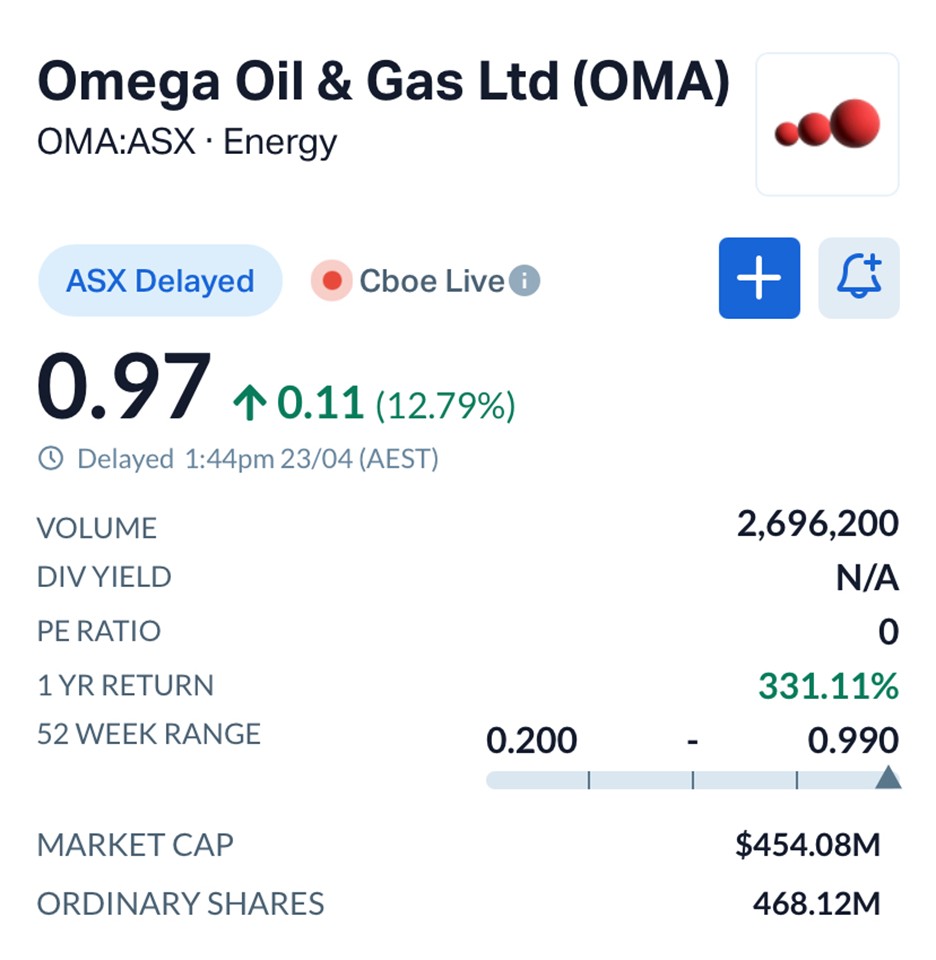
ASX: OMA share price movement | Source: MarketIndex
From explorer to developer
The raise marks a transition point.
Omega is moving beyond early-stage exploration into a more structured development phase, with capital now in place to execute a defined drilling program.
The company plans to drill four vertical wells and up to two horizontal wells, using techniques more commonly associated with the US shale industry.
This includes 5½-inch casing and extended horizontal drilling of up to 2,000 metres, a design aimed at maximising gas recovery and improving long-term economics.
Equally important is the shift toward extended six-month flow testing, which allows the company to demonstrate sustained production rather than short-term results.
Together, these changes suggest a move toward proving commercial viability rather than simply identifying resources.
Timing the energy cycle
The timing of the raise is notable.
Australia’s east coast gas market has been under increasing pressure, with supply constraints and rising prices becoming a persistent theme.
Government support has also intensified, with projects like Omega’s benefiting from “Prescribed Project” status, which streamlines approvals and reduces development timelines.
Managing Director Trevor Brown acknowledged this alignment, stating:
“We are moving decisively to capitalise on a unique window of opportunity. Government support and market dynamics are aligning to accelerate basin development and unlock badly needed new supplies.”
The comment reflects a broader shift in the sector.
Where exploration once focused on long-term discovery, the emphasis is now on speed to market and supply security.
A structured path to value
Omega has laid out a clear sequence of milestones that will guide its next phase.
Drilling is set to begin in June 2026, with a targeted resource upgrade and initial reserves estimate expected by the fourth quarter.
By the first half of 2027, the company aims to commence extended flow testing on its first horizontal well.
Each of these steps serves as a potential inflection point.
In resource development, value is often unlocked incrementally, with each milestone reducing uncertainty and improving confidence in the underlying asset.
Stay ahead of the market
The most important stories, delivered to your inbox. No noise, just what matters.
By subscribing, you agree to our Privacy Policy.
Market context and comparison
The approach mirrors developments seen in North America over the past decade, where the adoption of horizontal drilling and advanced completion techniques transformed previously uneconomic basins into major production hubs.
According to industry data, the US shale revolution significantly increased domestic gas output and reshaped global energy markets.
Omega’s strategy appears to draw directly from that playbook, adapting it to Australian conditions.
While the scale is smaller, the principle remains the same: apply proven technology to unlock resources more efficiently.
Why the market is paying attention
The strong response to the capital raise suggests that institutional investors are not just backing the project, but also the broader thesis.
That thesis is simple.
Australia needs more domestic gas supply, and companies that can deliver it efficiently stand to benefit from both pricing support and policy tailwinds.
The fact that Omega was able to raise more capital than initially planned, and do so at a minimal discount, indicates that this view is gaining traction.
It also provides the company with a financial buffer, reducing near-term funding risk and allowing management to focus on execution.
The Bigger Picture
Omega’s capital raise reflects a broader shift underway in the energy sector. As supply constraints tighten and policy support builds, the focus is moving from exploration toward execution and delivery. By securing funding on favourable terms and adopting proven development techniques, the company is positioning itself to move quickly in a market that increasingly rewards speed and efficiency.
It is a strategy that suggests confidence not only in the asset, but also in the timing of the cycle, capturing value now rather than waiting for conditions that may or may not improve further.
What is your take on this story?
This is user sentiment & not financial advice.
Disclaimer - Skrill Network is designed solely for educational and informational use. The content on this website should not be considered as investment advice or a directive. Before making any investment choices, it is crucial to carry out your own research, taking into account your individual investment objectives and personal situation. If you're considering investment decisions influenced by the information on this website, you should either seek independent financial counsel from a qualified expert or independently verify and research the information.