

Osmond Resources (ASX: OSM) to Anchor Europe’s First Vertically Integrated Rare Earth Hub

Team Skrill Network
Team Skrill Network comprises seasoned professionals from diverse fields including Finance, Mining, Technology, Investing, and Digital Strategy. They bring a deep knowledge and understanding of financial markets and behavioural patterns to every story, ensuring credibility and precision in every piece. Whether analysing emerging market trends or spotlighting small- and mid-cap growth companies across ASX, TSX, or NASDAQ, the team’s editorial approach blends data-driven insights with compelling storytelling. Their expertise enables them to process complex developments into content that resonates with both institutional investors and retail audiences. Backed by experience in content curation, SEO strategy, and investor-focused messaging, the team of writers at Skrill Network are committed to delivering stories that matter—authentic, relevant, and strategically aligned with the evolving landscape of global investing.
Read more
Key Highlights:
- Collaboration signed with Spanish engineering giant Técnicas Reunidas
- Targeting EU’s first vertically integrated MREC and MREO production
- Backed by European Commission’s PERMANET magnet initiative
- Facility to use TR’s proprietary RARETECH technology
- EU and Spanish funding pathways under review
In the global race for rare earth security, a small Australian company has just stepped into the European spotlight.
Osmond Resources (ASX: OSM) has signed a collaboration agreement with Spanish engineering heavyweight Técnicas Reunidas to deliver what could become the European Union’s first vertically integrated production hub for rare earth carbonates and oxides.
For decades, China has dominated rare earth processing, controlling much of the downstream refining that transforms mined material into critical inputs for electric vehicles, wind turbines, defence systems and high performance electronics. Europe has the demand but lacks a complete value chain. Osmond’s announcement signals a direct attempt to fill that gap.
Market Snapshot
From Ore to Oxide in Europe
Under the agreement, Osmond and Técnicas Reunidas will collaborate on the extraction of monazite and production of Mixed Rare Earth Carbonates and Mixed Rare Earth Oxides within the EU.
Importantly, Osmond will own the MREC facility, while Técnicas Reunidas will provide the technology and EPC services . In simple terms, Osmond supplies the resource and project ownership, and the Spanish giant brings engineering muscle and proprietary processing expertise.
Técnicas Reunidas is no small partner. Listed on the Madrid Stock Exchange, it employs nearly 14,000 people and generated more than €4.4 billion in revenue in 2024 . Over 65 years, it has delivered more than 2,600 industrial projects in over 70 countries.
The company also leads the European Commission backed PERMANET project, which aims to establish the first complete European value chain for permanent magnets . Permanent magnets rely heavily on rare earth elements such as neodymium and dysprosium, materials that are currently sourced predominantly from China.
The Technology Angle
Técnicas Reunidas brings its RARETECH technology, which is already used to produce rare earth concentrates from monazite . That reduces development risk for Osmond. Rather than attempting to commercialise experimental processing flowsheets, the project leverages proven technology.
This distinction matters. In the rare earth sector, the biggest technical hurdle is often not mining the ore, but refining it into usable oxides. By pairing Osmond’s upstream assets with an established downstream processing solution, the collaboration aims to create a vertically integrated supply chain inside Europe.
The Spanish Base
Osmond’s flagship Orión EU Critical Minerals Project in Andalucía covers 228 square kilometres and includes 756 Spanish mining units. The project hosts layers rich in rutile, zircon and rare earth bearing monazite.
Bulk rock channel samples from the Avellanar Zone show monazite grades of around 1.6 percent and total rare earth oxides above 1 percent in surface samples . These are meaningful concentrations for a sediment hosted system.
The company plans to fast track drilling, a Mineral Resource Estimate and a Scoping Study in the first half of calendar 2026 . Timing is deliberate. The EU has strengthened regulatory support for critical minerals as part of its drive to reduce reliance on imported supply.
Osmond also owns the Iberian One Project in central Spain, targeting kaolinite and alunite mineralisation linked to EU critical mineral needs . Work is underway with the University of Salamanca and SGS to accelerate development options.
Funding and Strategy
The agreement outlines that both parties will target Spanish and EU funding opportunities to support the project . In today’s capital markets, that is significant. Government backed grants and strategic funding can reduce the need for heavy equity dilution.
The broader context is geopolitical. Europe’s push for supply chain sovereignty has intensified since the energy crisis and escalating trade tensions of recent years. Rare earths sit at the centre of that strategy.
Unlike traditional mining announcements focused purely on resource size, this development is about industrial positioning. Osmond is attempting to embed itself within Europe’s strategic manufacturing ecosystem, not just export raw material.
Stay ahead of the market
The most important stories, delivered to your inbox. No noise, just what matters.
By subscribing, you agree to our Privacy Policy.
Market Reaction
Despite the strategic nature of the deal, Osmond shares were trading down 4.76 percent to 60 cents in afternoon trade on Monday, with a market capitalisation of approximately $82.8 million. That pullback reflects the broader volatility in small cap resource stocks rather than a clear rejection of the strategy.
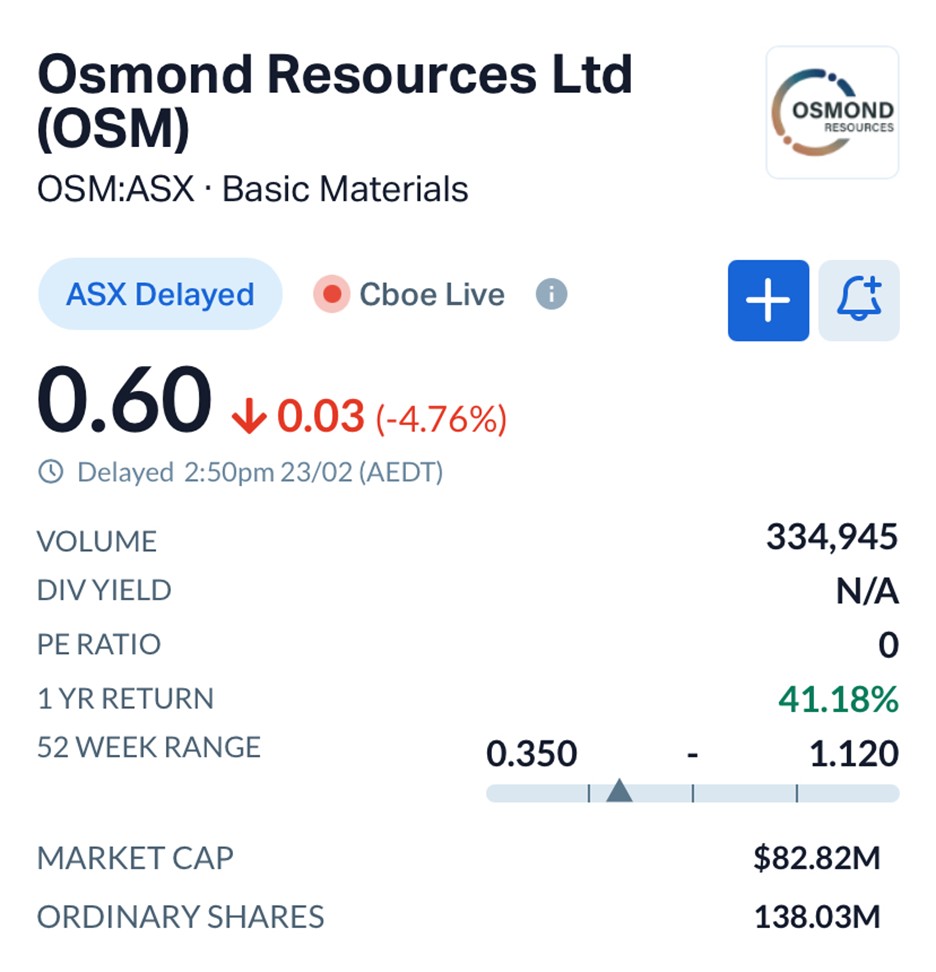
Source: MarketIndex
The Bigger Picture
Rare earths are often described as the vitamins of modern technology. They are used in small quantities but are essential to performance. Without them, electric motors, wind turbines and many defence applications simply do not function.
By aligning with a €4.4 billion engineering group and positioning within the European Commission’s magnet initiative, Osmond is attempting to move from exploration story to supply chain participant.
Whether this David can genuinely dent a Goliath remains to be seen. But in a world increasingly defined by critical mineral security, Osmond’s move places it squarely inside one of the most important industrial shifts of the decade.
What is your take on this story?
This is user sentiment & not financial advice.
Disclaimer - Skrill Network is designed solely for educational and informational use. The content on this website should not be considered as investment advice or a directive. Before making any investment choices, it is crucial to carry out your own research, taking into account your individual investment objectives and personal situation. If you're considering investment decisions influenced by the information on this website, you should either seek independent financial counsel from a qualified expert or independently verify and research the information.