

Red Mountain Mining (ASX: RMX) flags “spectacular” antimony hits at Oaky Creek

Team Skrill Network
Team Skrill Network comprises seasoned professionals from diverse fields including Finance, Mining, Technology, Investing, and Digital Strategy. They bring a deep knowledge and understanding of financial markets and behavioural patterns to every story, ensuring credibility and precision in every piece. Whether analysing emerging market trends or spotlighting small- and mid-cap growth companies across ASX, TSX, or NASDAQ, the team’s editorial approach blends data-driven insights with compelling storytelling. Their expertise enables them to process complex developments into content that resonates with both institutional investors and retail audiences. Backed by experience in content curation, SEO strategy, and investor-focused messaging, the team of writers at Skrill Network are committed to delivering stories that matter—authentic, relevant, and strategically aligned with the evolving landscape of global investing.
Read more
Key highlights
- RMX shares jumped 15.39% to $0.03 in afternoon trade on Thursday, with heavy turnover of 18.45 million shares.
- Rock-chip assays up to 34.3% antimony (Sb) were reported from the Oaky Creek prospect in northern NSW.
- RMX says 11 of 13 samples from the Oaky Creek North soil anomaly returned more than 1.9% Sb, pointing to a potentially extensive mineralised system.
- Next steps include auger results expected this month, completion of the auger program by Q1 2026, and drill target definition for H1 2026.
- The company also pointed to Australian Government policy support for antimony, citing inclusion in a A$1.2 billion Critical Minerals Strategic Reserve and Strategy.
A day the market noticed
Red Mountain Mining’s latest antimony update landed with enough force to move the tape. The stock was quoted at $0.03, up 15.39%, at 2:20pm AEDT, with volume at 18,448,364 shares. The company’s one-year return sits at 233.33%, underscoring how quickly “critical minerals” narratives can re-rate small explorers when results cooperate.
What RMX actually found at Oaky Creek
The announcement centres on new rock-chip geochemistry from Oaky Creek, part of RMX’s 100%-owned Armidale antimony-gold project in the Southern New England Orogen of northeast New South Wales.
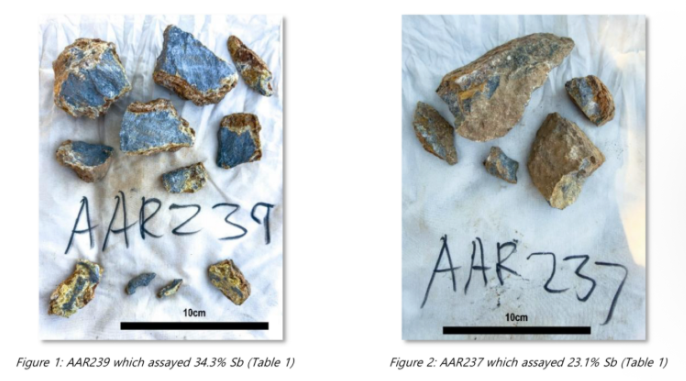
The standout numbers came from grab samples taken across the southern half of a 1.2km-long soil anomaly at Oaky Creek North:
Market Snapshot
- 34.3% Sb (sample AAR239)
- 23.1% Sb (sample AAR237)
- 19.1% Sb (sample AAR240)
RMX adds an important contextual datapoint: 11 of 13 samples collected from the Oaky Creek North soil anomaly returned above 1.9% Sb. For early-stage exploration, that kind of hit-rate is typically read as “not a one-off rock,” but a sign the system may be repeatable along trend, at least at surface.
The company also noted a pathfinder association: many samples carried anomalous arsenic and detectable gold, including two samples above 0.1 g/t Au (100 ppb). RMX argues this Sb-As-Au association is consistent with its target model: an orogenic vein-style antimony-gold system.
Source: RMX ASX Announcement
The “so what”: why these grades matter
High-percentage antimony results from rock chips are not the same thing as a resource. They are selective samples, often chosen because they look mineralised. RMX is explicit that rock-chip sampling is exploration in nature and not for resource determination.
But rock chips can still be very useful for one reason: they help confirm the system is real and guide where to spend the next exploration dollar.
In RMX’s case, the company is using these results to support two bigger claims:
- Continuity at surface
RMX says strongly mineralised rock chips now highlight a 1.6km strike extent at Oaky Creek North, and earlier programs plus soil work suggest a broader 3km long system across Oaky Creek North and South.
- Scale potential and drill targeting
The company’s working interpretation is a large-scale orogenic antimony-gold vein system, and it is now tightening sampling spacing (hand auger) to define drill-ready targets.
In plain English: RMX is trying to move from “this looks exciting on surface” to “here are the specific targets we can test with a drill rig.”
The exploration model RMX is pointing to
RMX repeatedly references Larvotto Resources’ Hillgrove project as an analogue, describing Hillgrove as Australia’s largest antimony deposit, located east of the Armidale project. RMX also notes Hillgrove as the 8th largest antimony deposit globally.
The key idea behind the analogue is straightforward: if the geological setting and mineralisation style line up, it can strengthen the case that the right “ingredients” exist. But it is still an analogue, not proof.
What RMX is concretely doing is targeting:
- Quartz-carbonate-stibnite veins and breccias
- Hosted in folded and faulted Carboniferous metasediments
- In a region RMX describes as Australia’s premier antimony province (Southern New England Orogen)
The stibnite focus matters because stibnite is the primary ore mineral for antimony. RMX even includes imagery in the release showing oxidised massive stibnite float for the top sample.
What’s next: the near-term catalysts RMX outlined
The company’s forward plan is unusually specific for an early-stage sampling update:
Auger assays are pending
RMX says assay results for the December 2025 auger program at Oaky Creek North and South are expected this month (January 2026), with additional field work planned to complete the auger program.
Stay ahead of the market
The most important stories, delivered to your inbox. No noise, just what matters.
By subscribing, you agree to our Privacy Policy.
Tightened sampling grid to sharpen drill targets
The December rock chips were collected during the first phase of a 50m x 20m spaced hand auger soil program designed to tighten the previous grid and “better constrain” targets.
Drill testing targeted in the first half of 2026
RMX anticipates the auger program (including results) will be completed before the end of Q1 2026, and that it will define multiple targets for drill testing during H1 2026.
A high-resolution airborne survey
RMX plans a high-resolution airborne magnetic-radiometric survey this quarter to improve structural mapping and define additional antimony and gold targets across the wider tenement.
The broader “why now”: antimony, supply chains, and policy pull
One reason antimony has been moving up the priority list globally is that it is used in flame retardants, alloys, and certain defence and industrial applications, and supply chains can be concentrated. RMX leans into that thematic tailwind by pointing to government policy: it says the Australian Government has prioritised antimony in its A$1.2 billion Critical Minerals Strategic Reserve and Strategy, framing it as “policy validation” for RMX’s antimony projects.
For readers new to the space, the practical takeaway is this: policy does not create deposits, but it can influence the availability of funding, strategic interest, and downstream partnerships, especially if a project shows credible scale.
A clear-eyed read: what this update is, and what it is not
This is a strong surface geochemistry update, and the market reaction suggests it was taken seriously. Still, the key uncertainties remain the usual ones for explorers:
- Continuity at depth (surface rock chips do not guarantee drill intersections)
- True widths and geometry (no drilling reported in this announcement)
- Metallurgy and recoveries (not addressed here, and typically comes later)
- Permitting and access (RMX notes EL9732 is granted and covers freehold land with access agreements)
RMX’s stated path is sensible: tighten the geochemical picture, overlay better geophysics, and then drill the highest-confidence targets.
What is your take on this story?
This is user sentiment & not financial advice.
Disclaimer - Skrill Network is designed solely for educational and informational use. The content on this website should not be considered as investment advice or a directive. Before making any investment choices, it is crucial to carry out your own research, taking into account your individual investment objectives and personal situation. If you're considering investment decisions influenced by the information on this website, you should either seek independent financial counsel from a qualified expert or independently verify and research the information.