
🇺🇸 USA







• Elsight secures a US$2 million follow-on order from a U.S. public safety customer
• New order is more than four times larger than the initial US$460,000 purchase made in January 2026
• Halo connectivity platform continues gaining traction across public safety and autonomous drone networks
• Regulatory momentum toward nationwide BVLOS drone operations in the U.S. remains a major industry catalyst
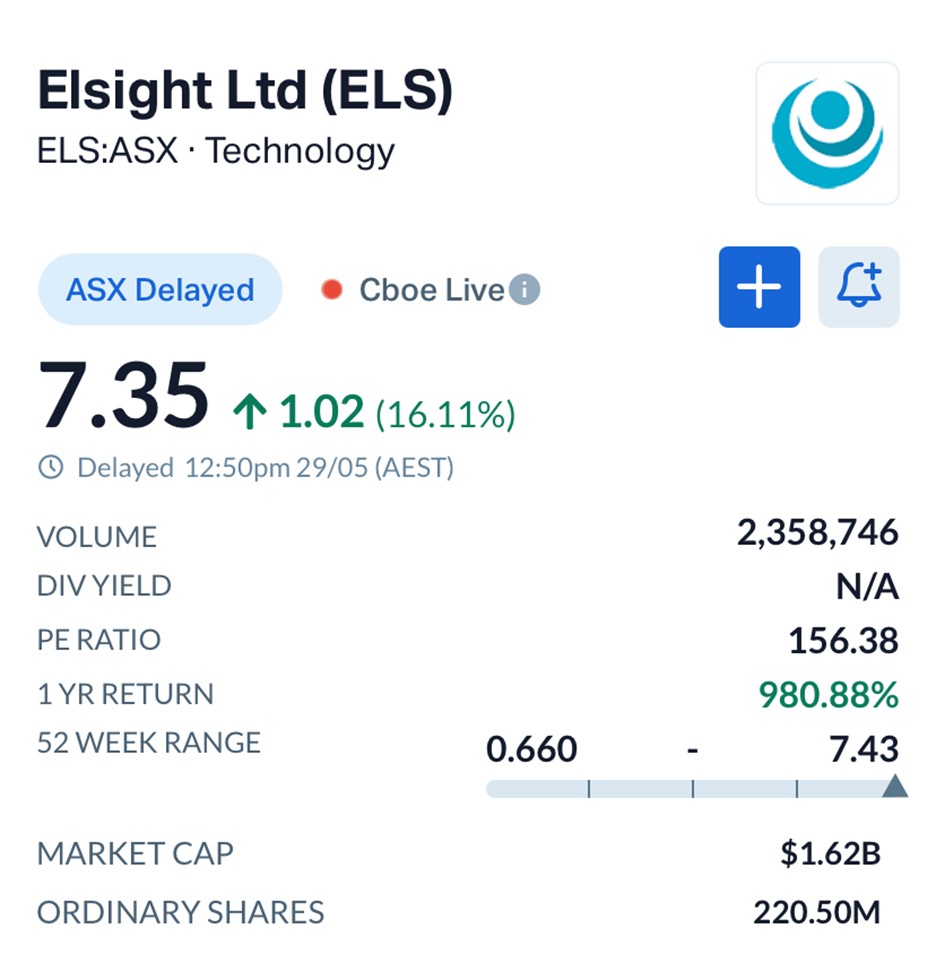
• Elsight shares climbed 16.11% to $7.35, extending a remarkable 980.88% gain over the past year
A follow-on order often tells a bigger story than the first sale.
For drone connectivity specialist Elsight (ASX: ELS), a new US$2 million purchase order from an existing U.S. public safety customer suggests the company’s technology has moved beyond trial programs and into larger-scale deployment.
The order, announced on Friday, expands a relationship that began with a US$460,000 procurement in January 2026. Within five months, the customer has increased its commitment more than fourfold, providing another sign that demand for reliable drone communications is accelerating as autonomous flight operations become more common.
Shares in Elsight rose 16.11% to $7.35 by late morning trade on 29 May, lifting the company’s market capitalisation to approximately $1.56 billion.
At the centre of the deal is Elsight’s Halo platform, a compact connectivity system designed to keep drones and other autonomous vehicles connected even when individual communication networks fail.
Rather than relying on a single carrier, Halo combines multiple cellular networks with satellite and radio frequency links, creating a redundant communications pathway that is particularly valuable for Beyond Visual Line of Sight, or BVLOS, operations.
BVLOS flights allow drones to travel beyond the direct sight of an operator, opening the door to applications ranging from emergency response and infrastructure inspection to logistics and security monitoring.
Those missions depend heavily on uninterrupted connectivity.
“A U.S. Public safety customer increasing their order within months signals strong conviction, highlighting the Company’s operational validation and commercial traction,” Elsight chief executive Yoav Amitai said.
“Public safety agencies are preparing for scaled BVLOS operations and selecting technology partners that meet the highest standards of reliability and compliance.”
The latest order arrives as regulatory changes continue reshaping the global drone industry.
For years, commercial drone operators seeking BVLOS approvals in the United States have faced lengthy case-by-case waiver processes through the Federal Aviation Administration (FAA).
That framework is gradually changing.
A White House directive issued in June 2025 instructed regulators to accelerate the development of nationwide BVLOS rules. Draft proposals were released in August 2025, public consultation concluded in October, and the industry is now awaiting the final Part 108 framework expected during 2026.
The proposed changes are widely viewed as one of the most important developments in the drone sector since commercial UAV regulations were first introduced.
Public safety agencies have emerged among the earliest adopters.
Drone as a First Responder programs are increasingly being deployed across U.S. municipalities, allowing emergency services to launch drones ahead of ground crews to provide real-time situational awareness during incidents.
The requirement is simple: communications cannot fail.
That backdrop helps explain why connectivity providers are becoming strategically important pieces of the drone ecosystem.
Elsight has also strengthened its credentials on the defence side of the market.
In April, Halo was added to the U.S. Defense Contract Management Agency’s Blue UAS Cleared List, a designation that streamlines procurement for Department of Defense agencies while confirming compliance with strict National Defense Authorization Act requirements.
Although the certification is defence-focused, it also carries weight among commercial and public-sector buyers handling sensitive infrastructure and operational data.
The progression has been notable.
January brought the first public safety order.
April delivered defence validation.
May produced a significantly larger follow-on purchase.
For technology companies operating in emerging industries, repeat orders often carry greater significance than initial contracts because they demonstrate real-world adoption after field testing and operational evaluation.
The broader challenge now becomes execution.
Drone adoption continues to accelerate globally, but procurement cycles can remain uneven. Purchase orders provide visibility, although they do not necessarily translate into recurring software-style revenue streams.
Investors will also be watching closely for the FAA’s final BVLOS framework, which remains a major catalyst for wider commercial deployment across the United States.
For now, Elsight finds itself positioned at the intersection of two powerful trends: growing demand for autonomous operations and increasing regulatory support for drones flying beyond traditional limitations.
The latest order suggests that customers are beginning to prepare for that future today.
Elsight ASX Announcement, May 2026; U.S. FAA BVLOS regulatory framework timeline; U.S. Department of Defense Blue UAS Program.
Disclaimer - Skrill Network is designed solely for educational and informational use. The content on this website should not be considered as investment advice or a directive. Before making any investment choices, it is crucial to carry out your own research, taking into account your individual investment objectives and personal situation. If you're considering investment decisions influenced by the information on this website, you should either seek independent financial counsel from a qualified expert or independently verify and research the information.
Tags:
RECENT POSTS
TAGS
Subscribe to the Skrill Network Newsletter today and stay informed
Recommended Articles
