

Silver’s Breakout Moment: Why Silver Is Surging
Key Highlights
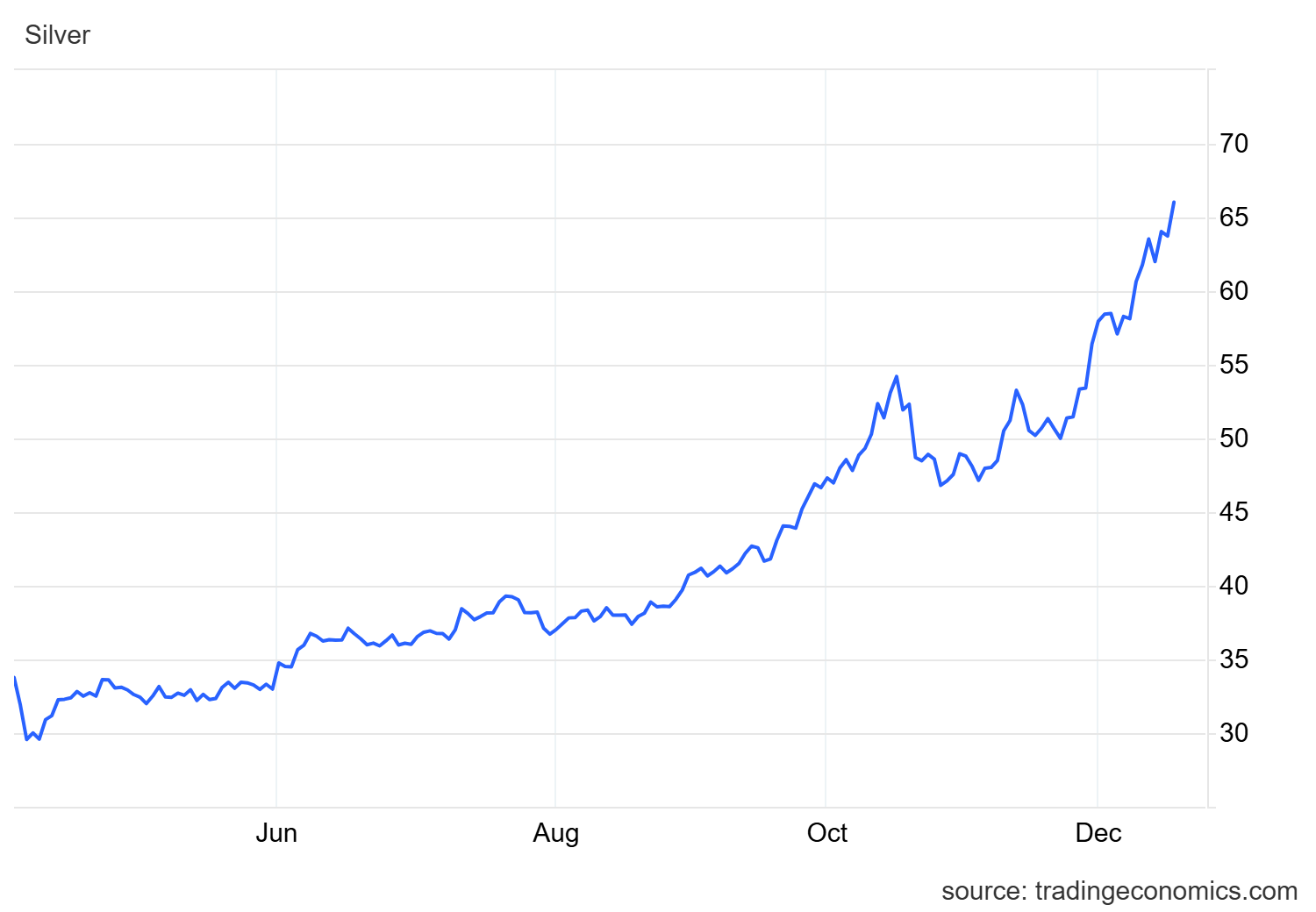
- COMEX silver futures hit a new all-time high of 66.00 dollars per ounce on December 17, 2025, with prices hovering around 65.89 dollars during the session.
- More than 20,021 tonnes (644 million ounces) withdrawn from SGE vaults in 2025, pushing inventories to a ten-year low.
- Industrial demand in China, driven by solar panels, electric vehicles and data centres, reaches record levels according to the Silver Institute.
- Safe-haven appetite rises amid global inflation, geopolitical flashpoints and weaker US economic signals.
- Analysts warn that if silver approaches 100 dollars, the market could see an institutional shock due to tight physical supply and leveraged futures exposure.
Silver is the story of the moment, and all eyes are on China
If investors were looking for the metal that best captures the mood of global markets right now, silver has stepped confidently into the spotlight. On December 17, COMEX silver futures reached a new peak of 66.00 dollars per ounce, reflecting a powerful mix of industrial strength and safe-haven interest, pushing the metal to new highs and widening the premium over global benchmarks.
Source: TradingEconomics
Market Snapshot
What makes this rally even more interesting is the growing role of Asia, particularly China. While the exact daily SGE benchmark price for December 17 is not publicly confirmed, industry trackers consistently show that Chinese domestic silver prices have been trending firmer than COMEX futures. This behaviour often reflects strong physical demand inside China, where the metal plays a vital role in high-tech manufacturing and green-energy expansion.
This puts Chinese spot prices (68USD/Ounce) more than two dollars above COMEX futures, signalling something unusual in the silver market. Prices tend to converge internationally, but when China trades consistently higher, it usually reflects one thing: very strong physical buying.
And this year, China has been buying silver at a scale rarely seen before.
China’s appetite for silver has been one of the most closely watched trends in the metals market this year, and for good reason. The country has been buying large volumes of silver, though the data shows a more nuanced story than a simple straight-line surge.
In the first quarter of 2025, China’s silver concentrate imports rose 10.18 percent year-on-year, reaching roughly 462,000 metric tons. That is a strong signal of real physical demand coming from industries like solar manufacturing, electronics and electric vehicles. But when you zoom into the monthly numbers, the picture becomes a little more mixed. March 2025 imports, for example, were lower than February’s, and the overall growth rate is not as explosive as some earlier years.
Even with these month-to-month shifts, the broader trend is hard to ignore. China is on track to become the world’s largest silver importer and exporter by 2026, with annual imports projected to exceed 413 million dollars. Industrial demand is the biggest driver, but investment interest has been rising as well, making silver a strategic metal in both manufacturing and financial markets.
So while it is true that China is buying silver on a scale that feels unusually large, it is also true that not every month shows the same strength. The real story lies in the cumulative momentum. Industrial needs continue to grow, investors remain active and China’s influence over global silver flows is becoming more obvious each year.
According to SGE data and market trackers, more than 20,021 tonnes of silver have been withdrawn from Shanghai vaults in 2025. That equals roughly 644 million ounces of metal pulled out for industrial manufacturers, investors and refiners. Several research groups report that SGE inventories are now hovering near a ten-year low.
For a market that truly hinges on physical supply, this is a major development. Prices are not rising because of speculation alone. They are rising because metal is genuinely leaving the shelves.
China’s industrial demand is rewriting the silver story
Part of silver’s appeal has always been its versatility. It is both an industrial workhorse and a monetary hedge. But right now, China’s industrial sector is the louder engine.
Silver is woven deeply into the world’s transition to cleaner technologies. China, being the largest hub for these industries, is consuming more of the metal than ever before.
Here is where silver is essential:
- Solar photovoltaic cells
- Electric vehicle components
- Charging infrastructure
- Data centres and advanced semiconductors
- High-performance electronics
The Silver Institute notes that global silver demand is expected to hit record highs in 2025, with industrial consumption projected to exceed 700 million ounces. Solar manufacturing continues to dominate, and China leads global production by a wide margin.
Even though solar companies are reducing the amount of silver per panel, total demand still rises because installations are growing rapidly. EV manufacturing and data centres add further strain to supply.
In short, China’s factories are absorbing vast quantities of silver, tightening availability and lifting prices in the physical market.
Safe-haven buying returns as global uncertainty widens
Industrial demand is only half the story. The other half is unfolding in global markets.
Investors worldwide are turning back to precious metals as a hedge against instability. Silver benefits from this not just as a safe-haven asset, but as an undervalued alternative to gold with more price torque.
Here is what the macro backdrop looks like:
- US unemployment has risen to 4.6 percent, the highest since 2021.
- Growth indicators are slowing.
- The market sees a 75 percent probability that the Federal Reserve holds rates in January.
- Inflation remains sticky.
Investors are cautious ahead of US CPI, retail sales and manufacturing data.
Jeffrey Christian of CPM Group commented that silver’s average price through November was 38.26 dollars, making today’s near-record values even more striking. He added that a structural rise in investment demand has continued for more than a decade due to long-running political and economic uncertainty.
This evolving trend has caught the attention of industry experts. Jeffrey Christian of CPM Group noted in his December market commentary that silver demand is being shaped by forces that are both cyclical and long-term. As he explained, “We have seen an upward shift in investment demand for silver driven by persistent economic and political pressures. These conditions continue to support strong buying interest, especially in markets where industrial use is expanding.”
When investors combine softening macro indicators with tight physical supply, silver becomes an attractive dual-purpose asset. It offers safety during volatile markets and exposure to booming industrial sectors.
Sources: CPM Group commentary, TradingEconomics
Are we witnessing a physical squeeze? The data suggests so
The scale of physical withdrawals from SGE vaults raises an important question:
Is the silver market quietly entering a supply squeeze?
Consider the below data:
644 million ounces withdrawn from SGE in 2025.
Inventories have slipped toward a ten-year low.
The premium for immediate physical delivery has widened sharply.
Shanghai consistently trades above COMEX, which indicates real scarcity.
Meanwhile, real-time data from COMEX shows normal turnover in registered inventories, suggesting that the strain is not fully visible in Western markets yet. But China’s physical demand is no longer something global traders can ignore.
Because the SGE is a physically settled exchange, its behaviour reflects actual supply and demand, not leveraged futures exposure. When Shanghai tightens, the global market usually follows.
Stay ahead of the market
The most important stories, delivered to your inbox. No noise, just what matters.
By subscribing, you agree to our Privacy Policy.
Geopolitics is adding fuel to the fire
Silver’s rally is also being shaped by a rapidly changing geopolitical landscape.
Several global flashpoints are influencing the market:
US sanctions on Venezuela and Russia have increased geopolitical uncertainty.
Tensions in Eastern Europe and South America are pushing investors toward safe assets.
Concerns about energy markets are creating spillover effects across commodities.
Growing talk of de-dollarisation has boosted interest in physical precious metals.
Silver has historically reacted strongly to geopolitical uncertainty, but what makes this cycle different is the simultaneous surge in industrial demand. When safe-haven buyers and manufacturers both enter the market aggressively, prices can rise sharply.
Could silver break 100 dollars?
The question of whether silver could push toward 100 dollars per ounce is becoming part of market discussions. While the move is far from guaranteed, several factors support the speculation:
Industrial demand shows no signs of slowing
The Silver Institute expects another significant global deficit in 2025
Safe-haven flows remain robust
China’s influence in the physical market is growing
Investor participation is widening across ETFs and physical holdings
Historically, silver tends to move sharply when momentum builds. With the current mix of supply constraints, geopolitical pressure and industrial expansion, analysts expect elevated volatility through 2026.
What is your take on this story?
This is user sentiment & not financial advice.
Disclaimer - Skrill Network is designed solely for educational and informational use. The content on this website should not be considered as investment advice or a directive. Before making any investment choices, it is crucial to carry out your own research, taking into account your individual investment objectives and personal situation. If you're considering investment decisions influenced by the information on this website, you should either seek independent financial counsel from a qualified expert or independently verify and research the information.