

Supply Chain Shockwaves: Why Orora Axed Its Middle East Operations Amid Global Disruption

Team Skrill Network
Team Skrill Network comprises seasoned professionals from diverse fields including Finance, Mining, Technology, Investing, and Digital Strategy. They bring a deep knowledge and understanding of financial markets and behavioural patterns to every story, ensuring credibility and precision in every piece. Whether analysing emerging market trends or spotlighting small- and mid-cap growth companies across ASX, TSX, or NASDAQ, the team’s editorial approach blends data-driven insights with compelling storytelling. Their expertise enables them to process complex developments into content that resonates with both institutional investors and retail audiences. Backed by experience in content curation, SEO strategy, and investor-focused messaging, the team of writers at Skrill Network are committed to delivering stories that matter—authentic, relevant, and strategically aligned with the evolving landscape of global investing.
Read more
Key Highlights:
- Orora Limited shares plunge nearly 17% after Middle East shutdown
- UAE facility shifted to “hot idle” mode as shipping routes collapse
- FY26 EBIT guidance slashed, with €20m–€27m conflict impact
- Production redirected to Mexico in strategic supply chain shift
- Premium spirits demand weakens as global uncertainty hits consumers
The Australian share market is feeling the real-world impact of geopolitical tensions, with Orora Limited emerging as one of the first major corporate casualties.
Shares in the packaging giant dropped 18.23% to $1.615 by late morning, after the company confirmed it would halt production at its Middle East facility due to ongoing supply chain disruptions.
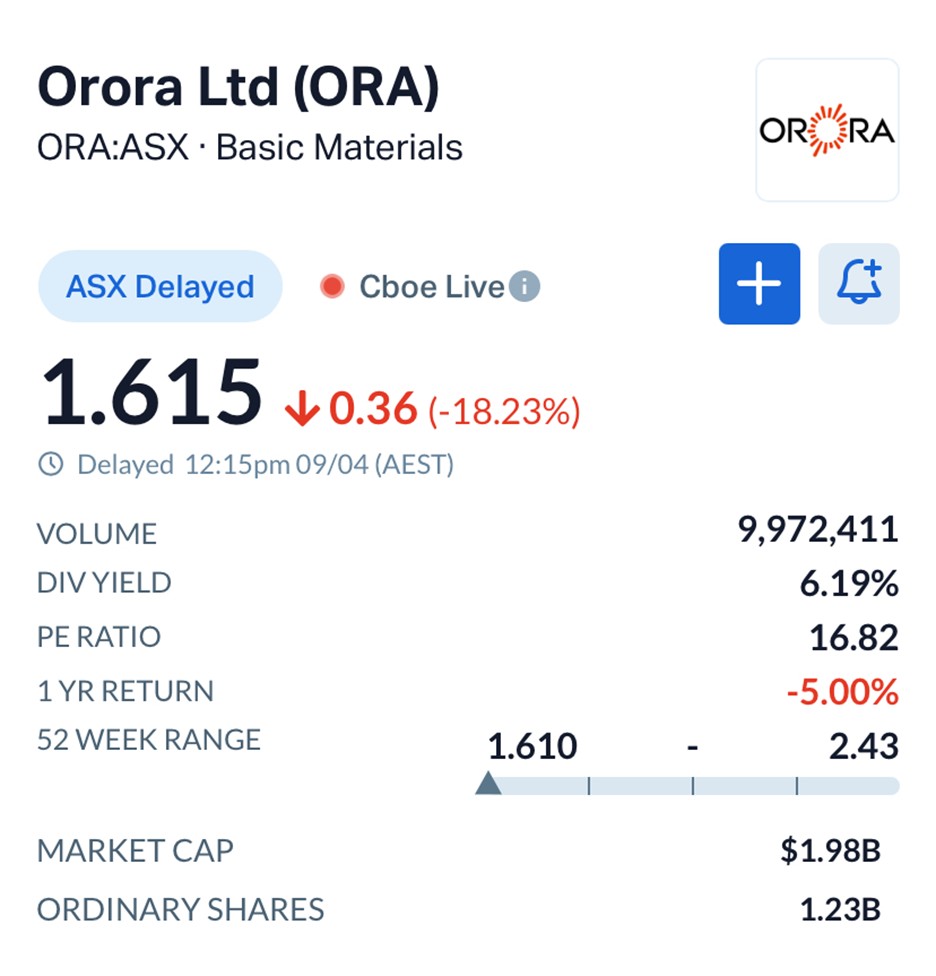
Market Snapshot
This is not a story about rising oil prices or investor sentiment. It is about the physical breakdown of global trade routes.
When Supply Chains Stop, So Does Production
Orora’s Ras al Khaimah facility in the United Arab Emirates has effectively gone offline.
The company has shifted the plant into what it calls a “closed loop hot operation.” In simple terms, the furnace remains running, but no bottles are being produced.
The reason is straightforward.
Shipping routes are closed, and overland transport is no longer viable. Without a way to move goods, production becomes pointless.
The facility accounts for roughly 15% of Orora’s Saverglass division capacity, primarily producing high-end bottles for North American markets.
The Financial Fallout
The shutdown has forced Orora to sharply revise its earnings outlook.
Saverglass FY26 underlying EBIT is now expected to come in between €63 million and €68 million, down from earlier expectations of around €79.2 million.
The total impact from the Middle East conflict is estimated at €20 million to €27 million in the second half of FY26 alone.
Breaking that down:
- Direct losses of €9 million to €11 million stem from keeping the UAE facility running without production and managing staff costs
- Indirect losses of €11 million to €16 million are tied to weaker demand and shifting consumer behavior
This dual hit highlights how geopolitical shocks ripple through both operations and end markets.
A Subtle but Important Consumer Shift
One of the more revealing aspects of Orora’s update is not operational, but behavioural.
The company noted a clear shift away from premium spirits toward lower-priced alternatives and wine.
This “negative mix shift” is already impacting margins, as premium spirits typically command higher profits.
In effect, the conflict is not just disrupting supply chains. It is also reshaping consumer spending patterns.
This aligns with broader global trends seen during periods of economic uncertainty, where discretionary and premium purchases tend to decline.
From UAE to Mexico: A Strategic Pivot
In response, Orora is moving quickly to reconfigure its supply chain.
Production is being shifted to its Acatlán facility in Mexico, with moulds already being transported to restart output for North American customers by late FY26.
This move reflects a broader industry trend often referred to as “friend-shoring,” where companies relocate production to more stable and accessible regions.
It is a practical solution, but not without cost.
Relocating production takes time, capital, and operational adjustments, all of which weigh on short-term profitability.
The Silver Lining
Despite the disruption, there are some stabilising factors.
Orora confirmed that all staff in the region are safe and the facility itself remains undamaged.
The company has also hedged its energy costs for the next 12 to 18 months, insulating it from immediate spikes in fuel prices.
Additionally, its balance sheet remains relatively strong, with leverage expected to stay below 1.5 times by mid-2026.
However, in a clear signal of caution, Orora has paused its on-market share buyback program while it assesses the evolving situation.
A Broader Warning for Globalisation
Orora’s situation offers a rare, tangible example of how geopolitical tensions can disrupt even well-established global businesses.
Stay ahead of the market
The most important stories, delivered to your inbox. No noise, just what matters.
By subscribing, you agree to our Privacy Policy.
For years, companies have optimised supply chains for efficiency, often stretching them across continents.
But when critical routes close, that efficiency can quickly turn into vulnerability.
The Strait of Hormuz disruption is not just a headline. It is now showing up in earnings reports, production decisions, and investor portfolios.
Market Reaction and What Comes Next
The sharp sell-off in Orora’s shares reflects more than just a downgrade in earnings.
It signals investor concern about how long these disruptions may last and whether similar impacts could spread to other sectors.
If supply chain disruptions persist, more companies with international exposure could face similar challenges.
For now, Orora is adapting. But the bigger question remains.
How resilient are global supply chains in a world where geopolitical risks are no longer theoretical?
The Verdict
Orora’s Middle East shutdown is a turning point.
It shifts the conversation from abstract risks to real consequences.
This is no longer just about oil prices or market sentiment. It is about the mechanics of global trade breaking down in real time.
And for the ASX, it may be the first of many such stories.
What is your take on this story?
This is user sentiment & not financial advice.
Disclaimer - Skrill Network is designed solely for educational and informational use. The content on this website should not be considered as investment advice or a directive. Before making any investment choices, it is crucial to carry out your own research, taking into account your individual investment objectives and personal situation. If you're considering investment decisions influenced by the information on this website, you should either seek independent financial counsel from a qualified expert or independently verify and research the information.